UPSC Current Affairs
Planer Parade
PLANET PARADE What is a ‘Planet Parade’? A ‘planet parade’ occurs when several planets in our solar system are visible in the night sky at the same time. It is not an official term in astronomy, but it refers to a rare event when multiple planets can be seen aligning or forming an arc across the sky.
VRAuthor Desk
3 min read
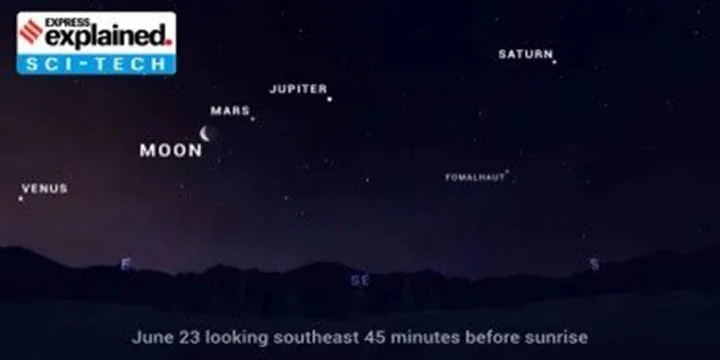
PLANET PARADE What is a ‘Planet Parade’? A ‘planet parade’ occurs when several planets in our solar system are visible in the night sky at the same time. It is not an official term in astronomy, but it refers to a rare event when multiple planets can be seen aligning or forming an arc across the sky.
PLANET PARADE
What is a ‘Planet Parade’?
- A ‘planet parade’ occurs when several planets in our solar system are visible in the night sky at the same time.
- It is not an official term in astronomy, but it refers to a rare event when multiple planets can be seen aligning or forming an arc across the sky.
- A radio astronomer and in-charge of the SciPOP outreach program at the Inter-University Centre for Astronomy & Astrophysics (IUCAA), explains that planets move at different speeds across the sky, and sometimes they align, allowing us to see many of them at once.
- This can occur either in the morning sky or the evening sky.
CURRENT PLANET PARADE
- For the past few days, four planets — Venus, Saturn, Jupiter, and Mars — have been visible to the naked eye.
- Uranus and Neptune are also visible, but require a telescope or even a pair of binoculars to be seen.
- These 6 planets are forming a breathtaking arc across the night sky, providing a spectacular viewing experience for skywatchers.
ARE PLANET PARADES RARE?
- Planet parades are not extremely rare. According to NASA, these multi-planet viewing opportunities don’t happen every year, but they are not a once-in-a-lifetime event either.
- The last such planet parade occurred in May-June 2024, when all the planets of the solar system were visible in the morning sky.
- This current event has been ongoing since December, and it's not a one-day phenomenon.
- In fact, Mercury, the fifth planet visible to the naked eye, will appear in the evening sky after February 20.
- Alignment of planets is often talked about, but according to NASA, there is nothing special about the way planets appear to align.
- The alignment is simply due to the plane of the solar system, causing planets to always appear in a sort of line.
HOW TO VIEW THE PLANETS?
- There are eight planets in the solar system: Mercury, Venus, Earth, Mars, Jupiter, Saturn, Neptune, and Uranus.
- Of these, five planets can be seen with the naked eye — Venus, Mars, Jupiter, Saturn, and Mercury (which will be visible later). The other two, Neptune and Uranus, require a telescope or binoculars to be seen clearly.
- Planets are generally visible a few hours after sunset, when the sky is dark enough. Clear skies and the absence of light pollution are ideal for viewing.
- This is why the best places to observe the planets are areas far from cities and towns.
- To distinguish between planets and stars, look for twinkling.
- Stars twinkle, while planets shine with a constant brightness. Planets are usually also brighter than stars.
- There are now many mobile apps and websites available to help identify the exact locations of celestial bodies in the sky.
- Prelims: Key facts, institutions, locations and terminology in the article.
- Mains: Connect the topic with Polity & Governance.
- Revision: Use the article headings to prepare concise notes and answer-writing points.
Test your understanding
Questions from this article
Prelims practiceWith reference to Planer Parade, consider the following statements:
- A ‘planet parade’ occurs when several planets in our solar system are visible in the night sky at the same time.
- It is not an official term in astronomy, but it refers to a rare event when multiple planets can be seen aligning or forming an arc across the sky.
- A radio astronomer and in-charge of the SciPOP outreach program at the Inter-University Centre for Astronomy & Astrophysics (IUCAA), explains that planets move at different speeds across the sky, and sometimes they…
Which of the statements given above are correct?
- 1 and 2 only
- 2 and 3 only
- 1 and 3 only
- 1, 2 and 3
View answer
Answer: (d) 1, 2 and 3. All three statements are drawn from the article.
Mains practiceDiscuss the background, key issues and significance of Planer Parade for India.
Answer in 250 words.
View answer approach
- PLANET PARADE
- What is a ‘Planet Parade’?
- CURRENT PLANET PARADE
- ARE PLANET PARADES RARE?
- HOW TO VIEW THE PLANETS?
Frequently asked questionsFrequently asked questions
Why is Planer Parade in the news?
PLANET PARADE What is a ‘Planet Parade’? A ‘planet parade’ occurs when several planets in our solar system are visible in the night sky at the same time.
What are the key facts about Planer Parade?
It is not an official term in astronomy, but it refers to a rare event when multiple planets can be seen aligning or forming an arc across the sky. A radio astronomer and in-charge of the SciPOP outreach program at the Inter-University Centre for Astronomy & Astrophysics (IUCAA), explains that planets move at different speeds across the sky, and sometimes they align, allowing us to see many of them at… This can occur either in the morning sky or the evening sky.
Why is Planer Parade important for UPSC preparation?
The topic connects current developments with Polity & Governance and is relevant for both objective revision and analytical answer writing.