UPSC Current Affairs
Overseas Citizen Of India
Recently, the Indian Ministry of External Affairs addressed concerns raised by Overseas Citizens of India (OCI) regarding their classification as “foreigners.” It clarified that there have been no recent changes to OCI rules, and the existing regulations from… ABOUT OCI An Overseas Citizen of India (OCI) is a person of Indian origin who has been granted an OCI card, allowing them certain rights and privileges in India. This status was created to facilitate a connection between India and its diaspora living abroad.
VRAuthor Desk
3 min read
Recently, the Indian Ministry of External Affairs addressed concerns raised by Overseas Citizens of India (OCI) regarding their classification as “foreigners.” It clarified that there have been no recent changes to OCI rules, and the existing regulations from… ABOUT OCI An Overseas Citizen of India (OCI) is a person of Indian origin who has been granted an OCI card, allowing them certain rights and privileges in India. This status was created to facilitate a connection between India and its diaspora living abroad.
Recently, the Indian Ministry of External Affairs addressed concerns raised by Overseas Citizens of India (OCI) regarding their classification as “foreigners.”
It clarified that there have been no recent changes to OCI rules, and the existing
regulations from a 2021 gazette notification remain in effect.
ABOUT OCI
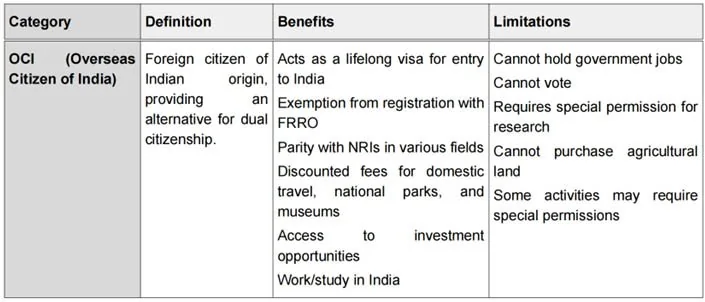
- An Overseas Citizen of India (OCI) is a person of Indian origin who has been granted an OCI card, allowing them certain rights and privileges in India.
- This status was created to facilitate a connection between India and its diaspora living abroad.
Background of the OCI Scheme
- The OCI scheme was introduced in August 2005.
- It provides registration for all Persons of Indian Origin (PIOs) who were citizens of India on January 26, 1950, or afterward, or those who were eligible for Indian citizenship on that date.
- The initiative aimed to offer ‘dual citizenship’ to Indians living overseas, as noted by former Home Minister LK Advani when presenting the legislation.
RIGHTS & PRIVILEGES OF OCI CARD HOLDERS
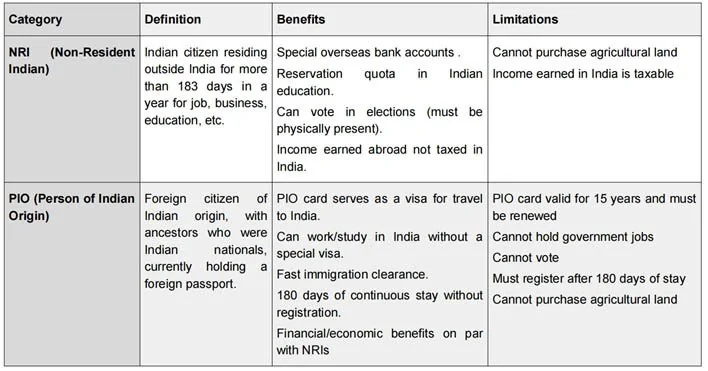
- Visa Benefits: OCI card holders receive a multiple-entry, life-long visa for visiting India. They are not required to register with local police authorities for any length of stay.
- Large Community: As of 2023, there are over 4.5 million OCI card holders across 129 countries. The United States has the largest number, with about 1.68 million OCI card holders.
- Equal Status with NRIs: Initially, OCI holders had similar rights to Non-Resident Indians (NRIs) in economic, financial, and educational matters, except for buying agricultural land.
RECENT CHANGES
On
March 4, 2021, the
Ministry of Home Affairs issued a notification that updated rules
for OCI card holders:
- Permission Required: OCI card holders must seek permission to visit protected areas in India, similar to foreign nationals.
- Research and Activities: New restrictions require OCI holders to obtain special permits for conducting research or undertaking missionary, journalistic, or other specified activities in protected areas.
- Financial Regulations: The new rules treat OCI holders as “foreign nationals” for certain economic and educational purposes, reversing their previous equal status with NRIs under the Foreign Exchange Management Act (FEMA).
HISTORICAL CHANGES
The 2021 notification replaced earlier notifications from
2005,
2007, and
2009, which defined OCI rights:
- 2005 Notification: Allowed lifelong multiple-entry visas and exemptions from registration for any length of stay, along with parity with NRIs in most fields.
- 2007 Updates: Expanded rights to include equal treatment with NRIs for inter-country adoptions, domestic airfare, and entry fees at wildlife parks.
- 2009 Amendments: Further enhanced rights, aligning OCI holders with NRIs in terms of entry fees at monuments and eligibility for professional exams.
RESTRICTIONS FOR OCI APPLICANTS
- Ineligibility: Individuals are not eligible for OCI status if their parents or grandparents were ever citizens of Pakistan or Bangladesh.
- However, spouses of Indian citizens or OCI holders (married for at least two years) can apply.
- Voting and Employment Limitations: OCI card holders cannot:
- Vote in elections.
- Hold positions in the Legislative Assembly, Parliament, or other constitutional offices (like President or Judge).
- Generally hold government jobs in India.
- Prelims: Key facts, institutions, locations and terminology in the article.
- Mains: Connect the topic with Economy, International Relations, Polity & Governance.
- Revision: Use the article headings to prepare concise notes and answer-writing points.
Test your understanding
Questions from this article
Prelims practiceWith reference to Overseas Citizen Of India, consider the following statements:
- An Overseas Citizen of India (OCI) is a person of Indian origin who has been granted an OCI card, allowing them certain rights and privileges in India.
- This status was created to facilitate a connection between India and its diaspora living abroad.
- The OCI scheme was introduced in August 2005.
Which of the statements given above are correct?
- 1 and 2 only
- 2 and 3 only
- 1 and 3 only
- 1, 2 and 3
View answer
Answer: (d) 1, 2 and 3. All three statements are drawn from the article.
Mains practiceDiscuss the background, key issues and significance of Overseas Citizen Of India for India.
Answer in 250 words.
View answer approach
- ABOUT OCI
- RIGHTS & PRIVILEGES OF OCI CARD HOLDERS
- for OCI card holders:
- RESTRICTIONS FOR OCI APPLICANTS
Frequently asked questionsFrequently asked questions
Why is Overseas Citizen Of India in the news?
Recently, the Indian Ministry of External Affairs addressed concerns raised by Overseas Citizens of India (OCI) regarding their classification as “foreigners.” It clarified that there have been no recent changes to OCI rules, and the existing regulations from… ABOUT OCI An Overseas Citizen of India (OCI) is a person of Indian origin who has been granted an OCI card, allowing them certain rights and privileges in India.
What are the key facts about Overseas Citizen Of India?
This status was created to facilitate a connection between India and its diaspora living abroad. Background of the OCI Scheme The OCI scheme was introduced in August 2005. It provides registration for all Persons of Indian Origin (PIOs) who were citizens of India on January 26, 1950, or afterward, or those who were eligible for Indian citizenship on that date.
Why is Overseas Citizen Of India important for UPSC preparation?
The topic connects current developments with Economy, International Relations, Polity & Governance and is relevant for both objective revision and analytical answer writing.