northern lights, or
aurora borealis, at
Hanle village in Ladakh early Saturday morning. Northern lights were also witnessed in other parts of the world, including in the
United States and the United Kingdom.
Meanwhile,
southern lights, or
aurora australis, were spotted in countries such as New Zealand and Australia.
WHAT ARE AURORAS?
Auroras are
essentially natural lights that appear as
bright, swirling curtains in the
night sky and can be seen in a
range of colours, including
blue,
red, yellow, green, and
orange.
These lights
primarily appear near the poles of both the northern and southern hemispheres all year round but
sometimes they expand to lower latitudes.
As mentioned before,
in the north, the display is called
the aurora borealis; in the
south, it is known as
the aurora australis.
WHY DO AURORAS OCCUR?
It is
due to activity on the surface of the Sun.
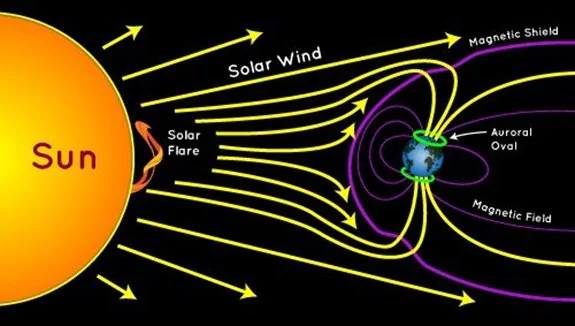
The star continuously releases a stream of charged particles, mainly
electrons and protons, and
magnetic fields called the solar wind. As the solar wind approaches the Earth, it is
deflected by the planet’s magnetic field, which acts like a protective shield.
 WHAT HAPPENS WHEN THE SOLAR WINDS APPROACH EARTH?
However,
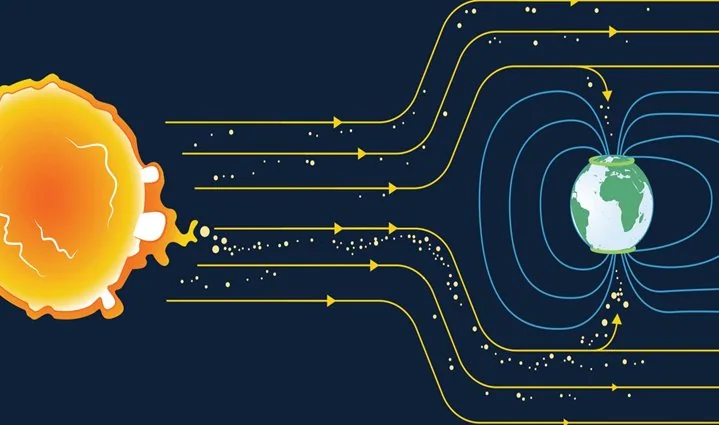
some of the charged particles are trapped in the magnetic field and they
travel down the magnetic field lines at the
north and south poles into the
upper atmosphere of the Earth. These particles
then interact with
different gases present there, resulting in tiny flashes that light up the night sky.
When solar wind particles
collide with oxygen, a green colour light is produced. Interaction with
nitrogen produces shades of blue and purple.
 HOW DO THE AURORAS EXPAND TO MID LATITUDES?
Auroras expand to midlatitudes
when the solar wind is extremely strong. This happens when the
activity on the Sun’s surface goes up, leading to solar flares and
coronal mass ejections (CMEs), which are essentially extra bursts of energy in the solar wind.
In such cases,
the solar wind is so intense that it can
result in a geomagnetic storm, also known as a
magnetic storm — a temporary disturbance of the Earth’s magnetic field.
It is during a magnetic storm that auroras can be seen in the mid-latitudes.
One such
geomagnetic storm was kicked off on Friday after a
CME hit the Earth. That’s why auroras were visible in several parts of the world.
The National Oceanic and Atmospheric Administration (NOAA) classified the storm as “extreme” and said more CME could hit the planet in the following days.
IMPACT OF GEOMAGNETIC STORMS
Geomagnetic storms can also affect space-dependent operations like:
- Global Positioning Systems (GPS).
- Radio and satellite communications.
- Flight operations.
- Power grids, and
- Space exploration programmes.
Test your understanding
Questions from this article
Prelims practiceWith reference to Northern & Southern Lights, consider the following statements:
- Global Positioning Systems (GPS).
- Radio and satellite communications.
- Space exploration programmes.
Which of the statements given above are correct?
- 1 and 2 only
- 2 and 3 only
- 1 and 3 only
- 1, 2 and 3
View answer
Answer: (d) 1, 2 and 3. All three statements are drawn from the article.
Mains practiceDiscuss the background, key issues and significance of Northern & Southern Lights for India.
Answer in 250 words.
View answer approach
- Background and context
- Key facts and institutional framework
- Significance and way forward
Frequently asked questionsFrequently asked questions
Why is Northern & Southern Lights in the news?
northern lights, or aurora borealis, at Hanle village in Ladakh early Saturday morning. Northern lights were also witnessed in other parts of the world, including in the United States and the United Kingdom.
What are the key facts about Northern & Southern Lights?
Meanwhile, southern lights, or aurora australis, were spotted in countries such as New Zealand and Australia. Auroras are essentially natural lights that appear as bright, swirling curtains in the night sky and can be seen in a range of colours, including blue, red, yellow, green, and orange. These lights primarily appear near the poles of both the northern and southern hemispheres all year round but sometimes they expand to lower latitudes.
Why is Northern & Southern Lights important for UPSC preparation?
The topic connects current developments with Polity & Governance and is relevant for both objective revision and analytical answer writing.