UPSC Current Affairs
New START Treaty: Nuclear Limits, Verification and Significance
New START is a strategic arms-control agreement between the United States and Russia that limits deployed nuclear forces and provides verification mechanisms. Its future affects strategic stability, transparency, deterrence and the wider global arms-control architecture.
VRAuthor Desk
5 min read
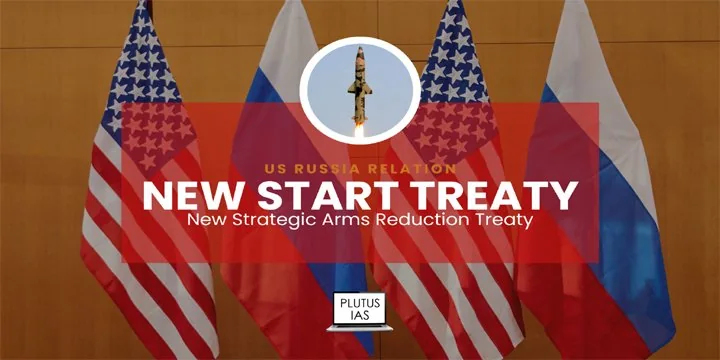
In brief: New START is a strategic arms-control agreement between the United States and Russia that limits deployed nuclear forces and provides verification mechanisms. Its future affects strategic stability, transparency, deterrence and the wider global arms-control architecture.
New START is a strategic arms-control agreement between the United States and Russia that limits deployed nuclear forces and provides verification mechanisms. Its future affects strategic stability, transparency, deterrence and the wider global arms-control architecture.
Why in News - S. President Donald Trump has responded positively to Russian President Vladimir Putin’s offer to voluntarily maintain limits on strategic nuclear weapons under the framework of the expiring New START Treaty.
- The discussion on nuclear arms control between the U.S. President Donald Trump and Russian President Vladimir Putin comes in the backdrop of Russia’s 2023 decision to suspend participation in the New START Treaty, which remains the last major arms control framework between the two nuclear superpowers.
- Putin has now offered to voluntarily maintain limits set by the treaty if the U.S. reciprocates. Trump has responded positively, saying it “sounds like a good idea.”
KEY HIGHLIGHTS
| Topic | Detail |
| Putin’s Proposal | Russia is willing to voluntarily continue limits on deployed nuclear weapons under the New START agreement if the U.S. reciprocates. |
| Trump’s Response | Trump said the idea “sounds good,” but no formal commitment has been made yet. |
| New START Treaty | Signed in 2010, expires in February 2026. It is the last remaining arms control treaty between the U.S. and Russia. |
| Russia’s Concern | Russia warned that U.S. supply of long-range Tomahawk missiles to Ukraine would destroy diplomatic ties. |
| Ukraine Missile Request | Ukraine has requested Tomahawk missiles capable of striking deep into Russia, including Moscow. |
| U.S. Status | The U.S. is considering Ukraine’s request but faces inventory challenges. |
| Background Tensions | Follow recent Russian drone incursions into NATO airspace and deteriorating U.S.-Russia relations. |
WHAT IS NEW START TREATY?
| Feature | Description |
| Full Form | Strategic Arms Reduction Treaty (New START) |
| Signed | 2010 (by U.S. President Obama and Russian President Medvedev) |
| In Force | Since 2011 |
| Validity | Initially till 2021, extended till February 2026 |
| Replaces | START-I (1991–1994) and SORT (2002) |
OBJECTIVES OF NEW START TREATY
- Slow down the strategic arms race.
- Impose verifiable limits on U.S. and Russian long-range nuclear weapons.
- Maintain strategic stability and reduce chances of miscalculation or accidental war.
- Foster transparency and trust through mutual inspections.
ARMS LIMITATION
| Category | Limit |
| Deployed ICBMs, SLBMs, and Bombers | 700 |
| Deployed Nuclear Warheads | 1,550 |
| Deployed + Non-Deployed Launchers & Bombers | 800 |
COMPLIANCE & VERIFICATION MECHANISMS
- On-site inspections by both countries.
- Data exchanges on missiles and warheads.
- Advance notifications of missile launches.
- Bilateral Consultative Commission (BCC) to resolve disputes.
LIMITATIONS OF THE TREATY
| Issue | Explanation |
| Does NOT cover tactical nukes | Excludes non-deployed and non-strategic (tactical) nuclear weapons, which are significant in number. |
| Missile defense systems | Russia opposes U.S. initiatives like space-based missile interceptors (e.g., "Golden Dome"). |
| Hypersonic threats | U.S. is concerned about Russian systems like Kinzhal and Avangard hypersonic glide vehicles. |
| Suspension by Russia | In 2023, Russia suspended its participation, raising fears of a new arms race. |
WHY TREATY MATTERS GLOBALLY?
- The U.S. and Russia together hold ~87% of the world’s nuclear warheads:
- Russia: ~5,459
- S.: ~5,177
- Without New START, no legal framework remains to regulate the world’s two largest nuclear arsenals.
- Its expiration or collapse could lead to:
- Unchecked nuclear arms buildup
- Collapse of mutual verification
- Increase in strategic instability
SIGNIFICANCE OF THE DEVELOPMENT
1. Potential Step Toward Arms Control Stability - Positive rhetoric could pave the way for renewed dialogue on arms control.
- Important as New START is the only active arms limitation treaty post-termination of INF.
2. High Stakes with Ukraine Conflict - Putin links missile deliveries to a breakdown in diplomatic ties.
- Tomahawk missiles can strike targets over 2,500 km away — covering most of European Russia.
3. Diplomatic Signal from Russia - Despite hostilities, Putin’s offer suggests Russia is still interested in nuclear parity and predictability.
4. Trump’s Return to Foreign Policy - Trump’s comment, though informal, signals his continued influence on strategic U.S.-Russia dynamics.
CONCLUSION Putin’s proposal to
voluntarily maintain nuclear limits under the expiring New START treaty and Trump’s
positive response offer a glimmer of hope for renewed nuclear arms control talks. However, tensions over
Ukraine, especially regarding the potential delivery of
long-range Tomahawk missiles, continue to threaten the
fragile strategic balance between the U.S. and Russia. The coming months will be crucial for the future of
global nuclear stability.
Why in news:
- Russian President Vladimir Putin declared that Moscow was suspending its participation in the New START treaty.
- New START’s official name is The Treaty between the United States of America and the Russian Federation on Measures for the Further Reduction and Limitation of Strategic Offensive Arms.
More about the treaty:
- It is a nuclear arms reduction treaty between the United States and the Russian Federation with the formal name of Measures for the Further Reduction and Limitation of Strategic Offensive Arms.
- It was signed on 8 April 2010 in Prague, and after ratification entered into force on 5 February 2011.
- New START replaced the Treaty of Moscow (SORT), which was to expire in December 2012.
- The treaty calls for halving the number of strategic nuclear missile launchers.
- Under the terms, U.S. and Russian inspection teams are also supposed to be able to conduct 18 short-notice inspections of the other country’s nuclear sites per year, to verify that the other side is holding up its end of the deal.
- The deal allows both Russia and the United States to hold onto hundreds of powerful nuclear weapons that, if deployed, could wreak widespread death and destruction.
- The quantity is sufficient to act as a deterrent for launching a nuclear weapon.
- A new inspection and verification regime will be established, replacing the SORT mechanism.
- It does not limit the number of operationally inactive nuclear warheads that can be stockpiled, a number in the high thousands.
Syllabus: Prelims + Mains; GS2-International Relations
Why This Topic Matters for UPSC
- Prelims: Revise definitions, institutions, locations, reports and factual features connected with New START Treaty: Nuclear Limits, Verification and Significance.
- Mains: Link the topic with International Relations, Nuclear Security, Treaties and organise the answer under background, significance, challenges and way forward.
- Interview: Explain the issue in balanced language and distinguish verified facts from opinion.
Key Takeaway
New START is a strategic arms-control agreement between the United States and Russia that limits deployed nuclear forces and provides verification mechanisms. Its future affects strategic stability, transparency, deterrence and the wider global arms-control architecture.
- Prelims: Revise the key facts and terminology.
- Mains: Connect the topic with International Relations, Nuclear Security, Treaties.
- Revision: Prepare notes under background, features, significance, challenges and way forward.
Test your understanding
Questions from this article
Prelims practiceWith reference to New START treaty, consider the following statements:
- Russian President Vladimir Putin declared that Moscow was suspending its participation in the New START treaty.
- New START’s official name is The Treaty between the United States of America and the Russian Federation on Measures for the Further Reduction and Limitation of Strategic Offensive Arms.
- It is a nuclear arms reduction treaty between the United States and the Russian Federation with the formal name of Measures for the Further Reduction and Limitation of Strategic Offensive Arms.
Which of the statements given above are correct?
- 1 and 2 only
- 2 and 3 only
- 1 and 3 only
- 1, 2 and 3
View answer
Answer: (d) 1, 2 and 3. All three statements are drawn from the article.
Mains practiceDiscuss the background, key issues and significance of New START treaty for India.
Answer in 250 words.
View answer approach
- Why in news:
- More about the treaty:
- Background and context
- Key facts and institutional framework
- Significance and way forward
Frequently asked questionsFrequently asked questions
What is New START Treaty?
New START is a strategic arms-control agreement between the United States and Russia that limits deployed nuclear forces and provides verification mechanisms. Its future affects strategic stability, transparency, deterrence and the wider global arms-control architecture.
Why is New START Treaty important for UPSC?
It connects current developments with International Relations, Nuclear Security, Treaties and supports factual revision as well as analytical answer writing.
How should aspirants prepare New START Treaty?
Prepare a short definition, key facts, institutional or legal framework, significance, challenges and a balanced way forward. Revise the specific developments and examples explained in the article.