National Handloom Day recognises India's weaving traditions and the livelihoods supported by the handloom sector. The observance connects cultural heritage with rural employment, women artisans, sustainable production, market access and government support.
National Handloom Day is celebrated every year on
7 August to:
- Recognize the contribution of India's handloom weavers to the country's economy and cultural heritage.
- Promote the handloom sector and encourage the use of indigenous handloom products.
- Commemorate the Swadeshi Movement, which was launched on 7 August 1905 in response to the Partition of Bengal. The movement encouraged the use of indigenous goods, including handloom textiles.
4 PILLARS OF 2026 OBSERVANCE
- Innovation in Design & Operations: Developing digital solutions to enhance and modernize loom productivity.
- Market Access & Digital Integration: Expanding international trade routes and e-commerce platforms for local weavers.
- Sustainability & Environmental Impact: Promoting eco-friendly, natural-dyed, and upcycled textile practices.
- Weaver Livelihoods & Financial Inclusion: Strengthening targeted financial and digital identity support through the expanded e-Pehchan portal
HISTORY
Date: 7 August every year
First celebrated: 2015 Launched by: Prime Minister Narendra Modi at Chennai. The day marks the anniversary of the
Swadeshi Movement (1905), which emphasized self-reliance and the boycott of foreign goods.
IMPORTANCE OF HANDLOOM SECTOR
Economic Importance - One of the largest employment generators after agriculture.
- Provides livelihood to millions of weavers and allied workers, particularly in rural areas.
- Supports MSMEs and rural entrepreneurship.
- Contributes to exports of textiles and handicrafts.
Social Importance - Women constitute a significant share of the handloom workforce.
- Preserves traditional skills and provides income to artisan communities.
Cultural Importance - Represents India's rich textile diversity.
- Each region has its own distinctive weaving traditions.
Examples - Banarasi Silk (Uttar Pradesh)
- Kanchipuram Silk (Tamil Nadu)
- Chanderi (Madhya Pradesh)
- Pochampally Ikat (Telangana)
- Muga Silk (Assam)
- Sambalpuri Ikat (Odisha)
- Paithani (Maharashtra)
- Bhujodi Weaving (Gujarat)
GOVERNMENT INITIATIVES
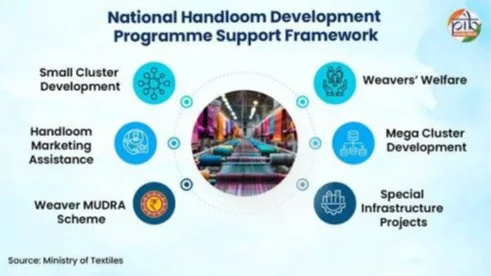
National Handloom Development Programme (NHDP) - Financial and technical support for handloom clusters.
- Infrastructure development and capacity building.
Raw Material Supply Scheme (RMSS) - Ensures timely availability of yarn at subsidized rates.
Weaver Mudra Scheme - Provides concessional credit to handloom weavers.
 India Handloom Brand
 - Promotes high-quality authentic handloom products.
Handloom Mark - Certifies that a product is genuinely handwoven.
Geographical Indication (GI) Tags Many handloom products have GI protection, helping preserve traditional crafts and improve market value.
E-commerce and Digital Marketing - Promotion through online platforms to improve market access for weavers.
CHALLENGES
- Competition from powerloom and machine-made textiles.
- Rising cost of raw materials.
- Low wages and declining profitability.
- Limited market access.
- Aging artisan population and declining interest among youth.
- Impact of climate variability on natural fibres like cotton and silk.
WAY FORWARD
- Strengthen branding and exports.
- Promote sustainable and eco-friendly textiles.
- Improve digital marketing and e-commerce access.
- Expand skill development and design innovation.
- Increase institutional credit and social security for weavers.
- Integrate handloom promotion with tourism and cultural initiatives.
August 7, 2024. The day has
special significance in the history of the freedom struggle in the country.
On the same day in 1905 Swadeshi Andolan was started. Announcing the date to celebrate National handloom day in
2015, Prime Minister Narendra Modi had said that all families in the country must keep at least one product of khadi and one of handloom.
VIRAASAT EXHIBITION
“VIRAASAT”, a
fortnight long exhibition dedicated to celebrating
10th National Handloom Day began at
Handloom Haat in Janpath on Saturday, 3rd August, 2024. National Handloom Development Corporation Ltd (NHDC) is
organising the handloom expo under the aegis of the
Ministry of Textiles, Government of India which will conclude on 16th August, 2024.
THE THEME FOR 10th HANDLOOM DAY: The theme for this year’s National Handloom Day focusses on
Technological advancements & innovations in handloom & weaving. This will
enhance market reach & will require more skills to be adopted.
Why This Topic Matters for UPSC
- Prelims: Revise definitions, institutions, locations, reports and factual features connected with National Handloom Day: History, Importance and Initiatives.
- Mains: Link the topic with Art and Culture, Economy, Rural Development and organise the answer under background, significance, challenges and way forward.
- Interview: Explain the issue in balanced language and distinguish verified facts from opinion.
Key Takeaway
National Handloom Day recognises India's weaving traditions and the livelihoods supported by the handloom sector. The observance connects cultural heritage with rural employment, women artisans, sustainable production, market access and government support.
Test your understanding
Questions from this article
Prelims practiceWith reference to National Handloom Day, consider the following statements:
- The day has special significance in the history of the freedom struggle in the country.
- On the same day in 1905 Swadeshi Andolan was started.
- Announcing the date to celebrate National handloom day in 2015, Prime Minister Narendra Modi had said that all families in the country must keep at least one product of khadi and one of handloom.
Which of the statements given above are correct?
- 1 and 2 only
- 2 and 3 only
- 1 and 3 only
- 1, 2 and 3
View answer
Answer: (d) 1, 2 and 3. All three statements are drawn from the article.
Mains practiceDiscuss the background, key issues and significance of National Handloom Day for India.
Answer in 250 words.
View answer approach
- VIRAASAT EXHIBITION
- Background and context
- Key facts and institutional framework
- Significance and way forward
Frequently asked questionsFrequently asked questions
What is National Handloom Day?
National Handloom Day recognises India's weaving traditions and the livelihoods supported by the handloom sector. The observance connects cultural heritage with rural employment, women artisans, sustainable production, market access and government support.
Why is National Handloom Day important for UPSC?
It connects current developments with Art and Culture, Economy, Rural Development and supports factual revision as well as analytical answer writing.
How should aspirants prepare National Handloom Day?
Prepare a short definition, key facts, institutional or legal framework, significance, challenges and a balanced way forward. Revise the specific developments and examples explained in the article.