UPSC Current Affairs
Money Bills
Chandrachud agreed to list petitions challenging the Money Bill route taken by the Centre to pass contentious amendments in the Parliament. “I will list when I form Constitution Benches,” The Chief Justice addressed WHAT IS A MONEY BILL? A Money Bill is deemed to contain only provisions dealing with all or any of the matters under clauses (a) to (g) of Article 110(1), largely including the appropriation of money from the Consolidated Fund of India and taxation.
VRAuthor Desk
3 min read
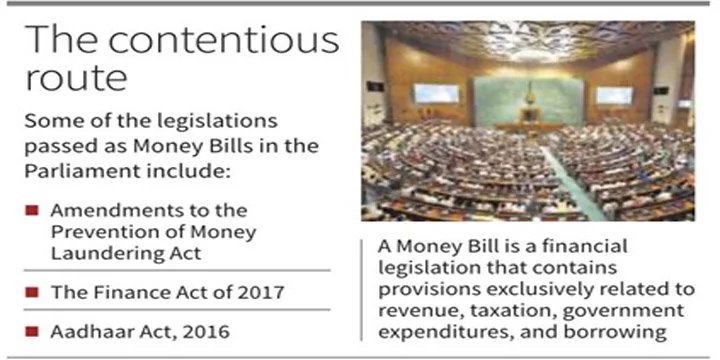
Chandrachud agreed to list petitions challenging the Money Bill route taken by the Centre to pass contentious amendments in the Parliament. “I will list when I form Constitution Benches,” The Chief Justice addressed WHAT IS A MONEY BILL? A Money Bill is deemed to contain only provisions dealing with all or any of the matters under clauses (a) to (g) of Article 110(1), largely including the appropriation of money from the Consolidated Fund of India and taxation.
D.Y. Chandrachud agreed to list petitions challenging the Money Bill route taken by the Centre to pass contentious amendments in the Parliament.
“I will list when I form Constitution Benches,”
The Chief Justice addressed
WHAT IS A MONEY BILL?
A Money Bill is deemed to contain only provisions dealing with all or any of the matters under
clauses (a) to (g) of Article 110(1), largely including the
appropriation of money from the Consolidated Fund of India and
taxation.
In other words, a Money Bill is restricted
only to the specified financial matters.
ARTICLE 110
A Bill shall be deemed to be a Money Bill if it contains only provisions dealing with
all or any of the following matters, namely:—
- The imposition, abolition, remission, alteration or regulation of any tax;
- The regulation of the borrowing of money or the giving of any guarantee by the Government of India, or the amendment of the law with respect to any financial obligations undertaken or to be undertaken by the Government of India;
- The custody of the Consolidated Fund or the Contingency Fund of India, the payment of moneys into or the withdrawal of moneys from any such Fund;
- The appropriation of moneys out of the Consolidated Fund of India;
- The declaring of any expenditure to be expenditure charged on the Consolidated Fund of India or the increasing of the amount of any such expenditure;
- The receipt of money on account of the Consolidated Fund of India or the public account of India or the custody or issue of such money or the audit of the accounts of the Union or of a State; or
- Any matter incidental to any of the matters specified in sub-clauses (a) to (f).
OTHER PROVISIONS
- A Bill shall not be deemed to be a Money Bill by reason only that it provides for the imposition of fines or other pecuniary penalties, or for the demand or payment of fees for licences or fees for services rendered, or by reason that it provides for the imposition, abolition, remission, alteration or regulation of any tax by any local authority or body for local purposes.
- If any question arises whether a Bill is a Money Bill or not, the decision of the Speaker of the House of the People thereon shall be final.
- There shall be endorsement on every Money Bill- the certificate of the Speaker of the House of the People signed by him that it is a Money Bill.
- It is introduced in Lok Sabha only with prior consent of the President. Once passed, the President has to sign it.
- It can be introduced by a minister only & no provision of joint sitting is there.
POWERS OF RAJYA SABHA ON MONEY BILLS
The Rajya Sabha has
no power to reject or amend a Money Bill, but it
can make recommendations and return it to the Lok Sabha within 14 days.
If the rajya sabha
doesn't return the bill within 14 days, neither passes it, it's considered passed in both houses.
In case
Rajya Sabha gives some
recommendations, The
Lok Sabha can then accept or reject the recommendations.
THE CURRENT CASE
The reference
includes legal questions concerning amendments made from 2015 onwards in the
Prevention of Money Laundering Act (PMLA) through Money Bills, giving the
Enforcement Directorate almost blanket powers of arrest, raids, etc.
Though
the court had upheld the legality of the PMLA amendments, it left the question of whether the amendments could have been passed as Money Bills to the seven-judge bench
- Prelims: Key facts, institutions, locations and terminology in the article.
- Mains: Connect the topic with Polity & Governance.
- Revision: Use the article headings to prepare concise notes and answer-writing points.
Test your understanding
Questions from this article
Prelims practiceWith reference to Money Bills, consider the following statements:
- The imposition, abolition, remission, alteration or regulation of any tax;
- The regulation of the borrowing of money or the giving of any guarantee by the Government of India, or the amendment of the law with respect to any financial obligations undertaken or to be undertaken by the Government…
- The custody of the Consolidated Fund or the Contingency Fund of India, the payment of moneys into or the withdrawal of moneys from any such Fund;
Which of the statements given above are correct?
- 1 and 2 only
- 2 and 3 only
- 1 and 3 only
- 1, 2 and 3
View answer
Answer: (d) 1, 2 and 3. All three statements are drawn from the article.
Mains practiceDiscuss the background, key issues and significance of Money Bills for India.
Answer in 250 words.
View answer approach
- OTHER PROVISIONS
- Background and context
- Key facts and institutional framework
- Significance and way forward
Frequently asked questionsFrequently asked questions
Why is Money Bills in the news?
Chandrachud agreed to list petitions challenging the Money Bill route taken by the Centre to pass contentious amendments in the Parliament. “I will list when I form Constitution Benches,” The Chief Justice addressed WHAT IS A MONEY BILL?
What are the key facts about Money Bills?
A Money Bill is deemed to contain only provisions dealing with all or any of the matters under clauses (a) to (g) of Article 110(1), largely including the appropriation of money from the Consolidated Fund of India and taxation. In other words, a Money Bill is restricted only to the specified financial matters. ARTICLE 110 A Bill shall be deemed to be a Money Bill if it contains only provisions dealing with all or any of the following matters, namely:— The imposition, abolition, remission, alteration or regulation of any tax; The regulation of the borrowing of money…
Why is Money Bills important for UPSC preparation?
The topic connects current developments with Polity & Governance and is relevant for both objective revision and analytical answer writing.