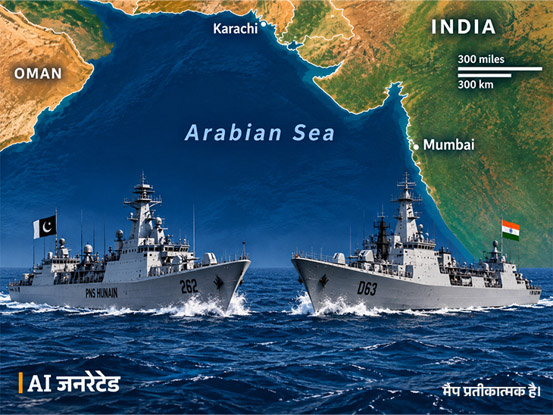
A naval collision between India and Pakistan in the Arabian Sea has brought attention to maritime safety and the rules that govern the movement of their naval vessels. The incident has also highlighted the importance of the 1991 India-Pakistan agreement and international rules for preventing collisions at sea.
Context
The incident took place on September 15, 2026, in the North Arabian Sea. It involved an Indian Navy warship, INS Kolkata, and a Pakistani Navy vessel, PNS Hunain. India and Pakistan have given different accounts of what happened immediately before the collision.
- An Indian Navy warship, INS Kolkata, and a Pakistani Navy vessel, PNS Hunain, collided in the North Arabian Sea on September 15, 2026.
- India said the collision followed a dangerous overtaking manoeuvre by the Pakistani vessel, while Pakistan rejected India’s allegations and gave a different account.
- The incident has brought attention to the 1991 India-Pakistan agreement, which requires naval vessels of the two countries to maintain a minimum separation while operating in international waters.
Why in the News?
The collision took place on September 15 in the North Arabian Sea. The two vessels involved were INS Kolkata and PNS Hunain.
- Date: September 15, 2026
- Location: North Arabian Sea
- Vessels involved: INS Kolkata and PNS Hunain
According to India:
- PNS Hunain approached INS Kolkata at high speed.
- It carried out a dangerous overtaking manoeuvre.
- The manoeuvre resulted in the collision.
- India said this violated the 1991 bilateral agreement and the International Regulations for Preventing Collisions at Sea.
Damage:
- INS Kolkata: No major damage and remained at sea.
- PNS Hunain: Sustained damage and returned to harbour.
Pakistan rejected India’s allegations and alleged that the Indian warship had carried out a provocative manoeuvre. Therefore, the exact sequence of movements immediately before the collision remains disputed.
INS Kolkata
INS Kolkata is the lead ship of the Indian Navy’s Project 15A Kolkata-class guided missile destroyers. It is a major warship designed for multiple naval operations.
- Built by Mazagon Dock Shipbuilders, Mumbai.
- Length: 164 metres
- Full-load displacement: About 7,400 tonnes
- Maximum speed: About 30 knots
- Commissioned: August 2014
Major capabilities include:-
- Long-range air defence
- Anti-surface warfare
- Anti-submarine warfare
- Helicopter operations
- BrahMos supersonic cruise missiles as its principal anti-surface strike weapon
PNS Hunain
PNS Hunain (F-273) is an offshore patrol vessel of the Pakistan Navy. It is designed for maritime surveillance, patrolling, and security-related operations.
- Built by Damen Shipyards in Romania.
- Commissioned: July 2024
- Based on the OPV 2600 design and a follow-on to Pakistan’s Yarmook-class patrol ships.
- Length: Approximately 98 metres
- Displacement: About 2,600 tonnes
- Maximum speed: Around 24 knots
Its roles include:
- Maritime surveillance
- Patrolling
- Maritime security
- Military operations
Pakistan describes it as a multi-purpose platform with electronic warfare, anti-ship and anti-air warfare capabilities, self-protection and terminal defence systems.
It can also operate a multirole helicopter.
Watch : India-Pakistan Naval Collision in the Arabian Sea
What Does India Say?
India has maintained that INS Kolkata was carrying out routine surveillance when the incident occurred. According to India’s account, the Pakistani vessel came too close while carrying out an overtaking manoeuvre.
- INS Kolkata was conducting routine surveillance.
- PNS Hunain approached the Indian warship at high speed.
- The Pakistani vessel carried out a dangerous overtaking manoeuvre.
- The manoeuvre brought the two ships into proximity and resulted in the collision.
- India said the incident violated:
- The 1991 India-Pakistan agreement
- The International Regulations for Preventing Collisions at Sea.
- On September 18, India’s Ministry of External Affairs said it had examined Pakistan’s response and rejected its allegations.
What Does Pakistan Say?
Pakistan has rejected India’s allegations about the incident. It has presented a different version of what happened before the collision.
- Pakistan rejected India’s allegations.
- It alleged that the Indian warship had carried out a provocative manoeuvre.
- The two countries therefore have different accounts of the events immediately before the collision.
- The precise sequence of movements remains unresolved.
What is Article 10 of the 1991 Agreement?
The incident has brought attention to Article 10 of the Agreement between India and Pakistan on Advance Notice on Military Exercises, Manoeuvres and Troop Movements, signed on April 6, 1991. The provision is meant to reduce the possibility of accidental contact between the two countries’ naval vessels.
- Naval ships and submarines of India and Pakistan should not approach within three nautical miles of each other while operating in international waters.
- The purpose is to avoid accidents.
- 3 nautical miles ≈ 5.6 km.
- Article 10 is part of a wider military confidence-building framework between India and Pakistan.
- It aims to reduce:
- Accidental confrontation
- Miscalculation
- Risks during military operations
- It is a bilateral requirement between India and Pakistan and is not a universal international rule applicable to all warships.
International Regulations for Preventing Collisions at Sea
India has also referred to the International Regulations for Preventing Collisions at Sea. These rules provide a framework for safe movement of vessels and help prevent accidents at sea. These rules provide a framework for:-
- Safe navigation
- Vessel movements
- Overtaking
- Maintaining appropriate distance
- Preventing collisions
India has argued that the Pakistani vessel’s manoeuvre violated applicable navigation requirements.
Has a Similar Incident Happened Before?
There has been an earlier reported incident involving Indian and Pakistani naval vessels. It took place in 2011 during anti-piracy operations in the Gulf of Aden.
- In June 2011, Pakistani warship PNS Babur came close to Indian Navy frigate INS Godavari.
- The incident occurred during anti-piracy operations in the Gulf of Aden.
- It resulted in minor damage.
- India protested, citing violations of navigational-safety requirements.
- The September 2026 incident is the second reported India–Pakistan naval collision involving the 1991 framework.
India’s Diplomatic Response
Following the incident, India also took diplomatic steps to raise the issue with Pakistan. These actions were aimed at communicating India’s concerns and seeking adherence to the existing rules and agreements. India has:-
- Summoned Pakistan’s Chargé d’Affaires in New Delhi.
- Lodged a strong diplomatic protest.
- Instructed India’s Chargé d’Affaires in Islamabad to raise the issue with Pakistan’s Foreign Ministry.
- Advised Pakistan to ensure that its military units:
- Exercise due care.
- Follow relevant bilateral agreements.
- Take steps to prevent a recurrence.
India later said it had examined Pakistan’s response and rejected its allegations.
International Waters
The collision occurred in international waters. However, being in international waters does not mean that the two countries have no agreed rules governing the conduct of their naval vessels.
- The collision occurred in international waters.
- According to India’s position, this does not mean that the two navies are outside their agreed bilateral rules of conduct.
The incident therefore brings together two aspects of maritime conduct: international navigation rules and the specific bilateral arrangements between India and Pakistan.
Conclusion
On September 15, 2026, Indian Navy warship INS Kolkata and Pakistani Navy vessel PNS Hunain were involved in a collision in the North Arabian Sea. India said that PNS Hunain approached INS Kolkata at high speed and carried out a dangerous overtaking manoeuvre. Pakistan rejected India’s account and alleged that the Indian warship had made a provocative manoeuvre. Therefore, the exact sequence of movements before the collision remains disputed. The incident brought attention to Article 10 of the 1991 India-Pakistan Agreement, which says that naval ships and submarines of the two countries should not come within three nautical miles of each other while operating in international waters. Three nautical miles is about 5.6 km. The agreement was intended to reduce the risk of accidents and military miscalculation. India also referred to the International Regulations for Preventing Collisions at Sea. India said INS Kolkata suffered no major damage and continued its deployment, while PNS Hunain was damaged and returned to harbour. India later lodged a diplomatic protest and asked Pakistan to follow the relevant agreements and safety rules.
Test your understanding
Questions from this article
Prelims practiceQuestion: With reference to India-Pakistan Naval Collision in the Arabian Sea: What Happened?, consider the following statements:
- A naval collision between India and Pakistan in the Arabian Sea has brought attention to maritime safety and the rules that govern the movement of their naval vessels
- The incident has also highlighted the importance of the 1991 India-Pakistan agreement and international rules for preventing collisions at sea
Which of the statements given above is/are correct?
- 1 only
- 2 only
- Both 1 and 2
- Neither 1 nor 2
View answer and explanation
Suggested answer: (c) Both 1 and 2
Explanation: India-Pakistan naval collision in the Arabian Sea. Know what happened, key details, causes, and the latest developments surrounding the incident
Mains practiceQuestion: Discuss India-Pakistan Naval Collision in the Arabian Sea: What Happened? with reference to Context, Why in the News?, According to India: and Damage:. (150 words, 10 marks)
View answer-writing approach
Answer approach:
- Introduce the topic using its meaning and context.
- Explain Context, Why in the News?, According to India: and Damage:.
- Use facts and examples given in the article.
- Conclude with a balanced way forward.
Frequently asked questionsFrequently asked questions
What is India-Pakistan Naval Collision in the Arabian Sea: What Happened??
India-Pakistan naval collision in the Arabian Sea. Know what happened, key details, causes, and the latest developments surrounding the incident
Why is India-Pakistan Naval Collision in the Arabian Sea: What Happened? relevant for UPSC preparation?
The incident has also highlighted the importance of the 1991 India-Pakistan agreement and international rules for preventing collisions at sea
What key points should aspirants remember about India-Pakistan Naval Collision in the Arabian Sea: What Happened??
The article covers Context, Why in the News?, According to India: and Damage:.