UPSC Current Affairs
India-Myanmar border Free Movement Regime
Context: Recently, Union Home Minister Amit Shah announced that the Centre has decided to fence the entire length of the India-Myanmar border to stop the free movement of people. The two countries share a largely unfenced 1,643 km border, which goes along the states of Manipur, Mizoram, Assam, Nagaland and Arunachal Pradesh. The Free movement regime agreement was implemented in 2018.
VRAuthor Desk
3 min read
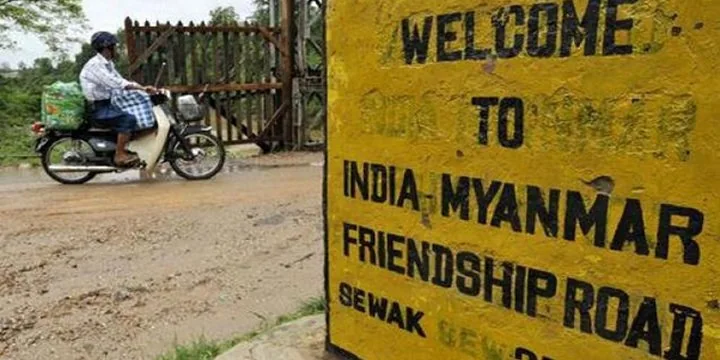
Context: Recently, Union Home Minister Amit Shah announced that the Centre has decided to fence the entire length of the India-Myanmar border to stop the free movement of people. The two countries share a largely unfenced 1,643 km border, which goes along the states of Manipur, Mizoram, Assam, Nagaland and Arunachal Pradesh. The Free movement regime agreement was implemented in 2018.
Context:
- Recently, Union Home Minister Amit Shah announced that the Centre has decided to fence the entire length of the India-Myanmar border to stop the free movement of people.
- The two countries share a largely unfenced 1,643 km border, which goes along the states of Manipur, Mizoram, Assam, Nagaland and Arunachal Pradesh.
- The Free movement regime agreement was implemented in 2018.
About Free Movement Regime on the India-Myanmar Border:
- The FMR is a mutually agreed arrangement between the two countries which allows tribes living along the border on either side to travel up to 16 km inside the other country without a visa.
- It was implemented in 2018 as part of the government’s Act East policy.
- It was implemented at a time when diplomatic relations between India and Myanmar were on the upswing.
Rationale behind the FMR:
- The border between India and Myanmar was demarcated by the British in 1826 but without seeking the opinion of the people living in the region.
- The border effectively divided people of the same ethnicity and culture into two nations without even taking their consent.
- The current India-Myanmar Border reflects the line that the British drew.
- People in the area have strong ethnic and familial ties across the border.
- In Manipur’s Moreh region, there are villages where some homes are actually in Myanmar.
- In Nagaland’s Mon district, the border actually passes through the house of the chief of Longwa village, splitting his home into two between India and Myanmar.
- Apart from facilitating people-to-people contact, the FMR was supposed to foster local trade and business.
- The region has a long history of trans-border commerce through the customs and border haats.
- Given the low-income economy, such exchanges are vital for the sustenance of local livelihoods in the region.
- For people in Myanmar along the border too, Indian towns are closer for business, education, and healthcare than those in their own country.
Criticism surrounding FMR:
- The illegal migration of tribal Kuki-Chin peoples from Myanmar into India is one of the key issues in the ongoing Manipur conflict.
- The Meiteis have accused these illegal migrants and the alleged “narco-terror network” along the India-Myanmar Border (IMB) of fomenting trouble in the state.
- The Kukis have blamed the Meiteis and Chief Minister of using this as a pretext for “ethnic cleansing”.
- In the middle of this charged and sensitive debate in the state, questions have been raised about the FMR.
- Although beneficial to local people and helpful in improving Indo-Myanmar ties, it has been criticised in the past for unintentionally aiding illegal immigration, drug trafficking, and also gun running.
- The border runs through forested and undulating terrain and is almost entirely unfenced, and difficult to monitor.
- In Manipur, less than 6 km of the border is fenced.
- Prelims: Key facts, institutions, locations and terminology in the article.
- Mains: Connect the topic with Environment, Economy, International Relations.
- Revision: Use the article headings to prepare concise notes and answer-writing points.
Test your understanding
Questions from this article
Prelims practiceWith reference to India-Myanmar border Free Movement Regime, consider the following statements:
- Recently, Union Home Minister Amit Shah announced that the Centre has decided to fence the entire length of the India-Myanmar border to stop the free movement of people.
- The two countries share a largely unfenced 1,643 km border, which goes along the states of Manipur, Mizoram, Assam, Nagaland and Arunachal Pradesh.
- The Free movement regime agreement was implemented in 2018.
Which of the statements given above are correct?
- 1 and 2 only
- 2 and 3 only
- 1 and 3 only
- 1, 2 and 3
View answer
Answer: (d) 1, 2 and 3. All three statements are drawn from the article.
Mains practiceDiscuss the background, key issues and significance of India-Myanmar border Free Movement Regime for India.
Answer in 250 words.
View answer approach
- Context:
- About Free Movement Regime on the India-Myanmar Border:
- Rationale behind the FMR:
- Criticism surrounding FMR:
Frequently asked questionsFrequently asked questions
Why is India-Myanmar Border Free Movement Regime in the news?
Context: Recently, Union Home Minister Amit Shah announced that the Centre has decided to fence the entire length of the India-Myanmar border to stop the free movement of people. The two countries share a largely unfenced 1,643 km border, which goes along the states of Manipur, Mizoram, Assam, Nagaland and Arunachal Pradesh.
What are the key facts about India-Myanmar Border Free Movement Regime?
The Free movement regime agreement was implemented in 2018. About Free Movement Regime on the India-Myanmar Border: The FMR is a mutually agreed arrangement between the two countries which allows tribes living along the border on either side to travel up to 16 km inside the other country without a visa. It was implemented in 2018 as part of the government’s Act East policy.
Why is India-Myanmar Border Free Movement Regime important for UPSC preparation?
The topic connects current developments with Environment, Economy, International Relations and is relevant for both objective revision and analytical answer writing.