UPSC Current Affairs
India-Germany Relations: Cooperation, Challenges and Way Forward
India and Germany share a strategic partnership spanning trade, technology, green development, defence, education and multilateral cooperation. Their relationship is shaped by economic complementarities as well as differences over regulation, geopolitics and market access.
VRAuthor Desk
8 min read
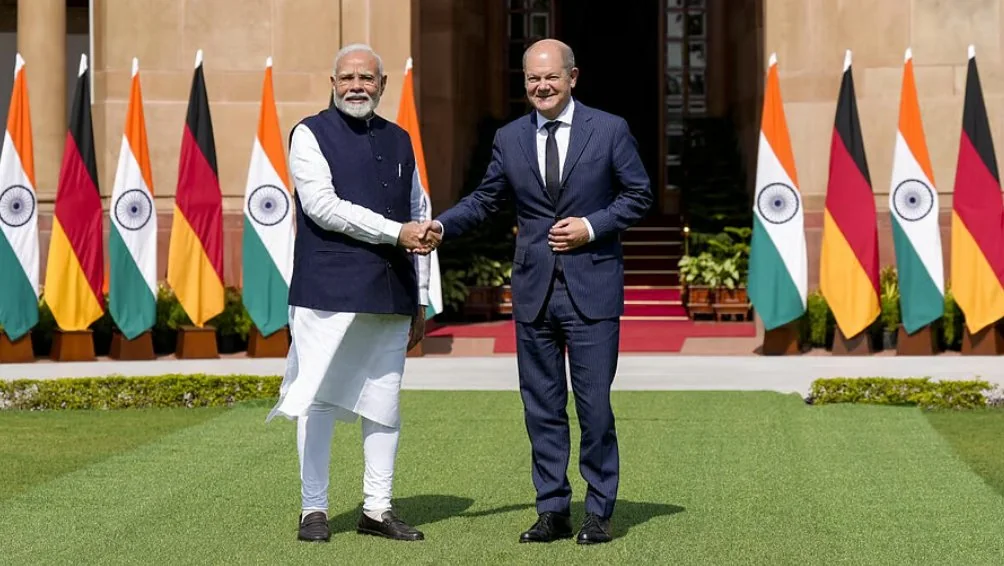
In brief: India and Germany share a strategic partnership spanning trade, technology, green development, defence, education and multilateral cooperation. Their relationship is shaped by economic complementarities as well as differences over regulation, geopolitics and market access.
India and Germany share a strategic partnership spanning trade, technology, green development, defence, education and multilateral cooperation. Their relationship is shaped by economic complementarities as well as differences over regulation, geopolitics and market access.
Why in News?
- India and Germany are expected to sign the Project-75I submarine deal worth about €8 billion (over ₹90,000 crore) for six next-generation conventional submarines.
- The submarines will be built in India through collaboration between Germany's ThyssenKrupp Marine Systems (TKMS) and Mazagon Dock Shipbuilders Limited (MDL).
- The agreement marks a shift in India–Germany relations from traditional economic cooperation towards a strategic-industrial partnership centred on defence manufacturing, technology transfer and supply-chain resilience.
EVOLUTION OF TIES
Phase I: Formative Years (1951–1970s) - India was among the first countries to establish diplomatic relations with the Federal Republic of Germany (FRG) in 1951.
- Relations were influenced by the Hallstein Doctrine, as India maintained relations with both West Germany (FRG) and East Germany (GDR).
- Jawaharlal Nehru's 1956 visit to West Germany laid the foundation for industrial cooperation, including the Rourkela Steel Plant.
Phase II: Developmental & Technical Cooperation (1970s–1990) - India recognised East Germany (GDR) in 1972.
- Germany became one of India's largest development partners.
- IIT Madras was established with German technical and financial assistance.
- India welcomed the reunification of Germany in 1990.
Phase III: Economic Liberalisation & Strategic Partnership (1991–2010) - India's economic reforms strengthened German investments.
- German Mittelstand (SMEs) began viewing India as a manufacturing destination.
- Relations were elevated to a Strategic Partnership in 2000.
- India and Germany became partners in the G4 Group along with Japan and Brazil to advocate UN Security Council reforms.Phase IV:
Institutional Partnership (2011–2021) - Inter-Governmental Consultations (IGC) were launched in 2011, enabling meetings between both Cabinets.
- Germany became an important partner in:
- Renewable energy
- Green Energy Corridors
- Skill development
- Make in India
- Industry 4.0 initiatives.
Phase V: Strategic Convergence (2022–Present) - Germany's Indo-Pacific Guidelines (2020) and Focus on India Strategy (2024) identify India as a key strategic partner.
- Defence cooperation has expanded through:
- Project-75I submarine programme
- Defence Industrial Cooperation Roadmap (2026).
SIGNIFICANCE OF GERMANY FOR INDIA
Defence Indigenisation - Project-75I represents a transition from a buyer-seller relationship to technology transfer and co-development.
- Six Type-214 submarines with Air Independent Propulsion (AIP) will be manufactured.
- Indigenous content is expected to increase from 45% in the first submarine to nearly 60% by the sixth, supporting Atmanirbhar Bharat.
Economic and Supply Chain Cooperation - Germany is India's largest trading partner within the European Union.
- Bilateral trade has crossed USD 50 billion, accounting for more than 25% of India's trade with the EU.
- German Mittelstand investments strengthen India's manufacturing and exports.
Climate and Energy Partnership - Germany supports India's low-carbon transition through the Green and Sustainable Development Partnership (GSDP).
- Germany has committed €10 billion by 2030, with nearly €5 billion already earmarked by early 2026.
- Cooperation includes:
- Green hydrogen
- Green ammonia
- Sustainable infrastructure.
Education and Skilled Mobility - More than 60,000 Indian students study in Germany.
- The Migration and Mobility Partnership Agreement (MMPA) facilitates skilled migration.
- Programmes like SPARC-GIANT promote joint research in healthcare, sustainability and semiconductors.
Technology and Semiconductors - Cooperation has expanded through:
- Joint Declaration on Semiconductor Ecosystem Partnership
- Innovation & Technology Roadmap (2024).
- Major investments include Infineon's Global Capability Centre in GIFT City, Gujarat.
Indo-Pacific Security - Germany recognises India as an important democratic partner in maintaining a rules-based Indo-Pacific.
- Cooperation includes:
- Naval exercises
- Maritime consultations
- Support for India-Middle East-Europe Economic Corridor (IMEC).
Multilateral Cooperation - India and Germany cooperate in:
- They advocate:
- UNSC reforms
- Global financial reforms
- Digital Public Infrastructure
- Multipolar global governance.
MAJOR CHALLENGES
Defence Export Restrictions - Germany's strict arms export regulations create uncertainty in defence technology transfer.
- Project-75I approvals experienced prolonged delays.
Differences in AI and Digital Regulations - The EU AI Act and India's Digital Personal Data Protection (DPDP) Act create regulatory differences affecting:
- AI collaboration
- Data sharing
- Digital infrastructure.
Trade Issues - Although India and the EU concluded FTA negotiations in 2026, implementation remains pending.
- Challenges remain regarding:
- Data governance
- Sustainability standards
- Market access
- Carbon Border Adjustment Mechanism (CBAM).
Geopolitical Differences - Germany has concerns over India's continued energy imports from Russia.
- India remains concerned about Germany's economic dependence on China.
Climate Technology and Intellectual Property - High licensing costs for German green technologies limit technology transfer.
- Limited funds under GSDP reach IP-sharing projects.
Ease of Doing Business - German companies cite:
- Bureaucracy (64%)
- Corruption (39%)
- Tax complexity (27%) as major barriers to investment in India.
Labour Mobility Issues - Challenges include:
- Recognition of professional qualifications
- German language requirements
- Limited mutual recognition of engineering degrees.
Sanitary and Phytosanitary (SPS) Standards - Strict EU SPS standards restrict Indian agricultural exports.
- Example: Rejection of Indian mango exports due to pesticide residue concerns.
WAY FORWARD
- Establish an Indo-German Defence Innovation Bridge for co-development of defence technologies.
- Launch a Digital Sovereignty Dialogue to harmonise AI governance and digital standards.
- Develop a Green Hydrogen Offtake Corridor through long-term green ammonia agreements.
- Create a Mutual Skills Recognition Framework for easier mobility of skilled professionals.
- Launch a Mittelstand–Startup Synergy Fund to promote joint innovation.
- Expand maritime cooperation through a German liaison officer at IFC-IOR.
- Build a Circular Economy Partnership focusing on e-waste and plastic recycling.
- Harmonise agricultural standards through a Mutual Equivalence Agreement on SPS measures.
CONCLUSION
- India–Germany relations have evolved into a strategic-industrial partnership combining German technology with India's manufacturing capabilities.
- Deepening cooperation in defence, technology, climate action and supply chains can strengthen a resilient, rules-based and multipolar Indo-Pacific, provided regulatory and strategic challenges are effectively addressed.
Context: High-Level Talk Between India and Germany - On May 20, 2025, Prime Minister Narendra Modi spoke with newly elected German Chancellor Friedrich Merz.
- They discussed bilateral relations, regional and global developments, and reaffirmed a joint stance against terrorism.
- Chancellor Merz is the leader of Germany's Christian Democratic Union (CDU) and took office earlier in May 2025.
KEY HIGHLIGHTS OF THE CONVERSATION
a. Congratulations & Strategic Partnership - PM Modi congratulated Merz on becoming Chancellor.
- Both leaders reaffirmed their commitment to deepening the India-Germany Strategic Partnership, which has seen 25 years of robust growth.
b. Commitment to Fighting Terrorism - Both sides “stood united in combating terrorism in all forms”, as per official statements.
- They reiterated the importance of coordinated global efforts to counter terrorism and safeguard democratic values.
c. Areas of Future Cooperation Identified - The two leaders agreed to strengthen cooperation in:
- Trade and Investment
- Defence and Security
- Innovation and Technology
d. Diaspora & People-to-People Ties - They acknowledged the positive contribution of the Indian diaspora in Germany, which acts as a cultural and economic bridge.
e. Invitation Extended - PM Modi invited Chancellor Merz to visit India, and both agreed to stay in close touch moving forward.
STRATEGIC SIGNIFICANCE
- India and Germany have a Strategic Partnership since 2001, further elevated through the Inter-Governmental Consultations (IGC)
- Key pillars include:
- Economic partnership: Germany is India’s largest trading partner in the EU.
- Defence collaboration
- Green energy and climate cooperation
- Education and research: Large Indian student community in Germany
- Both share democratic values, rule of law, and seek a rules-based international order.
STAND ON TERRORISM
- Terrorism remains a common concern:
- India faces cross-border terrorism, particularly from Pakistan-based groups.
- Germany is concerned with homegrown radicalization and international terrorism, including from the Middle East and extremist ideologies.
- A joint approach enhances intelligence sharing, capacity building, and multilateral anti-terror cooperation.
INDIA V/S GERMANY (ELECTORAL & POLITICAL SYSTEMS)
India’s Electoral System - Type: First-Past-the-Post (FPTP)
- Constituencies: 543 Lok Sabha seats; one MP elected per constituency.
- Voting Process:
- Conducted by the Election Commission of India (ECI).
- Electronic Voting Machines (EVMs) are used.
- Voters’ fingers are ink-marked to prevent multiple voting.
- Government Formation:
- The party or coalition with majority (272+ seats) forms the government.
- Its leader becomes the Prime Minister.
- Type: Mixed-Member Proportional (MMP)
- Voting Structure:
- Two Votes:
- First vote: For a local candidate (FPTP style) – 299 seats.
- Second vote: For a party list (proportional) – determines total share in 630-member Bundestag.
- Threshold: Parties need at least 5% of the vote or 3 direct seats to enter Parliament.
- This system ensures local representation + proportional fairness.
| Feature | India | Germany |
| System | Parliamentary democracy | Federal Parliamentary Republic |
| Head of Government | Prime Minister (executive powers) | Chancellor (executive powers) |
| Head of State | President (ceremonial) | President (ceremonial) |
| Federalism | States have powers under the Constitution | Strong federal structure; Bundesrat (upper house) represents states |
| Upper House Powers | Rajya Sabha can delay but not veto major laws | Bundesrat can veto laws affecting states |
Why This Topic Matters for UPSC
- Prelims: Revise definitions, institutions, locations, reports and factual features connected with India-Germany Relations: Cooperation, Challenges and Way Forward.
- Mains: Link the topic with International Relations, Europe, Trade, Green Development and organise the answer under background, significance, challenges and way forward.
- Interview: Explain the issue in balanced language and distinguish verified facts from opinion.
Key Takeaway
India and Germany share a strategic partnership spanning trade, technology, green development, defence, education and multilateral cooperation. Their relationship is shaped by economic complementarities as well as differences over regulation, geopolitics and market access.
- Prelims: Revise the key facts and terminology.
- Mains: Connect the topic with International Relations, Europe, Trade, Green Development.
- Revision: Prepare notes under background, features, significance, challenges and way forward.
Test your understanding
Questions from this article
Prelims practiceWith reference to INDIA GERMANY TIES, consider the following statements:
- On May 20, 2025, Prime Minister Narendra Modi spoke with newly elected German Chancellor Friedrich Merz.
- They discussed bilateral relations, regional and global developments, and reaffirmed a joint stance against terrorism.
- Chancellor Merz is the leader of Germany's Christian Democratic Union (CDU) and took office earlier in May 2025.
Which of the statements given above are correct?
- 1 and 2 only
- 2 and 3 only
- 1 and 3 only
- 1, 2 and 3
View answer
Answer: (d) 1, 2 and 3. All three statements are drawn from the article.
Mains practiceDiscuss the background, key issues and significance of INDIA GERMANY TIES for India.
Answer in 250 words.
View answer approach
- KEY HIGHLIGHTS OF THE CONVERSATION
- STRATEGIC SIGNIFICANCE
- STAND ON TERRORISM
- INDIA V/S GERMANY (ELECTORAL & POLITICAL SYSTEMS)
Frequently asked questionsFrequently asked questions
What is India-Germany Relations?
India and Germany share a strategic partnership spanning trade, technology, green development, defence, education and multilateral cooperation. Their relationship is shaped by economic complementarities as well as differences over regulation, geopolitics and market access.
Why is India-Germany Relations important for UPSC?
It connects current developments with International Relations, Europe, Trade, Green Development and supports factual revision as well as analytical answer writing.
How should aspirants prepare India-Germany Relations?
Prepare a short definition, key facts, institutional or legal framework, significance, challenges and a balanced way forward. Revise the specific developments and examples explained in the article.