UPSC Current Affairs
India Eliminates Trachoma : WHO
October 8, 2024, the World Health Organization (WHO) officially declared that India has eliminated Trachoma as a public health problem. India is now the third country in the South-East Asia Region to achieve this milestone. The certification was presented to Aradhana Patnaik, Additional Secretary and Mission Director of the National Health Mission, by Ms.
VRAuthor Desk
3 min read
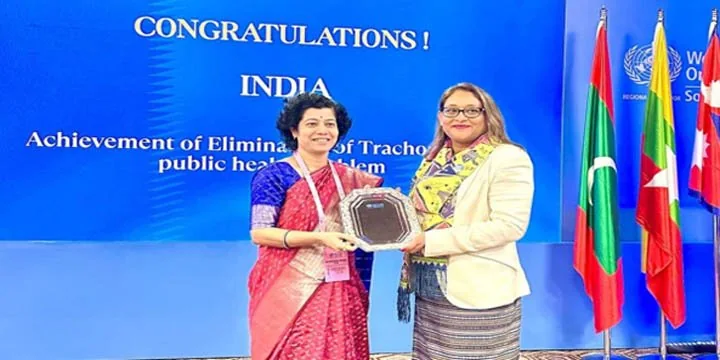
October 8, 2024, the World Health Organization (WHO) officially declared that India has eliminated Trachoma as a public health problem. India is now the third country in the South-East Asia Region to achieve this milestone. The certification was presented to Aradhana Patnaik, Additional Secretary and Mission Director of the National Health Mission, by Ms.
October 8, 2024, the World Health Organization
(WHO) officially declared that India has eliminated Trachoma as a public health problem.
- India is now the third country in the South-East Asia Region to achieve this milestone.
- The certification was presented to Aradhana Patnaik, Additional Secretary and Mission Director of the National Health Mission, by Ms. Saima Wazed, WHO’s Regional Director for South-East Asia, during the WHO’s Regional Committee meeting in New Delhi.
ABOUT TRACHOMA
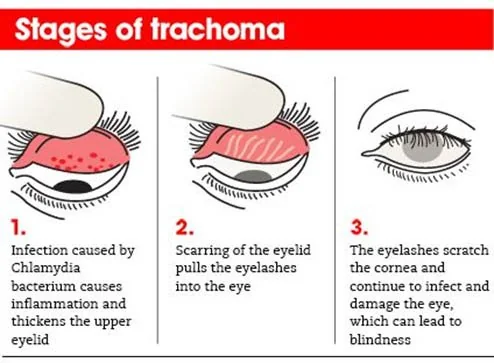
- Trachoma is a contagious bacterial infection caused by Chlamydia trachomatis that primarily affects the eyes.
- Transmission: It spreads through direct contact with the eyes, eyelids, nose, or throat secretions of infected individuals. If untreated, it can lead to irreversible blindness.
- Impact: WHO classifies Trachoma as a neglected tropical disease, affecting approximately 150 million people globally, with 6 million at risk of blindness.
STAGES OF TRACHOMA
HISTORICAL CONTEXT OF GOVT. INITIATIVES
- 1950-60s: Trachoma was a leading cause of blindness in India.
- 1963: The Government of India launched the National Trachoma Control Program.
- Integration: In subsequent years, Trachoma control efforts were incorporated into the National Program for Control of Blindness (NPCB).
- 1971: Blindness due to Trachoma was recorded at 5%; current estimates show it has reduced to less than 1% due to sustained intervention.
- 2017: India was declared free from infective Trachoma, but ongoing surveillance continued until 2024.
THE SAFE STRATEGY
To eliminate Trachoma, WHO recommends the
SAFE strategy:
- Surgery: For those suffering from trachomatous trichiasis (the blinding stage).
- Antibiotics: Particularly azithromycin, to clear the infection.
- Facial Cleanliness: Promoting hygiene practices.
- Environmental Improvement: Ensuring access to clean water and sanitation.
SURVEILLANCE & CERTIFICATION
- National Trachomatous Trichiasis (TT) Survey: Conducted from 2021-2024 in 200 endemic districts as part of WHO's mandate for certification.
- Dossier Compilation: Reports compiled by the NPCBVI team were submitted to the WHO for final evaluation, leading to the declaration of elimination.
APART FROM INDIA, HOW MANY OTHER COUNTRIES HAVE ELIMINATED TRACHOMA?
India joins 17 other countries that have successfully eliminated Trachoma as a public health issue, including:
- Benin, Cambodia, China, Gambia, Ghana, Iran, Laos, Malawi, Mali, Mexico, Morocco, Myanmar, Nepal, Oman, Saudi Arabia, Togo, and Vanuatu.
ABOUT WHO
- Establishment: Founded on April 7, 1948; celebrated annually as World Health Day.
- Headquarters: Geneva, Switzerland.
- Membership: Comprises 194 Member States, including 150 country offices and six regional offices.
- Objectives:
- Directing and coordinating international health work.
- Building partnerships with UN agencies and health authorities.
- Supporting governments in strengthening health services.
- Promoting cooperation among scientific and professional groups in health advancement.
Governance:
The
World Health Assembly (WHA) is the decision-making body of WHO, meeting annually at the WHO headquarters.
- Prelims: Key facts, institutions, locations and terminology in the article.
- Mains: Connect the topic with International Relations, Polity & Governance, Health.
- Revision: Use the article headings to prepare concise notes and answer-writing points.
Test your understanding
Questions from this article
Prelims practiceWith reference to India Eliminates Trachoma : WHO, consider the following statements:
- India is now the third country in the South-East Asia Region to achieve this milestone.
- The certification was presented to Aradhana Patnaik, Additional Secretary and Mission Director of the National Health Mission, by Ms. Saima Wazed, WHO’s Regional Director for South-East Asia, during the WHO’s Regional…
- Trachoma is a contagious bacterial infection caused by Chlamydia trachomatis that primarily affects the eyes.
Which of the statements given above are correct?
- 1 and 2 only
- 2 and 3 only
- 1 and 3 only
- 1, 2 and 3
View answer
Answer: (d) 1, 2 and 3. All three statements are drawn from the article.
Mains practiceDiscuss the background, key issues and significance of India Eliminates Trachoma : WHO for India.
Answer in 250 words.
View answer approach
- ABOUT TRACHOMA
- STAGES OF TRACHOMA
- HISTORICAL CONTEXT OF GOVT. INITIATIVES
- SURVEILLANCE & CERTIFICATION
- APART FROM INDIA, HOW MANY OTHER COUNTRIES HAVE ELIMINATED TRACHOMA?
Frequently asked questionsFrequently asked questions
Why is India Eliminates Trachoma : Who in the news?
October 8, 2024, the World Health Organization (WHO) officially declared that India has eliminated Trachoma as a public health problem. India is now the third country in the South-East Asia Region to achieve this milestone.
What are the key facts about India Eliminates Trachoma : Who?
The certification was presented to Aradhana Patnaik, Additional Secretary and Mission Director of the National Health Mission, by Ms. Saima Wazed, WHO’s Regional Director for South-East Asia, during the WHO’s Regional Committee meeting in New Delhi. ABOUT TRACHOMA Trachoma is a contagious bacterial infection caused by Chlamydia trachomatis that primarily affects the eyes.
Why is India Eliminates Trachoma : Who important for UPSC preparation?
The topic connects current developments with International Relations, Polity & Governance, Health and is relevant for both objective revision and analytical answer writing.