UPSC Current Affairs
India-Bangladesh ties
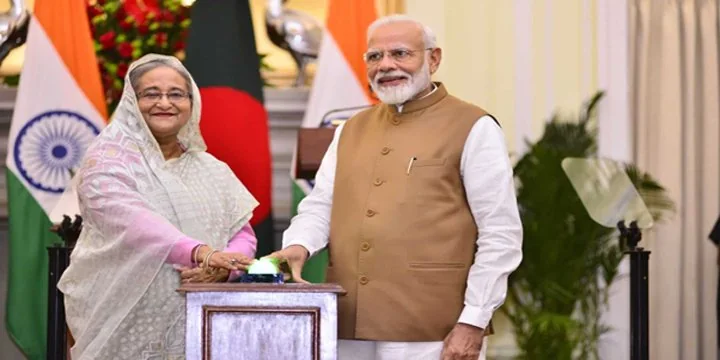
Context: Prime Minister Sheikh Hasina has returned to power in Bangladesh for a historic fourth straight term earlier this month after her party, the Awami League, secured twothirds of the seats in the recently held national elections. Prime Minister Narendra Modi was among the first world leaders to congratulate Ms. Hasina showcasing the close bilateral relationship between the two countries.
VRAuthor Desk
3 min read
Context: Prime Minister Sheikh Hasina has returned to power in Bangladesh for a historic fourth straight term earlier this month after her party, the Awami League, secured twothirds of the seats in the recently held national elections. Prime Minister Narendra Modi was among the first world leaders to congratulate Ms. Hasina showcasing the close bilateral relationship between the two countries.
Context:
- Prime Minister Sheikh Hasina has returned to power in Bangladesh for a historic fourth straight term earlier this month after her party, the Awami League, secured twothirds of the seats in the recently held national elections.
- Prime Minister Narendra Modi was among the first world leaders to congratulate Ms. Hasina showcasing the close bilateral relationship between the two countries.
Historical background:
- The foundation of India’s relationship with Bangladesh was laid down in the 1971 Bangladesh Liberation War.
- India provided critical military and also material support to assist Bangladesh in its fight for independence from Pakistan.
- Despite this, relations worsened within a few years as military regimes took control.
- There was a rise in antiIndia sentiment in the mid1970s over issues ranging from boundary disputes and insurgency to the sharing of water.
- The instability continued for a few decades until Sheikh Hasina came to power in 1996 and scripted a new chapter in bilateral ties with a treaty on the sharing of waters of Ganga.
- Since then, India and Bangladesh have built cooperation in trade, energy, infrastructure, connectivity and defence.
Economic cooperation:
- Bilateral trade between India and Bangladesh has grown significantly over the last decade.
- Bangladesh has emerged as India’s largest trade partner in South Asia with bilateral trade reaching $18 billion in 20212022 from $10.8 billion in 202021.
- India is also the second biggest trade partner of Bangladesh, with exports amounting to $2 billion in Indian markets.
- In 2022, both nations concluded a joint feasibility study on a Comprehensive Economic Partnership Agreement (CEPA) between two nations.
- The agreement which is designed to reduce or eliminate customs duties on traded goods and simplify trade norms, is anticipated to open up broader social and economic opportunities.
- The CEPA gains additional significance as Bangladesh is set to lose its Least Developed Country (LDC) status after 2026, thereby losing its dutyfree and quotafree market access in India.
- Bangladesh will be eager to finalise a Free Trade Agreement (FTA) with New Delhi.
Ties in infrastructure:
- As a “major development partner” of Bangladesh, India is funding several infrastructure and connectivity projects in Bangladesh.
- India has extended Lines of Credits worth over $7 billion to Bangladesh since 2010.
- PM Modi and Sheikh Hasina made history last year when they inaugurated the AkhauraAgartala rail link which connects Bangladesh and the northeast through Tripura.
- The link has given India access to Chattogram and Mongla ports in Bangladesh for the movement of cargo.
- It is likely to boost smallscale industries and develop the states of Assam and Tripura.
- Bangladesh imports nearly 2,000 megawatts of electricity from India.
- The BIMSTEC Master Plan for Transport Connectivity focuses on connecting major transport projects in India, Bangladesh, Myanmar and Thailand, thereby establishing a shipping network between the respective countries.
- Prelims: Key facts, institutions, locations and terminology in the article.
- Mains: Connect the topic with Economy, International Relations, Defence.
- Revision: Use the article headings to prepare concise notes and answer-writing points.
Test your understanding
Questions from this article
Prelims practiceWith reference to India-Bangladesh ties, consider the following statements:
- Prime Minister Sheikh Hasina has returned to power in Bangladesh for a historic fourth straight term earlier this month after her party, the Awami League, secured twothirds of the seats in the recently held national…
- Prime Minister Narendra Modi was among the first world leaders to congratulate Ms. Hasina showcasing the close bilateral relationship between the two countries.
- The foundation of India’s relationship with Bangladesh was laid down in the 1971 Bangladesh Liberation War.
Which of the statements given above are correct?
- 1 and 2 only
- 2 and 3 only
- 1 and 3 only
- 1, 2 and 3
View answer
Answer: (d) 1, 2 and 3. All three statements are drawn from the article.
Mains practiceDiscuss the background, key issues and significance of India-Bangladesh ties for India.
Answer in 250 words.
View answer approach
- Context:
- Historical background:
- Economic cooperation:
- Ties in infrastructure:
Frequently asked questionsFrequently asked questions
Why is India-Bangladesh Ties in the news?
Context: Prime Minister Sheikh Hasina has returned to power in Bangladesh for a historic fourth straight term earlier this month after her party, the Awami League, secured twothirds of the seats in the recently held national elections. Prime Minister Narendra Modi was among the first world leaders to congratulate Ms.
What are the key facts about India-Bangladesh Ties?
Hasina showcasing the close bilateral relationship between the two countries. Historical background: The foundation of India’s relationship with Bangladesh was laid down in the 1971 Bangladesh Liberation War. India provided critical military and also material support to assist Bangladesh in its fight for independence from Pakistan.
Why is India-Bangladesh Ties important for UPSC preparation?
The topic connects current developments with Economy, International Relations, Defence and is relevant for both objective revision and analytical answer writing.