UPSC Current Affairs
In Gyanvapi case, the test ahead: Law on places of worship and the challenge it faces
The Issue The Supreme Court, while hearing a plea challenging the maintainability of the Gyanvapi suit in May 2022, noted that the 1991 law does not bar the “finding of the nature of the religious place”. It suggested that the ascertainment of a place’s religious character may not necessarily violate the provisions of Sections 3 and 4 of the Act. However, this ascertainment is limited to the state of affairs in 1947 and does not extend to the period prior to the construction of the mosque.
VRAuthor Desk
4 min read
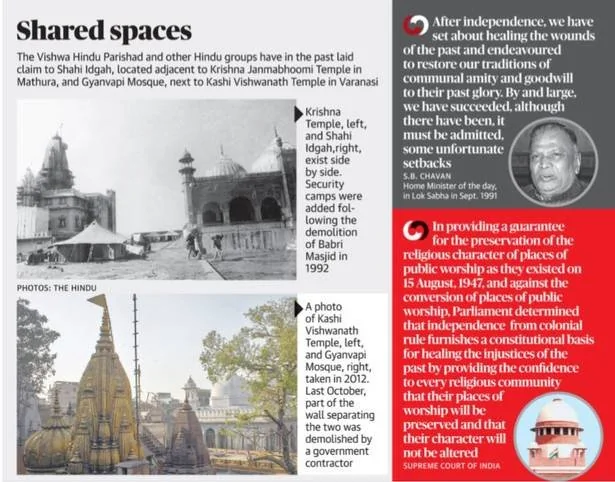
The Issue The Supreme Court, while hearing a plea challenging the maintainability of the Gyanvapi suit in May 2022, noted that the 1991 law does not bar the “finding of the nature of the religious place”. It suggested that the ascertainment of a place’s religious character may not necessarily violate the provisions of Sections 3 and 4 of the Act. However, this ascertainment is limited to the state of affairs in 1947 and does not extend to the period prior to the construction of the mosque.
The Issue
- The Supreme Court, while hearing a plea challenging the maintainability of the Gyanvapi suit in May 2022, noted that the 1991 law does not bar the “finding of the nature of the religious place”.
- It suggested that the ascertainment of a place’s religious character may not necessarily violate the provisions of Sections 3 and 4 of the Act. However, this ascertainment is limited to the state of affairs in 1947 and does not extend to the period prior to the construction of the mosque. This forms the basis for deciding the title of the disputed site.
- The Supreme Court is yet to hear final arguments to determine if the 1991 Act prohibits the filing of a plea regarding the religious character of a place of worship. So far, the court has only made oral observations and has not issued a conclusive ruling.
- A separate constitutional challenge to the 1991 Act is pending in the Supreme Court, which indicated in 2019 that the case could be referred to a larger constitution bench. The Centre, however, has not yet filed a response.
- The Archaeological Survey of India (ASI) report, submitted to the Varanasi court, suggests the existence of a Hindu temple prior to the Gyanvapi mosque. This report is considered expert evidence and can be contested in court.
- The courts will first have to determine the reliability of the ASI report and then interpret what the existence of a Hindu temple implies for the religious character of the mosque as of August 15, 1947.
- A similar ASI report was cited in the Babri Masjid-Ramjanmabhoomi suit. In its November 2019 order, the Supreme Court deemed the ASI report inconclusive.
- The report concluded that the architectural fragments and the nature of the structure indicated a Hindu religious origin, but it did not definitively establish whether a Hindu temple was demolished to construct the mosque. This lack of a specific finding is a significant evidentiary circumstance to consider in the final analysis.
Here are the summarized key takeaways from the ASI report:
1. Destruction of Pre-existing Structure:
- The report suggests that the pre-existing structure was likely destroyed during the reign of Mughal Emperor Aurangzeb in the 17th century.
- An inscription on a loose stone records the construction of the mosque between 1676 and 1677, and its repair in 1792-93. The report notes that lines relating to the mosque’s construction and expansion have been scratched out.
2. Inscriptions Found:
- The survey recorded 34 inscriptions on stones from pre-existing Hindu temples that were reused in the construction/repair of the mosque.
- These inscriptions are in Devanagari, Grantha, Telugu, and Kannada scripts and include names of deities like Janardhana (Vishnu), Rudra (Shiva), and Umesvara. Terms such as Maha-muktimandapa (freedom platform) were found in three inscriptions.
3. Reuse of Temple Parts:
- The survey found that parts of the pre-existing temple, such as pillars and pilasters, were reused for the expansion of the mosque and construction of the sahan (courtyard).
- For instance, Vyala (a Hindu mythological creature) figures carved on either side of a lotus medallion were mutilated and the space was decorated with a floral design after removing the stone mass from the corners.
4. Central Chamber and Main Entrance:
- The pre-existing temple had a large central chamber and additional chambers on all four sides. The central chamber now forms the main hall of the existing structure, with its thick walls, architectural components, and floral decorations.
- Animal figures carved on the lower ends of decorated arches were mutilated, and the inner part of the dome is decorated with geometric designs.
- The main entrance to the central chamber, originally from the west and decorated with carvings of animals, birds, and an ornamental torana, is now blocked by stone masonry.
5. Sculptural Remains in Cellars:
- Pillars from the pre-existing temple were reused to construct cellars in the eastern part of the platform, which were built to accommodate a large number of people for prayers.
- One such pillar, decorated with bells and niches for lamps, bears an inscription from Samvat 1669 (corresponding to January 1, 1613 CE) and is reused in cellar N2. Sculptures of Hindu deities and carved architectural members were found under the dumped soil in one of the cellars, indicating the existence of a large Hindu temple.
Conclusion- The Archaeological Survey of India (ASI) report on the Kashi Vishwanath-Gyanvapi mosque site presents significant findings that could influence the ongoing legal proceedings. However, the Supreme Court has yet to make a final ruling on whether the 1991 Act bars the filing of a plea regarding the religious character of a place of worship.
The court’s decision will be crucial in determining the future of the disputed site. It’s important to note that the ASI report, while informative, is considered expert evidence and can be contested in court. The courts will have to determine the reliability of the report and interpret its findings in the context of the religious character of the mosque as of August 15, 1947.
- Prelims: Key facts, institutions, locations and terminology in the article.
- Mains: Connect the topic with Economy, Polity & Governance.
- Revision: Use the article headings to prepare concise notes and answer-writing points.
Test your understanding
Questions from this article
Prelims practiceWith reference to In Gyanvapi case, the test ahead: Law on places of worship and the challenge it faces, consider the following statements:
- The Supreme Court, while hearing a plea challenging the maintainability of the Gyanvapi suit in May 2022, noted that the 1991 law does not bar the “finding of the nature of the religious place”.
- It suggested that the ascertainment of a place’s religious character may not necessarily violate the provisions of Sections 3 and 4 of the Act. However, this ascertainment is limited to the state of affairs in 1947 and…
- The Supreme Court is yet to hear final arguments to determine if the 1991 Act prohibits the filing of a plea regarding the religious character of a place of worship. So far, the court has only made oral observations and…
Which of the statements given above are correct?
- 1 and 2 only
- 2 and 3 only
- 1 and 3 only
- 1, 2 and 3
View answer
Answer: (d) 1, 2 and 3. All three statements are drawn from the article.
Mains practiceDiscuss the background, key issues and significance of In Gyanvapi case, the test ahead: Law on places of worship and the challenge it faces for India.
Answer in 250 words.
View answer approach
- Background and context
- Key facts and institutional framework
- Significance and way forward
Frequently asked questionsFrequently asked questions
Why is In Gyanvapi Case, The Test Ahead: Law On Places Of Worship And The Challenge It Faces in the news?
The Issue The Supreme Court, while hearing a plea challenging the maintainability of the Gyanvapi suit in May 2022, noted that the 1991 law does not bar the “finding of the nature of the religious place”. It suggested that the ascertainment of a place’s religious character may not necessarily violate the provisions of Sections 3 and 4 of the Act.
What are the key facts about In Gyanvapi Case, The Test Ahead: Law On Places Of Worship And The Challenge It Faces?
However, this ascertainment is limited to the state of affairs in 1947 and does not extend to the period prior to the construction of the mosque. This forms the basis for deciding the title of the disputed site. The Supreme Court is yet to hear final arguments to determine if the 1991 Act prohibits the filing of a plea regarding the religious character of a place of worship.
Why is In Gyanvapi Case, The Test Ahead: Law On Places Of Worship And The Challenge It Faces important for UPSC preparation?
The topic connects current developments with Economy, Polity & Governance and is relevant for both objective revision and analytical answer writing.