Crack the UPSC code with the genuine power of current affairs. Discover why staying updated, connecting news with the UPSC syllabus, understanding real-world issues and applying current affairs can transform your UPSC preparation and improve your performance in both UPSC Prelims and Mains.
Current affairs are an important part of the UPSC Civil Services Examination. While the static subjects generally remain the same, the current affairs syllabus keeps changing. It includes everything from new government policies, Supreme Court judgments, economic and foreign policy developments, environmental issues, scientific and technological innovation, social developments, etc. For a UPSC aspirant, reading current affairs every day is not just about knowing what happened in the country or world. The main purpose is to understand why an issue is important to know; aspirants must connect it with the Latest UPSC CSE Syllabus, analyse its deeper details, and use relevant information in the examination. The UPSC examination tests the awareness and analytical ability of aspirants at different stages. That’s why following a regular daily current affairs routine can help UPSC candidates connect static concepts with current developments. It can also improve their preparation for Prelims, Mains, and the Personality Test, too.
What are Current Affairs in UPSC Preparation?
Current affairs can help you prepare for the latest national and international events, socio-economic developments, government policies, and several other issues. With current affairs, aspirants can relate static topics to dynamic issues. They also improve aspirants’ analytical skills and provide updated facts, figures, and data. Aspirants can use this information for the preparation of the Mains examination. It is an important part of the UPSC syllabus as it helps in scoring well in all three stages of UPSC Prelims, Mains and UPSC Interview exam.
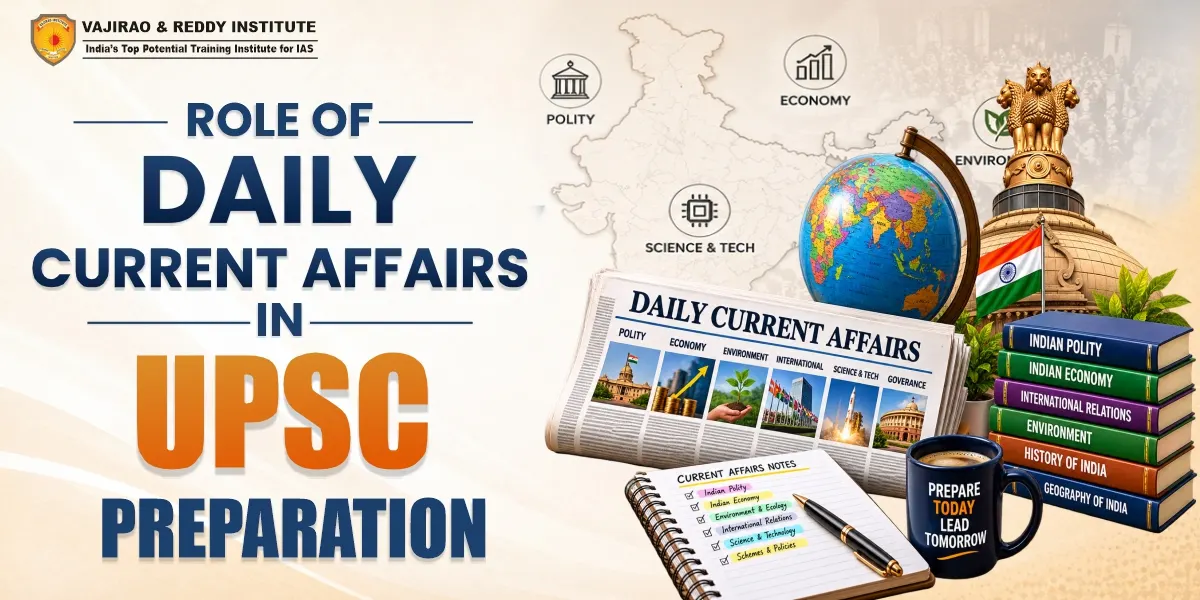
Role of Daily Current Affairs in UPSC Preparation
Current Affairs are one of the most important aspects of the UPSC exam. Candidates must cover all the latest happenings across the world to be able to answer questions related to them. Additionally, Daily Current Affairs also improves your knowledge, analytical skills, and answer-writing ability. Listed below are some reasons for covering Daily Current Affairs in the UPSC Preparation Exam: -
1. Connects Static Subjects with Real-World Events
One of the biggest advantages of following current affairs daily is that it helps aspirants understand how concepts from the syllabus books are used in the real world. For example, if you are studying Fundamental Rights, Parliament, the Indian economy, climate change, or international relations, a current event can provide practical context for the topic.
2. Helps in UPSC Prelims Preparation
To prepare for the UPSC Civil Services Preliminary Examination, build a strong foundation with NCERT textbooks from Classes 6-12. Use standard reference books for static subjects. Analyze the past 5 to 10 years of UPSC Previous Year Question Paper. Also, practice mock tests regularly and follow daily current affairs. Current affairs can play an important role in Prelims preparation. You can find questions in the Prelims related to the latest government schemes, international events, reports, environmental developments, organizations, science and technology, places in the news and other recent issues.
3. Improve UPSC Mains Answer Writing
Write a concise two-line introduction, then organize the main body under analytical subheadings with bullet points that address every part of the question. End with a positive, forward-looking conclusion. Manage time strictly, targeting 7 minutes for a 10-marker and 11 minutes for a 15-marker. Current affairs are important not only for prelims but also very useful in the Mains examination. You need to write answers in the Mains examination using analysis, examples, arguments, data, and contemporary relevance. So, instead of writing only theoretical answers, an aspirant can make an answer stronger by including: -
- Recent examples
- Government initiatives
- Relevant reports and statistics
- Constitutional or legal provisions
- Case studies
- International examples
- Policy challenges
- Practical solutions
4. Supports Preparation Across General Studies (GS) Papers
Aspirants can also find links between daily current affairs and different areas of the UPSC syllabus. This helps aspirants avoid unnecessary news. It also helps them focus on information that can be useful in the examination.
- GS Paper I: Society, geography, culture, history and important social developments.
- GS Paper II: Governance, constitution, welfare schemes, government policies, international relations and judiciary.
- GS Paper III: Economy, agriculture, environment, science and technology, internal security and disaster management.
- GS Paper IV: Ethics, integrity, governance, accountability and contemporary case studies.
5. Strengthens Essay Preparation
When you prepare for current affairs, you find real-world examples that strengthen your UPSC essay paper with answer preparation. These examples give you different views on topics like education, democracy, technology, women empowerment, development, climate change, and artificial intelligence. This makes your essay more relevant, practical, and impactful. Analyzing news regularly also helps aspirants view issues from different perspectives, including political, environmental, social, economic, and ethical dimensions. This approach makes your essay writing more balanced and impactful.
6. Develops Analytical and Critical Thinking
UPSC does not only test whether a candidate remembers an event. It also wants aspirants to understand its causes, consequences, challenges, and possible solutions. This habit gradually develops analytical thinking, which is very important for Mains answer writing and the Personality Test. Current-affairs preparation also helps develop awareness, analytical skills, and informed judgment.
7. Helps in UPSC Interview Preparation
The UPSC Interview checks a candidate’s awareness, judgment, balance of opinion and ability to discuss issues clearly. When you read national and international developments regularly, it can help candidates discuss contemporary issues with greater confidence. For the UPSC interview, aspirants must focus on understanding the issue rather than memorising opinions. They should be able to give balanced views and understand different perspectives.

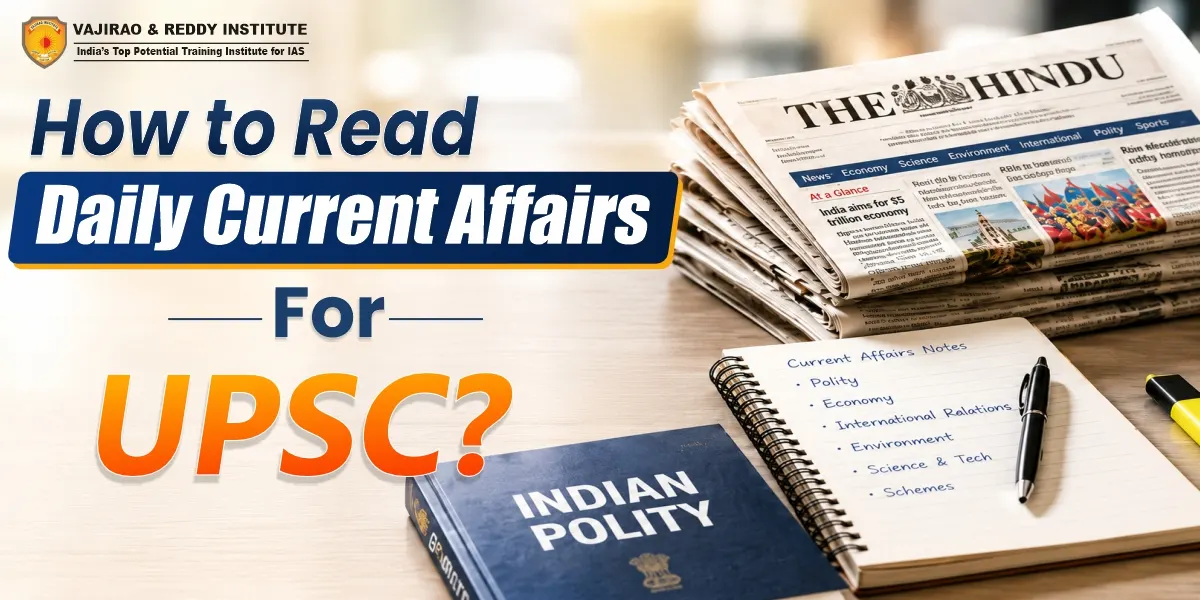
How to Read Daily Current Affairs for UPSC?
When it comes to reading current affairs, should you read every article or just important news related to your UPSC syllabus? Aspirants must understand that every topic in the newspaper can be important but not useful for Prelims, Mains, Essay, and the Personality Test. Let’s find out an easy strategy for reading daily current affairs step by step:
Step 1: Start With Reliable Sources
Aspirants can start their current affairs preparation with a few reliable sources, including Monthly Current Affairs Magazines. Avoid following too many newspapers, websites, or social media platforms. Instead, choose sources that provide accurate, relevant, and exam-oriented information. Focus on important national and international developments, government schemes, reports, and major issues. This approach saves valuable time, improves your understanding, and keeps you away from unnecessary confusion. The most commonly used sources by UPSC aspirants are: -
- The Hindu
- The Indian Express
- PIB
- Yojana
- Kurukshetra
- Government Ministry websites
- Important reports and official documents
- One reliable UPSC current affairs compilation
Step 2: Link Current Affairs with Static Subjects
While reading an important news item, you should always try to connect it with the UPSC CSE syllabus. This easy habit can help you understand the importance of the news for the exam. It also makes your notes more organized and easier to revise later. So, while reading every important piece of news, you must ask:
Which Part of the UPSC Syllabus can you Connect this Topic with? For example: -
- Aspirants can link New environmental regulation to Environment, Governance, and Economy. With this, you can learn about environmental protection, government rules, and industries.
- Supreme Court judgment can be linked to Polity, Governance, and Constitution. You can prepare for constitutional rights, legal rules, or the role of government.
- If you get news related to India’s international agreements, you can link it to International Relations, Security, and Economy. These types of agreements can help you learn more about India’s global relations, trade, investment and national security.
Step 3: Make Short Notes
You don’t need to copy complete newspaper articles to make notes. When using a Newspaper for UPSC, focus only on important facts, key arguments, government initiatives, data, and relevant examples. Write these points in simple and short language. This will make your notes easy to revise and save valuable preparation time. You can make notes using the following points: -
- Background
- Key facts
- Causes
- Significance
- Challenges
- Government initiatives
- Data or examples
- Way forward
Step 4: Revise Regularly
Aspirants need to revise current affairs on a daily basis. Daily revision helps you remember important facts, concepts, and examples for a longer time. This will also reduce the pressure of studying everything again before the examination. Make a simple revision routine to read current affairs daily, weekly, and monthly, and revise them again before Prelims/Mains. This helps you remember important facts and use them in the exam.
How Many Hours Should You Spend on Current Affairs?

There is no fixed number of hours for current affairs preparation. To understand How to Use Newspapers Effectively for the UPSC Mains Exam, aspirants should know the best newspaper for UPSC Mains without spending most of their study time on newspapers. They must balance current affairs with other important subjects. Generally, 1-2 hours daily is enough. During this time, read important news, make short notes, and revise regularly. Avoid reading too many articles. Focus only on relevant and exam-oriented news. Let’s go through this table to understand better:
| Aspirants |
Time Suggestions |
| Beginner |
45-60 minutes |
| Full-time aspirant |
60-90 minutes |
| Working professional |
30-60 minutes |
| Prelims-focused phase |
More time for revision + MCQs |
| Mains-focused phase |
More analysis + answer writing |
What Common Mistakes UPSC Candidates Must Avoid?
Remember, reading current affairs can become difficult if you use too many sources or do not revise properly. So, you must avoid a few common mistakes to save time, reduce confusion, and focus on important topics for Prelims, Mains, Essay, and Interview preparation.
- Don’t Read too Many Sources: Reading five or six newspapers and many current-affairs websites can confuse you and give you too much information. Aspirants can focus on a few reliable sources and important topics. Otherwise, it can also waste your valuable study time.
- Don’t Make Lengthy Notes: Keep your notes short, simple, and exam-oriented because long notes are difficult to read and revise. Write only the important facts, examples, and points.
- Ignoring Static Subjects: Current affairs can only help you understand your basic subjects. So, don’t depend on current affairs completely and give enough time to standard books and important topics, too.
- Reading Without Revision: Reading current affairs once is not enough. Without regular revision, you will forget much of the information. So, revise your notes weekly and monthly.
- Memorizing Facts Without Understanding: UPSC aspirants must understand concepts and think deeply, not just memories facts. Try to understand the issue, why it is important to discuss, and how it affects other topics.
- Don’t Collect News Without Linking to the Syllabus: Remember, everything is not relevant to UPSC. Always think whether the information is related to Prelims, Mains, Essay or Interview preparation. This will help you avoid reading irrelevant news.
Conclusion
Reading daily current affairs for UPSC preparation is not only to be aware of the latest news, but it also helps aspirants to connect static knowledge with real-world problems. It also helps write better Mains answers, prepares for Prelims, and builds different perspectives for the Interview. So, every UPSC candidate just has to follow an easy but regular plan using authorized sources for current affairs. Read only syllabus-related topics and make short notes, connecting them to static subjects. So, daily current affairs should be a regular part of preparation, not an additional burden for UPSC aspirants.
Frequently asked questionsFrequently asked questions
Is daily Current Affairs necessary for UPSC Preparation?
Yes, daily current affairs are necessary for UPSC preparation. With the help of current affairs, you understand recent problems and connect them with static subjects. So, current affairs help in preparing for Prelims, Mains, Essay, and Interview.
How much Current Affairs should I study daily for UPSC?
1-2 hours is usually enough for UPSC candidates to study current affairs daily. While reading current affairs, they just need to focus on important news, make short notes, and connect it with the syllabus.
Which Sources are best for UPSC Current Affairs?
Generally, the best UPSC current affairs sources that are most popular are The Hindu or The Indian Express, PIB and one trusted monthly current affairs magazine. You just need to choose limited sources and revise them regularly.
Should I make Notes from Daily Current affairs?
Yes, you should make short notes on daily current affairs. Remember to focus on important facts and syllabus-related topics only. With easy and short notes, you can revise them quickly and effectively for Prelims and Mains preparation.
Are Current Affairs important for UPSC Mains?
Yes, current affairs are very useful for UPSC Mains preparation. They help you connect static subjects with real-world issues and add examples, facts and different viewpoints to your answers.
How should beginners Start Current Affairs Preparation?
It’s very important for beginners to start with one reliable newspaper and one monthly current affairs source. They should read only UPSC syllabus related news, make short notes, connect topics with static subjects and revise regularly.