Indian Meteorological Department (IMD) issued a
red alert for heatwaves in
Delhi, Punjab, Haryana, and most parts of Western Rajasthan for Sunday (May 19).
The agency also said that
heatwaves and severe heatwave conditions will likely
prevail here for five days beginning Sunday.
Delhi, Chandigarh and other major cities in these states have recently witnessed temperatures
around and over 44°C.
WHAT IS A HEATWAVE?
According to the IMD’s website,
- Qualitatively, heat wave is a condition of air temperature which becomes fatal to human body when exposed.
- Quantitatively, it is defined based on the temperature thresholds over a region in terms of actual temperature or its departure from normal.
Therefore, for every region, a heatwave is determined based on the degree of difference from its usual temperatures.
QUANTITATIVE HEATWAVE
Heat wave is considered if
- Maximum temperature of a station reaches at least 40°C or more for
- At least 30°C or more for Hilly regions.
- For coastal areas, it is when the maximum temperature departure is 37°C or more than normal.
The
temperature deviance of
4.5°C to 6.4°C more than normal is classified as a heatwave.
Such temperatures must be recorded
at least in two stations in a meteorological subdivision for
at least two consecutive days.
The heatwave is declared on the second day.
WHAT IS A SEVERE HEATWAVE?
If the prevalent temperature is
4.5°C to 6.4°C more than normal, it is classified
as a heatwave.
A
rise of more than 6.4°C is considered
a severe heatwave.
May is the peak month for heatwaves in India.
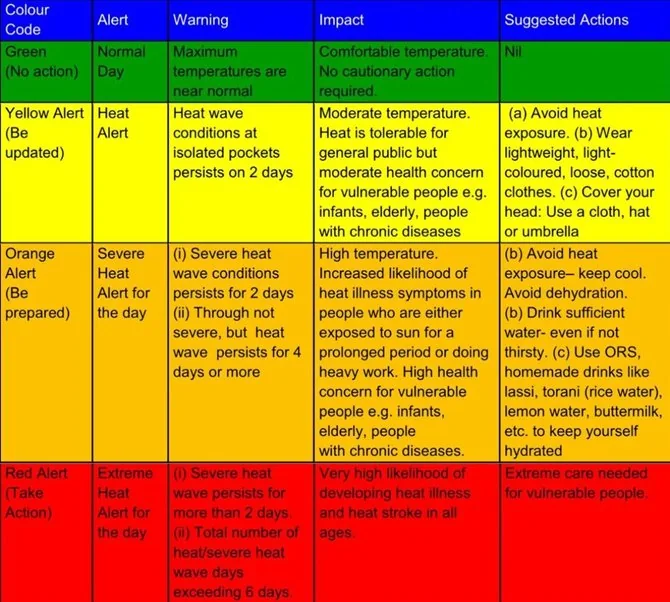
WHAT IS RED ALERT?
A
red alert refers to
an extreme heat warning.
It means that
a severe heatwave has persisted for more than two days or
the total number of heat/severe heatwave days has been more than six days.
WHAT CAN BE ITS IMPACT?
There is a
“very high likelihood of developing heat illness and heat stroke in all ages,” according to IMD. Extreme care needs to be exercised for vulnerable people, such as the
elderly, infants and those with chronic diseases.
 WHAT MEASURES CAN BE TAKEN?
According to the
National Disaster Management Authority (NDMA), the following measures can be taken to minimise heat wave impact:
- Avoid going out in the Sun, especially between noon and 3 pm.
- If you work outside, use a hat or an umbrella and apply a damp cloth on your head, neck, face and limbs.
- Drink sufficient water as often as possible, even if not thirsty.
- Wear lightweight, light-coloured, loose, and porous cotton clothes. Wear protective goggles, an umbrella/hat, shoes or chappals while going in the Sun.
- Avoid alcohol, tea, coffee and carbonated soft drinks, which dehydrate the body. Drink ORS, homemade drinks like lassi, torani (rice water), lemon water, buttermilk, Instead.
WHAT ACTION TO BE TAKEN IN CASE OF HEATSTROKE?
In case a person has been affected by sunstroke, this is what they should do:
- Lay the person in a cool place, under shade. Wipe them with a wet cloth/wash the body frequently. Pour normal-temperature water on the head. The main aim is to bring down the body temperature.
- Give the person ORS/lemon sharbat/torani or other liquids useful for hydrating the body.
- Take the person to the nearest health centre immediately. Medical attention is needed as heat strokes can be fatal.
Test your understanding
Questions from this article
Prelims practiceWith reference to IMD Heat Wave Alert For North India, consider the following statements:
- Qualitatively, heat wave is a condition of air temperature which becomes fatal to human body when exposed.
- Quantitatively, it is defined based on the temperature thresholds over a region in terms of actual temperature or its departure from normal.
- Maximum temperature of a station reaches at least 40°C or more for
Which of the statements given above are correct?
- 1 and 2 only
- 2 and 3 only
- 1 and 3 only
- 1, 2 and 3
View answer
Answer: (d) 1, 2 and 3. All three statements are drawn from the article.
Mains practiceDiscuss the background, key issues and significance of IMD Heat Wave Alert For North India for India.
Answer in 250 words.
View answer approach
- Background and context
- Key facts and institutional framework
- Significance and way forward
Frequently asked questionsFrequently asked questions
Why is Imd Heat Wave Alert For North India in the news?
Indian Meteorological Department (IMD) issued a red alert for heatwaves in Delhi, Punjab, Haryana, and most parts of Western Rajasthan for Sunday (May 19). The agency also said that heatwaves and severe heatwave conditions will likely prevail here for five days beginning Sunday.
What are the key facts about Imd Heat Wave Alert For North India?
Delhi, Chandigarh and other major cities in these states have recently witnessed temperatures around and over 44°C. According to the IMD’s website, Qualitatively, heat wave is a condition of air temperature which becomes fatal to human body when exposed. Quantitatively, it is defined based on the temperature thresholds over a region in terms of actual temperature or its departure from normal.
Why is Imd Heat Wave Alert For North India important for UPSC preparation?
The topic connects current developments with Defence, Polity & Governance, Health and is relevant for both objective revision and analytical answer writing.