UPSC Current Affairs
How the legal debate over sub-categorisation among SCs has evolved over the years
The beginning In 1975, the Punjab government divided its 25% SC reservation into two categories. The first category was reserved for the Balmiki and Mazhbi Sikh communities, considered the most economically and educationally backward. The second category included the rest of the SC communities.
VRAuthor Desk
3 min read
The beginning In 1975, the Punjab government divided its 25% SC reservation into two categories. The first category was reserved for the Balmiki and Mazhbi Sikh communities, considered the most economically and educationally backward. The second category included the rest of the SC communities.
The beginning
- In 1975, the Punjab government divided its 25% SC reservation into two categories. The first category was reserved for the Balmiki and Mazhbi Sikh communities, considered the most economically and educationally backward.
- The second category included the rest of the SC communities. This was one of the first instances of ‘sub-classification’ of reservations.
- However, in 2004, a similar law introduced by Andhra Pradesh was struck down by the Supreme Court in ‘E.V. Chinnaiah v State of Andhra Pradesh’. The court ruled that sub-classification violated the right to equality, as the SC list must be treated as a single, homogenous group.
- The court also highlighted Article 341 of the Constitution, which gives the President the power to create a list of SC communities for reservation, implying that states did not have the power to interfere with this list.
- Following the Supreme Court ruling, the Punjab & Haryana High Court struck down the 1975 notification in ‘Dr. Kishan Pal v. State of Punjab’ two years later.
The appeal
- In October 2006, four months after the Punjab & Haryana High Court invalidated the notification, the Punjab government passed the Punjab Scheduled Caste and Backward Classes (Reservation in Services) Act, 2006.
- This Act reinstated the first preference in reservations for the Balmiki and Mazhbi Sikh communities. However, in 2010, the High Court struck down this provision again. The Punjab government appealed to the Supreme Court, arguing that the 2004 ruling that the Scheduled Caste quota cannot be sub-classified was incorrect.
- In 2014, the Supreme Court, in ‘Davinder Singh v State of Punjab’, referred the appeal to a five-judge constitution bench to reconsider the 2004 E V Chinnaiah decision, as it involved the interpretation of several constitutional provisions.
Reconsidering the E V Chinnaiah ruling
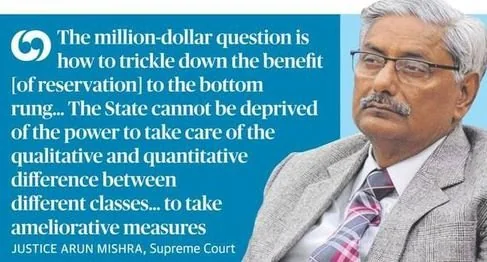
- In 2020, a constitution bench led by Justice Arun Mishra ruled that the court’s 2004 decision in E V Chinnaiah needed reconsideration.
- The ruling disagreed with the idea that Scheduled Castes are a homogeneous group, acknowledging inequalities within the list of Scheduled Castes, Scheduled Tribes, and socially and educationally backward classes.
- Since the E V Chinnaiah decision, the concept of a “creamy layer” has been applied to SC reservations. This concept, upheld by the Supreme Court in the 2018 ‘Jarnail Singh v Lachhmi Narain Gupta’ ruling, sets an income ceiling for those eligible for reservations. It was applied to promotions of SCs for the first time in 2018.
- States argue that sub-classification is essentially an application of the creamy layer formula, giving preferential treatment to the most disadvantaged castes instead of excluding better-off castes from the Scheduled Caste list.
- As the Davinder Singh bench was also composed of five judges (like E V Chinnaiah), a larger seven-judge bench is now hearing the issue, as only a larger bench’s judgement can overrule the decision of a smaller bench.
- The sub-classification strategy will impact not only Balmikis and Mazhabi Sikhs in Punjab and Madiga in Andhra Pradesh, but also Paswans in Bihar, Jatavs in UP, and Arundhatiyars in TamilNadu.
- Prelims: Key facts, institutions, locations and terminology in the article.
- Mains: Connect the topic with Economy, Polity & Governance.
- Revision: Use the article headings to prepare concise notes and answer-writing points.
Test your understanding
Questions from this article
Prelims practiceWith reference to How the legal debate over sub-categorisation among SCs has evolved over the years, consider the following statements:
- In 1975, the Punjab government divided its 25% SC reservation into two categories. The first category was reserved for the Balmiki and Mazhbi Sikh communities, considered the most economically and educationally backward.
- The second category included the rest of the SC communities. This was one of the first instances of ‘sub-classification’ of reservations.
- However, in 2004, a similar law introduced by Andhra Pradesh was struck down by the Supreme Court in ‘E.V. Chinnaiah v State of Andhra Pradesh’. The court ruled that sub-classification violated the right to equality, as…
Which of the statements given above are correct?
- 1 and 2 only
- 2 and 3 only
- 1 and 3 only
- 1, 2 and 3
View answer
Answer: (d) 1, 2 and 3. All three statements are drawn from the article.
Mains practiceDiscuss the background, key issues and significance of How the legal debate over sub-categorisation among SCs has evolved over the years for India.
Answer in 250 words.
View answer approach
- Background and context
- Key facts and institutional framework
- Significance and way forward
Frequently asked questionsFrequently asked questions
Why is How The Legal Debate Over Sub-Categorisation Among Scs Has Evolved Over The Years in the news?
The beginning In 1975, the Punjab government divided its 25% SC reservation into two categories. The first category was reserved for the Balmiki and Mazhbi Sikh communities, considered the most economically and educationally backward.
What are the key facts about How The Legal Debate Over Sub-Categorisation Among Scs Has Evolved Over The Years?
The second category included the rest of the SC communities. This was one of the first instances of ‘sub-classification’ of reservations. However, in 2004, a similar law introduced by Andhra Pradesh was struck down by the Supreme Court in ‘E.V.
Why is How The Legal Debate Over Sub-Categorisation Among Scs Has Evolved Over The Years important for UPSC preparation?
The topic connects current developments with Economy, Polity & Governance and is relevant for both objective revision and analytical answer writing.