UPSC Current Affairs
How school teachers are faring in India on salary, qualifications and more: 5 broad takeaways
The SOTTTER 23 survey was conducted in eight states, covering 422 schools, 3,615 teachers, 422 headmasters, 68 teacher-education institutions, 1,481 student-teachers in B.Ed and D.El.Ed programmes, and 268 teacher educators. The report also utilized data from the UDISE+ 2021-22, Periodic Labour Force Survey 2021-22, Teacher Eligibility Test (TET), and other research papers. Sub-standard qualifications The report reveals that while 90% of teachers have some form of professional certification, only 46% of primary school teachers possess the necessary Diploma in Elementary Education (D.El.Ed).
VRAuthor Desk
5 min read
The SOTTTER 23 survey was conducted in eight states, covering 422 schools, 3,615 teachers, 422 headmasters, 68 teacher-education institutions, 1,481 student-teachers in B.Ed and D.El.Ed programmes, and 268 teacher educators. The report also utilized data from the UDISE+ 2021-22, Periodic Labour Force Survey 2021-22, Teacher Eligibility Test (TET), and other research papers. Sub-standard qualifications The report reveals that while 90% of teachers have some form of professional certification, only 46% of primary school teachers possess the necessary Diploma in Elementary Education (D.El.Ed).
The SOTTTER 23 survey was conducted in eight states, covering 422 schools, 3,615 teachers, 422 headmasters, 68 teacher-education institutions, 1,481 student-teachers in B.Ed and D.El.Ed programmes, and 268 teacher educators. The report also utilized data from the UDISE+ 2021-22, Periodic Labour Force Survey 2021-22, Teacher Eligibility Test (TET), and other research papers.
Here are 5 key takeaways.
- Sub-standard qualifications
- The report reveals that while 90% of teachers have some form of professional certification, only 46% of primary school teachers possess the necessary Diploma in Elementary Education (D.El.Ed).
- A significant proportion of these certified teachers scored only 40-50% in the qualifying exam, and just 32% with D.El.Ed qualifications passed the Teacher Eligibility Test (TET). Only about 15% of TET-qualified teachers scored higher than 60% in the primary teachers’ qualification exam.
- The report also highlights a low level of subject knowledge in mathematics among primary teachers, with mean scores in the TET mathematics component as low as 46%.
- Additionally, it showed low competency levels in regional languages among primary school teachers, a concern given the government’s push for regional language instruction in its National Education Policy 2020.
- Private sector’s pros and cons
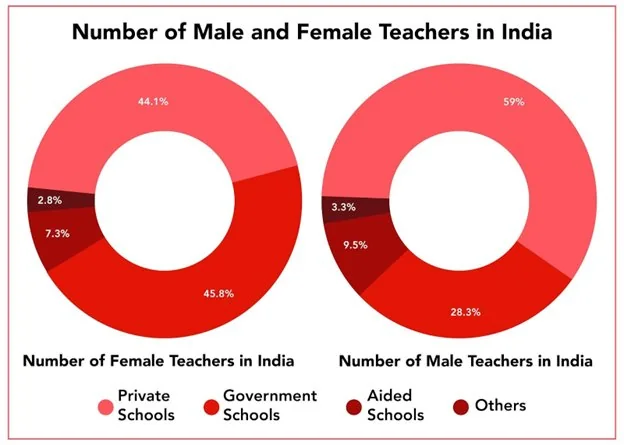
- The report indicates that in many states, the private sector employs 40% or more of the teaching workforce. These schools typically have superior facilities and support from clerical and non-teaching personnel compared to government schools, with 76% of private schools having facilities like libraries, computer labs, and internet access, compared to only 38% in government schools.
- However, the pay and working conditions in these schools are poor. This data is particularly relevant in light of the Centre’s ambitious ‘One Nation, One Student ID’ initiative planned for implementation by 2026-27, which aims to digitally consolidate all academic records into a single Automated Permanent Academic Account Registry (APAAR) ID.
- Working without contract
- The report notes that poor employment terms in the private sector and irregular recruitment in the government sector negatively impact the appeal of the teaching profession. According to the PLFS 2021-22, over 50% of teachers in private or non-government schools work without written contracts.
- This percentage is higher among younger female teachers, especially in early childhood care and education (ECCE). A significant proportion of women in the private sector, 50% in primary and 64% in secondary schools, work without written contracts.
- These teachers, without legally binding work agreements, receive the lowest salaries in both sectors, often less than half of what a teacher with a three-year contract earns.
- For example, an ECCE teacher earns Rs 7,665, about a third lower than the Rs 11,394 salary of government teachers. On average, primary level teachers earn only Rs 11,086, which is 65% lower than the Rs 31,225 salary of government teachers.
- More women than men in teaching
- The report indicates a skew in the teaching workforce, with older teachers in government schools and younger teachers in private schools. The data suggests a 6 to 8-year age difference, indicating that most teachers start in private schools post-qualification, shifting to government schools when recruitments occur.
- The wait time between professional qualification and securing a government job is estimated to be 5 to 7 years. The report also highlights a trend of more young women entering the profession, with the median age of women in teaching being three to four years less than men.
- This feminisation of the workforce is evident with 62% of secondary school teachers and 73% of primary school teachers aged 20-24 being women. However, there are more male than female teachers in the age group of 45 years and older.
- Abysmal student-teacher ratio and other teacher concerns
- The Right of Children to Free and Compulsory Education Act, 2009 mandates a student-teacher ratio of 30:1 for Classes 1 to 5, and 35:1 for Classes 6 to 8. However, the report reveals that about 38% of government school teachers teach different grades simultaneously in the same classroom.
- Government school teachers also face declining student attendance and have an average of seven substitution periods per week, compared to five for private school teachers. Regarding administrative duties, nearly 40% of government teachers, compared to 18-20% of private school teachers, reported a high workload that diverts attention from educational roles.
- The daily workload for government school teachers includes data maintenance, assisting with mid-day meals, among other tasks. Additionally, 41% of government schools reported a high proportion of unsupportive parents.
Conclusion- The report by the Tata Institute of Social Sciences (TISS) provides a comprehensive analysis of the current state of teachers, teaching, and teacher education in India. It highlights several key issues, including the lack of necessary professional qualifications among a significant proportion of teachers, poor employment terms in the private sector, and the burden of administrative responsibilities on government school teachers.
These findings underscore the need for systemic changes in teacher recruitment, training, and working conditions to improve the quality of education in India. The report serves as a valuable resource for policymakers, educators, and stakeholders in their efforts to ensure the right teacher for every child, as mandated by the Right of Children to Free and Compulsory Education Act, 2009.
- Prelims: Key facts, institutions, locations and terminology in the article.
- Mains: Connect the topic with International Relations, Polity & Governance, Science & Technology.
- Revision: Use the article headings to prepare concise notes and answer-writing points.
Test your understanding
Questions from this article
Prelims practiceWith reference to How school teachers are faring in India on salary, qualifications and more: 5 broad takeaways, consider the following statements:
- Sub-standard qualifications
- The report reveals that while 90% of teachers have some form of professional certification, only 46% of primary school teachers possess the necessary Diploma in Elementary Education (D.El.Ed).
- A significant proportion of these certified teachers scored only 40-50% in the qualifying exam, and just 32% with D.El.Ed qualifications passed the Teacher Eligibility Test (TET). Only about 15% of TET-qualified teachers…
Which of the statements given above are correct?
- 1 and 2 only
- 2 and 3 only
- 1 and 3 only
- 1, 2 and 3
View answer
Answer: (d) 1, 2 and 3. All three statements are drawn from the article.
Mains practiceDiscuss the background, key issues and significance of How school teachers are faring in India on salary, qualifications and more: 5 broad takeaways for India.
Answer in 250 words.
View answer approach
- Background and context
- Key facts and institutional framework
- Significance and way forward
Frequently asked questionsFrequently asked questions
Why is How School Teachers Are Faring In India On Salary, Qualifications And More: 5 Broad Takeaways in the news?
The SOTTTER 23 survey was conducted in eight states, covering 422 schools, 3,615 teachers, 422 headmasters, 68 teacher-education institutions, 1,481 student-teachers in B.Ed and D.El.Ed programmes, and 268 teacher educators. The report also utilized data from the UDISE+ 2021-22, Periodic Labour Force Survey 2021-22, Teacher Eligibility Test (TET), and other research papers.
What are the key facts about How School Teachers Are Faring In India On Salary, Qualifications And More: 5 Broad Takeaways?
Sub-standard qualifications The report reveals that while 90% of teachers have some form of professional certification, only 46% of primary school teachers possess the necessary Diploma in Elementary Education (D.El.Ed). A significant proportion of these certified teachers scored only 40-50% in the qualifying exam, and just 32% with D.El.Ed qualifications passed the Teacher Eligibility Test (TET). Only about 15% of TET-qualified teachers scored higher than 60% in the primary teachers’ qualification exam.
Why is How School Teachers Are Faring In India On Salary, Qualifications And More: 5 Broad Takeaways important for UPSC preparation?
The topic connects current developments with International Relations, Polity & Governance, Science & Technology and is relevant for both objective revision and analytical answer writing.