UPSC Current Affairs
Haryana’s private sector quota
Context: The Punjab and Haryana High Court on Friday (November 17) quashed a law passed by the Haryana government in 2020 that provided 75% reservation in private jobs to residents of the state. The HC noted that a government cannot discriminate against individuals simply because they do not belong to that state. It held that the Haryana State Employment of Local Candidates Act, 2020, to be violative of Part III of the Constitution, which contains fundamental rights.
VRAuthor Desk
4 min read
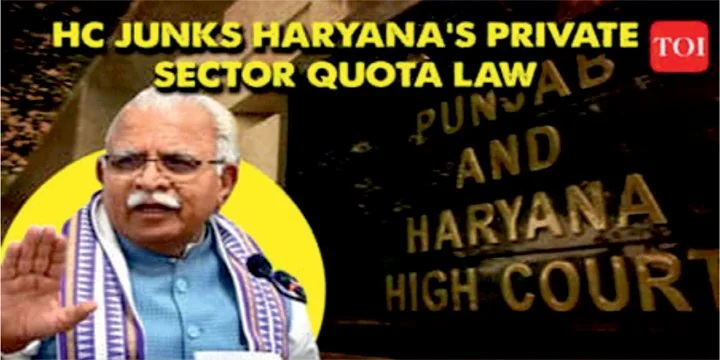
Context: The Punjab and Haryana High Court on Friday (November 17) quashed a law passed by the Haryana government in 2020 that provided 75% reservation in private jobs to residents of the state. The HC noted that a government cannot discriminate against individuals simply because they do not belong to that state. It held that the Haryana State Employment of Local Candidates Act, 2020, to be violative of Part III of the Constitution, which contains fundamental rights.
Context:
- The Punjab and Haryana High Court on Friday (November 17) quashed a law passed by the Haryana government in 2020 that provided 75% reservation in private jobs to residents of the state.
- The HC noted that a government cannot discriminate against individuals simply because they do not belong to that state.
- It held that the Haryana State Employment of Local Candidates Act, 2020, to be violative of Part III of the Constitution, which contains fundamental rights.
What was this law?
- The Bill passed by the Haryana Assembly in November 2020 reserved 75% of jobs in the private sector that offered a monthly salary of less than Rs 30,000 (originally Rs 50,000) for residents of Haryana.
- The Bill received the Governor’s assent on March 2, 2021, and came into effect on January 15, 2022.
- Earlier, in November 2019, the Andhra Pradesh Assembly had passed The Andhra Pradesh Employment of Local Candidates in the Industries/Factories Bill, 2019, reserving three-fourths of jobs for local candidates within three years of the commencement of the Act.
- The law was challenged in the Andhra Pradesh High Court, which observed that “it may be unconstitutional”.
- However, the challenge is yet to be heard on merits.
Who challenged the law and on what grounds?
- The Faridabad Industries Association and other Haryana-based associations went to court.
- They contended that Haryana wanted to create reservations in the private sector by introducing a policy of “sons of the soil”, which was an infringement of the constitutional rights of employers.
- The petitioners argued that private sector jobs are purely based on skills and an analytical bent of mind, and employees have a fundamental right to work in any part of India.
- Therefore, they argued, “The act of the respondent (government) forcing the employers to employ local candidates in private sector vide this impugned Act is the violation of the federal structure framed by the Constitution of India.
- The Haryana government argued that it had the power to create such reservations under Article 16(4) of the Constitution.
- It says that the right to equality in public employment does not prevent the State from “making any provision for the reservation of appointments or posts in favour of any backward class of citizens which, in the opinion of the State, is not adequately represented in the services under the State”.
What else was there in the Haryana law?
- All companies, societies, trusts, limited liability partnership firms, partnership firms, and large individual employers were covered under the Act.
- Any person employing 10 or more people on salary, wages, or other remuneration for manufacturing or providing any service, as well as any entity that may be notified by the government, were included.
- However, central or state governments or organisations owned by them were kept outside the ambit of the Act.
- According to the law, a candidate “domiciled in State of Haryana”, called a “local candidate”, could avail of the reservation after registering themselves on a designated online portal. Employers were required to make recruitments only through this portal.
- Employers could apply for an exemption under the Act, but that entailed a long procedure and required government-appointed officers to believe that the employer’s exemption request held merit.
- Employers could apply for an exemption under the Act, but that entailed a long procedure and required government-appointed officers to believe that the employer’s exemption request held merit.
- Also, the court said, the state “cannot as such discriminate against the individuals on account of the fact that they do not belong to a certain State”.
The way ahead:
- The HC had stayed this law in an interim order earlier on February 3, 2022, but the Supreme Court had, shortly afterward, set aside the stay.
- An SC Bench headed by Justice L Nageswara Rao had said the HC “has not given sufficient reasons for staying the legislation”.
- The SC had directed the HC to decide the validity of the Act within four weeks.
Syllabus: Mains; GS II – Governance
SOURCE: INDIAN EXPRESS
- Prelims: Key facts, institutions, locations and terminology in the article.
- Mains: Connect the topic with Polity & Governance.
- Revision: Use the article headings to prepare concise notes and answer-writing points.
Test your understanding
Questions from this article
Prelims practiceWith reference to Haryana’s private sector quota, consider the following statements:
- The Punjab and Haryana High Court on Friday (November 17) quashed a law passed by the Haryana government in 2020 that provided 75% reservation in private jobs to residents of the state.
- The HC noted that a government cannot discriminate against individuals simply because they do not belong to that state.
- It held that the Haryana State Employment of Local Candidates Act, 2020, to be violative of Part III of the Constitution, which contains fundamental rights.
Which of the statements given above are correct?
- 1 and 2 only
- 2 and 3 only
- 1 and 3 only
- 1, 2 and 3
View answer
Answer: (d) 1, 2 and 3. All three statements are drawn from the article.
Mains practiceDiscuss the background, key issues and significance of Haryana’s private sector quota for India.
Answer in 250 words.
View answer approach
- Context:
- What was this law?
- Who challenged the law and on what grounds?
- What else was there in the Haryana law?
- The way ahead:
Frequently asked questionsFrequently asked questions
Why is Haryana’S Private Sector Quota in the news?
Context: The Punjab and Haryana High Court on Friday (November 17) quashed a law passed by the Haryana government in 2020 that provided 75% reservation in private jobs to residents of the state. The HC noted that a government cannot discriminate against individuals simply because they do not belong to that state.
What are the key facts about Haryana’S Private Sector Quota?
It held that the Haryana State Employment of Local Candidates Act, 2020, to be violative of Part III of the Constitution, which contains fundamental rights. The Bill passed by the Haryana Assembly in November 2020 reserved 75% of jobs in the private sector that offered a monthly salary of less than Rs 30,000 (originally Rs 50,000) for residents of Haryana. The Bill received the Governor’s assent on March 2, 2021, and came into effect on January 15, 2022.
Why is Haryana’S Private Sector Quota important for UPSC preparation?
The topic connects current developments with Polity & Governance and is relevant for both objective revision and analytical answer writing.