UPSC Current Affairs
Haryana’s employment reservation law
Context: The Punjab and Haryana High Court on November 17 quashed a law enacted by the Haryana government in 2021 that guaranteed 75% reservation to locals in private sector jobs in Haryana. Sandhawalia and Harpreet Kaur Jeewan ruled that the Haryana State Employment of Local Candidates Act, 2020, was unconstitutional and violated fundamental rights. In November 2020, the Haryana Assembly passed the Haryana State Employment of Local Candidates Bill.
VRAuthor Desk
5 min read
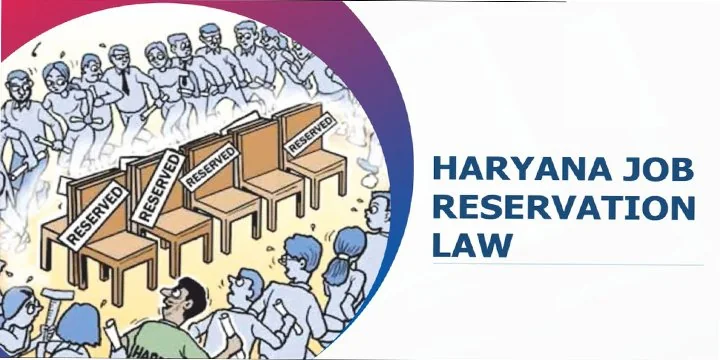
Context: The Punjab and Haryana High Court on November 17 quashed a law enacted by the Haryana government in 2021 that guaranteed 75% reservation to locals in private sector jobs in Haryana. Sandhawalia and Harpreet Kaur Jeewan ruled that the Haryana State Employment of Local Candidates Act, 2020, was unconstitutional and violated fundamental rights. In November 2020, the Haryana Assembly passed the Haryana State Employment of Local Candidates Bill.
Context:
- The Punjab and Haryana High Court on November 17 quashed a law enacted by the Haryana government in 2021 that guaranteed 75% reservation to locals in private sector jobs in Haryana.
- A division bench of Justices G. S. Sandhawalia and Harpreet Kaur Jeewan ruled that the Haryana State Employment of Local Candidates Act, 2020, was unconstitutional and violated fundamental rights.
What does the reservation law say?
- In November 2020, the Haryana Assembly passed the Haryana State Employment of Local Candidates Bill.
- The bill made it mandatory for employers in the State to reserve 75% of jobs paying a monthly salary of less than ₹30,000 (originally ₹50,000) for local residents of the State. The Bill received the Governor’s assent on March 2, 2021, and came into effect in January last year.
- The law is applicable to all private entities in the State including companies, trusts, societies, partnerships, and limited liability partnerships.
- It also covers any person employing 10 or more persons for the purpose of manufacturing or providing any service.
Who is a local candidate under the act?
- A ‘local candidate’ has been defined under the law as anyone domiciled in Haryana for the past five years.
- Such candidates will have to mandatorily register themselves on a designated portal in order to avail benefits and employers have to make recruitments only through this portal.
- Companies can seek an exemption if they do not find local candidates of a desired skill or qualification, but this claim can be rejected by government officials if they doubt its legitimacy.
- Employers found to be violating the Act are liable to a fine between ₹10,000 and ₹2 lakh.
Why was the law challenged?
- Several industry associations challenged the validity of the law on the ground that it violates Article 19 of the Constitution.
- It guarantees the right to freedom, including to reside and settle in any part of the Indian territory and practise any profession, business or trade.
- They also contended that the law was an infringement of Article 14 (equality before the law) and Article 15, which prohibits discrimination on various grounds such as religion, race, caste, sex or place of birth.
- The court was also apprised that the reservation creates a wedge between persons domiciled in different States and is contrary to the concept of common citizenship envisaged in the Constitution.
How has the State defended it?
- The State government contended that the law intends to ‘protect the right to livelihood of people domiciled in the State’, and that the enactment was rooted in the rising unemployment in Haryana.
- It was also asserted that the government is empowered to create such reservations under Article 16(4) of the Constitution.
- It stipulates that the right to equality in public employment does not prevent the State from ‘making any provision for the reservation of appointments or posts in favour of any backward class of citizens which, in the opinion of the State, is not adequately represented in the services under the State’.
Have other States enacted such laws?
- States such as Maharashtra, Karnataka, Andhra Pradesh and Madhya Pradesh have enacted laws providing reservations for their local residents in the private sector.
- In November 2019, the Andhra Pradesh Assembly passed the Andhra Pradesh Employment of Local Candidates in the Industries/Factories Bill, 2019, reserving threefourths of jobs for local candidates within three years of the commencement of the Act.
- The law was subsequently challenged in the Andhra Pradesh High Court, which opined that ‘it may be unconstitutional’. However, the challenge is yet to be heard on its merits.
Has the Supreme Court intervened?
- On February 3, 2022, the High Court passed an interim order staying the law following which a division Bench of the Supreme Court bench set it aside on the ground that the High Court had not provided ‘sufficient reasons’ for putting the law on hold.
- The High Court was ordered to expeditiously decide the petition and the Haryana government was also directed to not take any coercive steps against companies for noncompliance until the matter is finally decided upon.
Why did the High Court quash it?
- The court ruled that the law was unconstitutional to the extent that ‘a person’s right to carry on occupation, trade, or business’ under Article 19(1)(g) of the Constitution was being impaired.
- It also highlighted that the law discriminates against individuals who do not belong to a certain State by ‘putting up artificial walls throughout the country’.
- Placing reliance on Article 35 of the Constitution, the court outlined that the provision bars the State legislature from legislating on matters that fall within the purview of Article 16(3) of the Constitution (equality of opportunity in matters of public employment) since only the Parliament can pass laws on such subjects.
- Referring to Section 6 of the Act which requires employers to submit quarterly reports with details of local candidates employed and Section 8, under which officers could call for documents to ensure the law was being implemented, the court said that these restrictions amounted to ‘Inspector Raj’ that furthered State control over private employers.
Way forward:
- State governments should allow the reservation system to fulfill the original, intended and legitimate purpose of making India a fairer society and not a political tool to serve as the vote bank.
Syllabus: MAINS; GS II – Polity and Governance
SOURCE: THE HINDU
- Prelims: Key facts, institutions, locations and terminology in the article.
- Mains: Connect the topic with Economy, Polity & Governance.
- Revision: Use the article headings to prepare concise notes and answer-writing points.
Test your understanding
Questions from this article
Prelims practiceWith reference to Haryana’s employment reservation law, consider the following statements:
- The Punjab and Haryana High Court on November 17 quashed a law enacted by the Haryana government in 2021 that guaranteed 75% reservation to locals in private sector jobs in Haryana.
- A division bench of Justices G. S. Sandhawalia and Harpreet Kaur Jeewan ruled that the Haryana State Employment of Local Candidates Act, 2020, was unconstitutional and violated fundamental rights.
- In November 2020, the Haryana Assembly passed the Haryana State Employment of Local Candidates Bill.
Which of the statements given above are correct?
- 1 and 2 only
- 2 and 3 only
- 1 and 3 only
- 1, 2 and 3
View answer
Answer: (d) 1, 2 and 3. All three statements are drawn from the article.
Mains practiceDiscuss the background, key issues and significance of Haryana’s employment reservation law for India.
Answer in 250 words.
View answer approach
- Context:
- What does the reservation law say?
- Who is a local candidate under the act?
- Why was the law challenged?
- How has the State defended it?
Frequently asked questionsFrequently asked questions
Why is Haryana’S Employment Reservation Law in the news?
Context: The Punjab and Haryana High Court on November 17 quashed a law enacted by the Haryana government in 2021 that guaranteed 75% reservation to locals in private sector jobs in Haryana. Sandhawalia and Harpreet Kaur Jeewan ruled that the Haryana State Employment of Local Candidates Act, 2020, was unconstitutional and violated fundamental rights.
What are the key facts about Haryana’S Employment Reservation Law?
In November 2020, the Haryana Assembly passed the Haryana State Employment of Local Candidates Bill. The bill made it mandatory for employers in the State to reserve 75% of jobs paying a monthly salary of less than ₹30,000 (originally ₹50,000) for local residents of the State. The Bill received the Governor’s assent on March 2, 2021, and came into effect in January last year.
Why is Haryana’S Employment Reservation Law important for UPSC preparation?
The topic connects current developments with Economy, Polity & Governance and is relevant for both objective revision and analytical answer writing.