UPSC Current Affairs
HAKKI PIKKI’s
More than 181 members of the Hakki Pikki tribal community from Karnataka are stuck in violence-hit Sudan. The Hakki Pikki is a tribe that lives in several states in western and southern India, especially near forest areas. Hakki Pikkis (Hakki in Kannada means ‘bird’ and Pikki means ‘catchers’) are a semi-nomadic tribe, traditionally of bird catchers and hunters.
VRAuthor Desk
4 min read
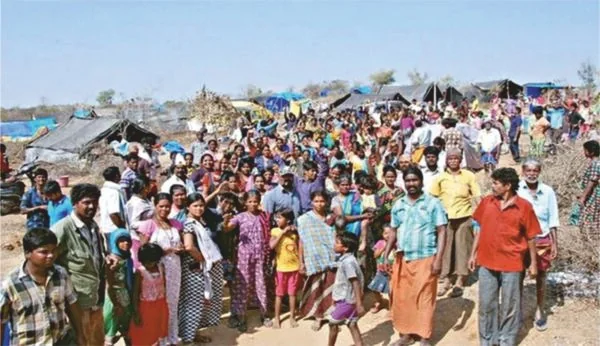
More than 181 members of the Hakki Pikki tribal community from Karnataka are stuck in violence-hit Sudan. The Hakki Pikki is a tribe that lives in several states in western and southern India, especially near forest areas. Hakki Pikkis (Hakki in Kannada means ‘bird’ and Pikki means ‘catchers’) are a semi-nomadic tribe, traditionally of bird catchers and hunters.
WHY IN THE NEWS?
- More than 181 members of the Hakki Pikki tribal community from Karnataka are stuck in violence-hit Sudan.
WHO ARE HAKKI PIKKI’s ?
- The Hakki Pikki is a tribe that lives in several states in western and southern India, especially near forest areas.
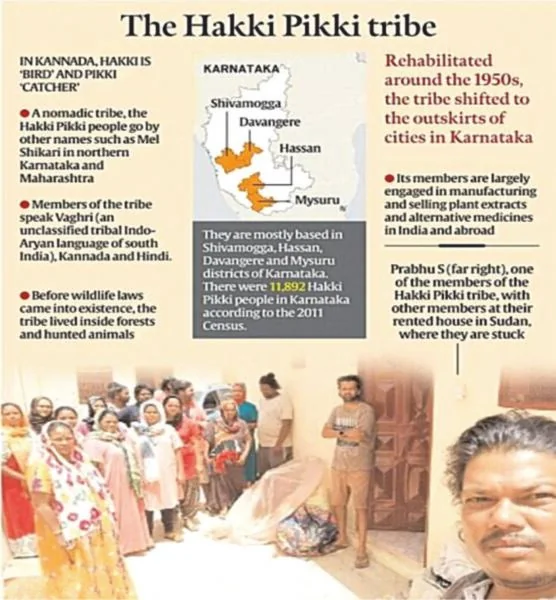
- Hakki Pikkis (Hakki in Kannada means ‘bird’ and Pikki means ‘catchers’) are a semi-nomadic tribe, traditionally of bird catchers and hunters.
- According to the 2011 census, the Hakki Pikki population in Karnataka is 11,892, and they live mainly in Davangere, Mysuru, Kolar, Hassan, and Shivamogga districts.
- In different regions, they are known by different names, such as Mel-Shikari in northern Karnataka and Maharashtra.
MORE ABOUT TRIBE HAKKI PIKKI
- The Hakki Pikki move in groups from place to place in search of a livelihood.
- They are divided into four clans, called Gujaratia, Panwar, Kaliwala, and Mewaras.
- These clans can be equated with castes in the traditional Hindu society.
- In the olden days, there was a hierarchy among the clans, with the Gujaratia at the top and the Mewaras at the bottom.
- The forest is the main natural resource of the Hakki Pikki.
LOCATION OF TRIBE:
- Hakki Pikki people are believed to hail originally from the bordering districts of Gujarat and Rajasthan.
- According to scholars, they came to the south in search of game.
- To Karnataka, they seem to have arrived via Andhra Pradesh, as they still remember a place called Jalapally near Hyderabad as their ancestral home, where their forefathers lived for a considerable period. They are now spread across South India.
- Till a few years ago, women used to wear the ghagra (skirt) common in Rajasthan, although now they wear saris and other garments.
RITUALS AND CUSTOMS OF HAKKI PIKKIS
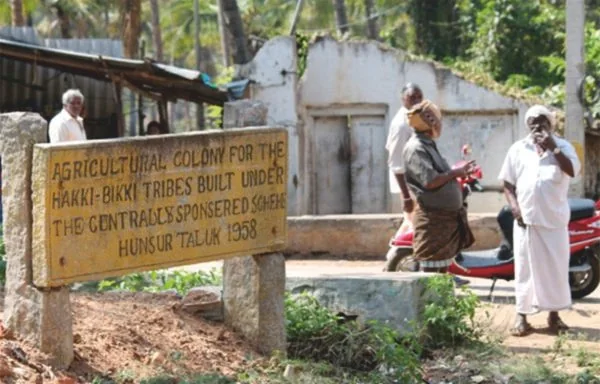
- Hakki Pikkis in Karnataka follow Hindu traditions and celebrate all Hindu festivals.
- They are non-vegetarians.
- The eldest son in a family is not supposed to cut his hair so that he can be identified easily.
- The tribe prefers cross-cousin marriages.
- According to locals, the usual age of marriage is 18 for women and 22 for men.
- The society is matriarchal, where the groom gives a dowry to the bride’s family.
- Monogamy is the norm.
CURRENT OCCUPATION OF HAKKI PIKKIS
- Traditionally, Hakki Pikkis lived in forest areas, leading a nomadic life for nine months a year and coming back to their permanent camps for three.
- Men of the tribe would hunt while women begged in villages.
- But as the wildlife protection laws became stricter, the Hakki Pikkis in Karnataka started selling spices, herbal oils, and plastic flowers in local temple fairs.
- The community moved to villages from the forests in the 1950s. Earlier, they killed animals to make a living.
- But then some of the community members were booked and jailed under wildlife laws.
- Hence, they shifted to selling herbal oils and other materials in villages and towns.
- The herbal oil business took off, and now the tribe members go to many places across the globe to sell their products.
- The Hakki Pikkis in Tamil Nadu travelled to Singapore, Thailand, and other places about 20-25 years ago to sell some marbles, in the process discovering there was a huge demand for Ayurvedic products in the African continent.
- They started selling their products in Africa, and Karnataka Hakki Pikkis followed them.
- People from the state have been traveling to African countries for the past 20 years.
- Education levels among the Hakki Pikkis are still low.
- For example, in the 2,000-strong population of Pakshirajapura, only eight people have completed the graduation-level course, and one person works as a police constable.
WHAT ARE THEY DOING IN SUDAN AND OTHER AFRICAN COUNTRIES?
- African countries offer them an opportunity to escape poverty faster.
- There is demand for tribal products in the African continent.
- If a person invests, say Rs 5 lakh on raw materials (hibiscus powder, oil extraction, gooseberry, Ayurvedic plants, etc.), they have a chance to double or triple it in a matter of 3-6 months in African countries.
- But in India, you don’t have such a market and business.
- They sell online and promote products on social media, including Facebook and YouTube
SYLLABUS: MAINS, GS-2, INTERNATIONAL RELATIONS
SOURCE: THE INDIAN EXPRESS
- Prelims: Key facts, institutions, locations and terminology in the article.
- Mains: Connect the topic with Environment, International Relations, Polity & Governance.
- Revision: Use the article headings to prepare concise notes and answer-writing points.
Test your understanding
Questions from this article
Prelims practiceWith reference to HAKKI PIKKI’s, consider the following statements:
- More than 181 members of the Hakki Pikki tribal community from Karnataka are stuck in violence-hit Sudan.
- The Hakki Pikki is a tribe that lives in several states in western and southern India, especially near forest areas.
- Hakki Pikkis (Hakki in Kannada means ‘bird’ and Pikki means ‘catchers’) are a semi-nomadic tribe, traditionally of bird catchers and hunters.
Which of the statements given above are correct?
- 1 and 2 only
- 2 and 3 only
- 1 and 3 only
- 1, 2 and 3
View answer
Answer: (d) 1, 2 and 3. All three statements are drawn from the article.
Mains practiceDiscuss the background, key issues and significance of HAKKI PIKKI’s for India.
Answer in 250 words.
View answer approach
- WHY IN THE NEWS?
- WHO ARE HAKKI PIKKI’s ?
- MORE ABOUT TRIBE HAKKI PIKKI
- LOCATION OF TRIBE:
- RITUALS AND CUSTOMS OF HAKKI PIKKIS
Frequently asked questionsFrequently asked questions
Why is Hakki Pikki’S in the news?
More than 181 members of the Hakki Pikki tribal community from Karnataka are stuck in violence-hit Sudan. The Hakki Pikki is a tribe that lives in several states in western and southern India, especially near forest areas.
What are the key facts about Hakki Pikki’S?
Hakki Pikkis (Hakki in Kannada means ‘bird’ and Pikki means ‘catchers’) are a semi-nomadic tribe, traditionally of bird catchers and hunters. According to the 2011 census, the Hakki Pikki population in Karnataka is 11,892, and they live mainly in Davangere, Mysuru, Kolar, Hassan, and Shivamogga districts. In different regions, they are known by different names, such as Mel-Shikari in northern Karnataka and Maharashtra.
Why is Hakki Pikki’S important for UPSC preparation?
The topic connects current developments with Environment, International Relations, Polity & Governance and is relevant for both objective revision and analytical answer writing.