GPS spoofing transmits deceptive navigation signals so that a receiver calculates a false position or time. It can disrupt aviation, shipping, telecommunications, financial systems and military operations, making resilient positioning and navigation a national-security priority.
Context - On November 6, 2025, Delhi’s Indira Gandhi International (IGI) Airport experienced a rare and serious GPS spoofing incident — the first known case of its kind in India.
- The event disrupted several flight operations, caused delays and diversions, and led aviation authorities to issue alerts and advisories to all incoming flights.
- The episode has raised concerns about cybersecurity in aviation, particularly about how external electronic signals can interfere with aircraft navigation systems.
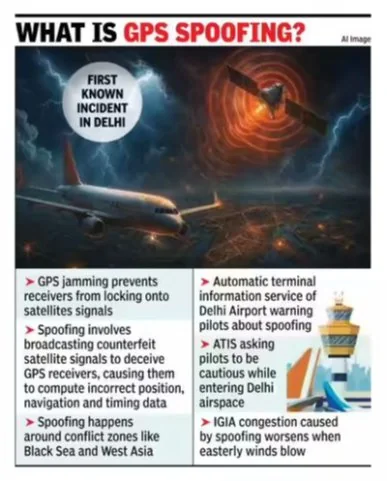
WHAT IS GPS SPOOFING?
- GPS spoofing is a cyber-attack where fake satellite signals are broadcast to deceive GPS receivers (in this case, aircraft navigation systems).
- These false signals mimic real satellite transmissions, leading the receiver to calculate incorrect position, altitude, or timing data.
In simple terms: The aircraft “thinks” it’s somewhere else in the sky than it actually is.
HOW DOES GPS SPOOFING WORK?
- Attackers generate artificial GPS signals that imitate real satellite data.
- The aircraft’s GPS receiver picks up these stronger fake signals instead of authentic ones.
- The onboard navigation system then shows incorrect coordinates — misleading pilots about their real location or height.
- This can cause confusion during landing, take-off, or route navigation.
- In aviation, such false readings can be highly dangerous, especially during low-visibility landings that rely on precise GPS guidance.
AREAS WHERE SPOOFING IS COMMON GPS spoofing has been increasingly reported in:
- Conflict zones – like Ukraine, the Black Sea, and Syria.
- West Asia and the Middle East – where electronic warfare systems are used to jam or mislead GPS signals.
- Military operation areas – to protect assets or mislead adversaries.
The Delhi incident is unusual because it happened in a
civilian, non-conflict zone, far from any active military theatre.
WHAT HAPPENED AT IGI AIRPORT?
The Technical Disruption - The spoofed signals affected the Required Navigation Performance (RNP) — a GPS-based landing system used by aircraft for precision approaches.
- Flights approaching Runway 10/28 (one of Delhi’s busiest runways) reported incorrect position data on their navigation screens.
- Pilots received false altitude and location readings, which made GPS-guided landing impossible.
- As a result, flights had to switch to ground-based navigation systems like:
- ILS (Instrument Landing System)
- VOR (VHF Omnidirectional Range)
- Visual landing approaches
OPERATIONAL IMPACT
- Several flights (including Air India and Vistara) were diverted to alternate airports.
- ATIS (Airport Terminal Information Service) broadcast warnings advising pilots to avoid GPS-based landings.
- Air traffic congestion increased, especially during east wind conditions, when certain runways are more dependent on GPS-based navigation.
- The incident led to temporary delays and re-routing, though safety was not compromised.
AIRPORT & REGULATORY RESPONSE The
Delhi International Airport Ltd (DIAL) and
Directorate General of Civil Aviation (DGCA) initiated prompt measures:
Immediate Steps Taken:
- Issued cautionary alerts through ATIS to all aircraft entering Delhi airspace.
- Suspended RNP-based landings
- Accelerated installation of a new ILS (Instrument Landing System) on Runway 10/28 — scheduled to be operational by November 27, 2025.
- Conducted test flights (by IndiGo) to validate new lighting and approach systems.
Investigation:
- DGCA and aviation cybersecurity teams are examining whether the spoofing signals originated from external sources — possibly drifting from West Asia, where active electronic jamming is ongoing.
WHY IS GPS SPOOFING DANGEROUS?
- Navigation Errors: Aircraft may believe they are off-course and make incorrect course corrections.
- Altitude Errors: False readings can mislead pilots during approach and descent, increasing accident risk.
- Autopilot Malfunction: Incorrect coordinates can disrupt autopilot and collision-avoidance systems.
- Air Traffic Management Issues: Miscommunication between aircraft and ATC (Air Traffic Control) due to conflicting data.
- Potential Loss of Control: In extreme cases, over reliance on spoofed GPS data could cause serious safety threats.
Fortunately,
Indian pilots are trained to detect such inconsistencies and
switch to ground-based aids like ILS and VOR when GPS signals appear unreliable.
POSSIBLE ORIGIN OF SPOOFING SIGNALS Experts suspect that:
- Electronic warfare operations in West Asia (for example, in and around Israel, Syria, and Iran) are jamming and spoofing GPS to protect sensitive zones.
- Under specific atmospheric conditions, such signals can travel long distances — even up to 2,000–2,500 km — and unintentionally affect civilian airspace in other countries, including India.
- Similar GPS disruptions have been previously observed affecting flights over Turkey and the Mediterranean.
ONGOING INVESTIGATION & POLICY IMPLICATIONS Indian aviation authorities are:
- Enhancing monitoring of satellite navigation signals across major airports.
- Planning training and simulation modules for pilots to handle GPS spoofing scenarios.
- Coordinating with international aviation bodies (ICAO, IATA) for better cybersecurity protocols in aviation.
- Upgrading landing systems to hybrid models that can operate both with GPS and traditional ground-based guidance.
This event highlights how
electronic warfare in distant regions can have
unintended spillover effects on civilian aviation, even in peaceful areas.
BROADER SIGNIFICANCE
- Marks a new kind of aviation risk — not mechanical or weather-related, but digital and cyber-based.
- Highlights the growing importance of cybersecurity in civil aviation.
- Underlines the need for redundant navigation systems (both satellite and ground-based).
- Encourages India to strengthen electronic intelligence and spectrum monitoring around its major airports.
WHY IN NEWS?
- Recently, a Dubai-bound business jet from Europe flew into Iranian airspace with no clearance in September due to a false signal on the aircraft navigation system.
WHAT IS GPS SPOOFING ?
- GPS spoofing is an attack aimed at overriding a GPS enabled device’s original location.
- To do so, the attacker uses a radio transmitter that broadcasts fake GPS signals and interferes with GPS receivers nearby.
- As a result, those devices display fake GPS locations.
- The Global Navigation Satellite System (GNSS), which GPS (the Global Positioning System) is a part of, is also used to sync the date and time across devices around the world.
- So if your device is GPS spoofed, it might also suddenly show that you have traveled to the future or back in time.
IMPLICATIONS OF GPS SPOOFING:
- GPS spoofing provides false signals to the GPS receiver of a plane, manipulating its inertial reference system.
- This can put the aircraft off its intended course and result in intrusion or collision.
- A GNSS interference can also result in false data for a plane’s fuel computation system, flight management system, and ground or wind speed information on the navigation display.
- Taxi drivers can use GPS spoofing to fake their location to earn more money for standing.
- GPS spoofing can change the perceived location of ships, planes, and other vehicles.
OTHER TYPES OF SPOOFING:
- URL spoofing. It is the process of creating fake URLs that pose as a different website. A spoofed URL looks like a legitimate source, but it is used for stealing your data.
- IP spoofing. It is a hacking technique when a packet’s original IP address is changed to a fake one. IP spoofing allows cybercriminals to carry out malicious activities and avoid detection.
- DNS spoofing. It is a cyberattack that directs internet users to fake or malicious websites. DNS spoofing is carried out by replacing real IP addresses with different ones
SYLLABUS: PRELIMS, CURRENT AFFAIRS
Why This Topic Matters for UPSC
- Prelims: Revise definitions, institutions, locations, reports and factual features connected with GPS Spoofing: Working, Risks and Countermeasures.
- Mains: Link the topic with Science and Technology, Internal Security, Aviation and organise the answer under background, significance, challenges and way forward.
- Interview: Explain the issue in balanced language and distinguish verified facts from opinion.
Key Takeaway
GPS spoofing transmits deceptive navigation signals so that a receiver calculates a false position or time. It can disrupt aviation, shipping, telecommunications, financial systems and military operations, making resilient positioning and navigation a national-security priority.
Test your understanding
Questions from this article
Prelims practiceWith reference to GPS SPOOFING, consider the following statements:
- Recently, a Dubai-bound business jet from Europe flew into Iranian airspace with no clearance in September due to a false signal on the aircraft navigation system.
- GPS spoofing is an attack aimed at overriding a GPS enabled device’s original location.
- To do so, the attacker uses a radio transmitter that broadcasts fake GPS signals and interferes with GPS receivers nearby.
Which of the statements given above are correct?
- 1 and 2 only
- 2 and 3 only
- 1 and 3 only
- 1, 2 and 3
View answer
Answer: (d) 1, 2 and 3. All three statements are drawn from the article.
Mains practiceDiscuss the background, key issues and significance of GPS SPOOFING for India.
Answer in 250 words.
View answer approach
- WHY IN NEWS?
- WHAT IS GPS SPOOFING ?
- IMPLICATIONS OF GPS SPOOFING:
- OTHER TYPES OF SPOOFING:
Frequently asked questionsFrequently asked questions
What is GPS Spoofing?
GPS spoofing transmits deceptive navigation signals so that a receiver calculates a false position or time. It can disrupt aviation, shipping, telecommunications, financial systems and military operations, making resilient positioning and navigation a national-security priority.
Why is GPS Spoofing important for UPSC?
It connects current developments with Science and Technology, Internal Security, Aviation and supports factual revision as well as analytical answer writing.
How should aspirants prepare GPS Spoofing?
Prepare a short definition, key facts, institutional or legal framework, significance, challenges and a balanced way forward. Revise the specific developments and examples explained in the article.