sheer number of sanctions faced by it,
Russia holds the record, having been slapped with more individual sanctions than Iran, Cuba, and North Korea combined.
That ignominious record is
unlikely to change anytime soon as Russian troops surged across the border last week to open a new line of attack near Kharkiv, Ukraine’s second-largest city after Kyiv.
Amid all this,
Russia’s economy has been resilient. The west obviously does not wanted & anticipated this.
RUSSIA’S ECONOMY
While it might be tempting to put this economic resilience down to a massive defence build-up, there could be more factors at play. And while the jury is still out on how long this will last,
things are not as bad as they should theoretically have been. The Russian
job market is strong, unemployment is at a record low, and rising wages continue to
propel consumer spending.
Russia’s economic resilience saga is borne out of the fact that following a
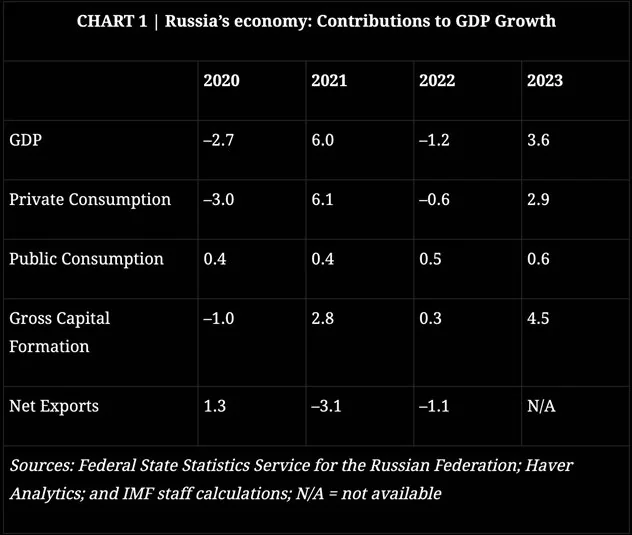
relatively mild contraction of 1.2% in 2022, the
economy again outperformed expectations in 2023, growing by 3.6 per cent.
FACTORS RESPONSIBLE FOR THE RESILIENCE
There are five factors at play:
- The gamut of sanctions on the Russian energy sector are not as tight as they were when imposed on countries such as Iran or Venezuela. There is significant elbow room, and that is almost by design.
HOW & WHY?
The sanctions were
formulated by the West keeping their own interests in mind, effectively to ensure that
Russia continues to produce fossil fuels despite the sanctions on its energy sector,
so that there is no significant surge in oil prices.
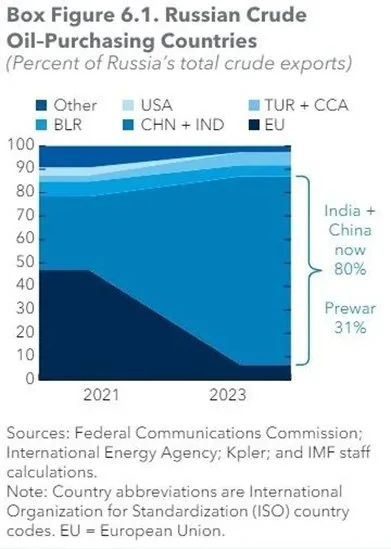
WHERE ARE RUSSIAN OIL EXPORTS GOING?
So, while
Russia’s fossil fuel exports to most of Western Europe have fallen, the overall export volumes have been relatively steady despite all the sanctions. This is because the oil that used to go to Europe is now being absorbed elsewhere, especially
China and India.
Russia’s overall oil exports have increased post war.
- The corporate investment in Russia has recovered from the drop in 2022, adding an estimated 5 percentage points to the growth in GDP in 2023.
ARE INVESTMENTS COMING IN?
Investment is being bolstered by
increased resources flowing to the country’s defence and manufacturing sectors. In addition, the
sanctions imposed after the start of the invasion of Ukraine have
made a retooling of the economy necessary.
The IMF, for instance, has highlighted that
some imports are being substituted by domestic goods, resulting in investments in new production facilities.
Also, some multinational corporations have stayed back, in the hope that the war would end and sanctions be lifted.
- Russia’s private consumption has recovered strongly, adding 2.9 percentage points to GDP growth. This is being driven by buoyant credit and a strong labour market, with record low unemployment of just 3 and a general rise in wages. The largely voluntary military recruitment model, using monetary incentives, has let sections of consumers carry on with their spending.
- Government spending too has added to growth but more modestly, with the fiscal impulse estimated at 1.2 percentage points of GDP in 2023. Defence spending in Russia has been ramped up to an estimated 7% of GDP. Despite the large increase in military spending, overall government spending has increased, but not as much in real terms, according to economists.
- Some financial sanctions had already been imposed in 2014 after the Crimea invasion, and Russia had already factored in that cost. The economy, and Moscow’s policy mandarins, have learnt to manoeuvre around these punitive measures over time.
 PROJECTIONS FOR NEXT YEAR
The IMF sees
growth slowing to 1.8% next year, and cautioned that Russia’s potential growth rate has dropped to around 1.25% from 1.7% before the war.
“This would mean that Russia’s income per capita may no longer converge toward Western European levels in the medium to long term.” For Putin, that is unlikely to be much of a worry at this point in time.
Test your understanding
Questions from this article
Prelims practiceWith reference to Factors That Have Kept Russia's Economy Resilient, consider the following statements:
- The gamut of sanctions on the Russian energy sector are not as tight as they were when imposed on countries such as Iran or Venezuela. There is significant elbow room, and that is almost by design.
- The corporate investment in Russia has recovered from the drop in 2022, adding an estimated 5 percentage points to the growth in GDP in 2023.
- Russia’s private consumption has recovered strongly, adding 2.9 percentage points to GDP growth. This is being driven by buoyant credit and a strong labour market, with record low unemployment of just 3 and a general…
Which of the statements given above are correct?
- 1 and 2 only
- 2 and 3 only
- 1 and 3 only
- 1, 2 and 3
View answer
Answer: (d) 1, 2 and 3. All three statements are drawn from the article.
Mains practiceDiscuss the background, key issues and significance of Factors That Have Kept Russia's Economy Resilient for India.
Answer in 250 words.
View answer approach
- Background and context
- Key facts and institutional framework
- Significance and way forward
Frequently asked questionsFrequently asked questions
Why is Factors That Have Kept Russia'S Economy Resilient in the news?
sheer number of sanctions faced by it, Russia holds the record, having been slapped with more individual sanctions than Iran, Cuba, and North Korea combined. That ignominious record is unlikely to change anytime soon as Russian troops surged across the border last week to open a new line of attack near Kharkiv, Ukraine’s second-largest city after Kyiv.
What are the key facts about Factors That Have Kept Russia'S Economy Resilient?
Amid all this, Russia’s economy has been resilient. The west obviously does not wanted & anticipated this. RUSSIA’S ECONOMY While it might be tempting to put this economic resilience down to a massive defence build-up, there could be more factors at play.
Why is Factors That Have Kept Russia'S Economy Resilient important for UPSC preparation?
The topic connects current developments with Economy, International Relations, Defence and is relevant for both objective revision and analytical answer writing.