UPSC Current Affairs
End-to-End encryption
Encryption generally refers to the act of changing some consumable information into an inconsumable form based on some rules. E2E is encryption which refers to particular locations between which information moves. In this setup, two important forms of encryption are involved which are encryption-in-transit and E2E encryption.
VRAuthor Desk
2 min read
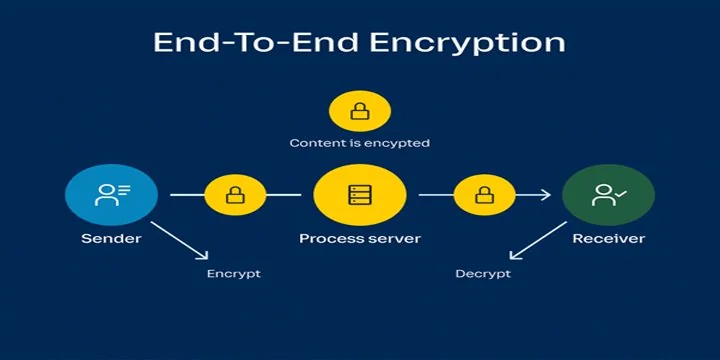
Encryption generally refers to the act of changing some consumable information into an inconsumable form based on some rules. E2E is encryption which refers to particular locations between which information moves. In this setup, two important forms of encryption are involved which are encryption-in-transit and E2E encryption.
What is encryption?
- Encryption generally refers to the act of changing some consumable information into an inconsumable form based on some rules.
What is E2E encryption?
- E2E is encryption which refers to particular locations between which information moves.
- In this setup, two important forms of encryption are involved which are encryption-in-transit and E2E encryption.
- encryption-in-transit means before a message is relayed from the server to the person (or vice versa), it is encrypted.
- This scheme is used to prevent an actor from being able to read the contents of the message by intercepting the relay signal.
- In E2E encryption, the message is encrypted both in transit and also at rest that is when being relayed from one’s phone to the server (or vice versa) and when it is sitting inside the server.
- It is only decrypted when receiver receives the message.
- Endtoend (E2E) encryption in particular protects information in a way that has transformed human rights organisations’, lawenforcement agencies’, and tech companies’ outlook on their ability to access information about individuals to protect, prosecute or profit from their engagement.
How is information encrypted?
- There are several ways to encrypt information depending on the level of secrecy and protection required for the same.
- If some information is to remain encrypted for 100 years, a computer must require more than 100 years to decrypt the information without the key.
- One broad distinction involved is between symmetric and asymmetric encryption.
- In symmetric encryption, the key used to encrypt some information is also the same key required to decrypt it.
- DES (Data Encryption Standard) is a famous example of a symmetric encryption protocol.
- Asymmetric encryption shall work as long as the private key and the correspondence between the public key and the private key are kept secret.
- Prelims: Key facts, institutions, locations and terminology in the article.
- Mains: Connect the topic with Economy, Polity & Governance.
- Revision: Use the article headings to prepare concise notes and answer-writing points.
Test your understanding
Questions from this article
Prelims practiceWith reference to End-to-End encryption, consider the following statements:
- Encryption generally refers to the act of changing some consumable information into an inconsumable form based on some rules.
- E2E is encryption which refers to particular locations between which information moves.
- In this setup, two important forms of encryption are involved which are encryption-in-transit and E2E encryption.
Which of the statements given above are correct?
- 1 and 2 only
- 2 and 3 only
- 1 and 3 only
- 1, 2 and 3
View answer
Answer: (d) 1, 2 and 3. All three statements are drawn from the article.
Mains practiceDiscuss the background, key issues and significance of End-to-End encryption for India.
Answer in 250 words.
View answer approach
- What is encryption?
- What is E2E encryption?
- How is information encrypted?
Frequently asked questionsFrequently asked questions
Why is End-To-End Encryption in the news?
Encryption generally refers to the act of changing some consumable information into an inconsumable form based on some rules. E2E is encryption which refers to particular locations between which information moves.
What are the key facts about End-To-End Encryption?
In this setup, two important forms of encryption are involved which are encryption-in-transit and E2E encryption. encryption-in-transit means before a message is relayed from the server to the person (or vice versa), it is encrypted. This scheme is used to prevent an actor from being able to read the contents of the message by intercepting the relay signal.
Why is End-To-End Encryption important for UPSC preparation?
The topic connects current developments with Economy, Polity & Governance and is relevant for both objective revision and analytical answer writing.