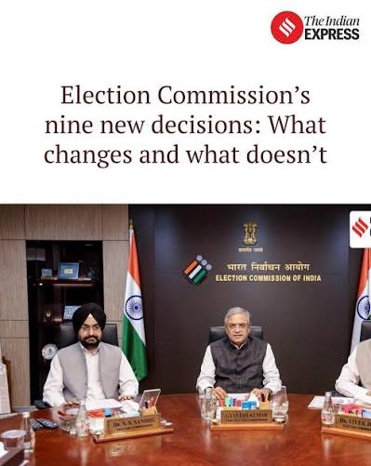
The Election Commission of India (ECI) has announced nine new decisions aimed at addressing concerns over its internal functioning, decision-making process, IT systems, and electoral-roll management. The decisions follow objections recorded by Election Commissioners Sukhbir Singh Sandhu and Vivek Joshi over several issues during the previous 10 months. While the new measures introduce greater procedural oversight, several questions related to Form 6, ECINet, electoral-roll appeals and internal responsibility remain unanswered.
Why in the News?
The Election Commission of India has announced nine decisions after concerns were raised about the functioning of the three-member Commission. The decisions introduced additional procedures for meetings, technology systems, and administrative matters.
- Election Commissioners Sukhbir Singh Sandhu and Vivek Joshi had recorded objections on at least 14 occasions.
- Their concerns covered electoral-roll management, IT systems, meetings and administrative decisions.
- The Commission had earlier described these objections as suggestions and inputs arising from normal deliberations.
- It had also maintained that important decisions had the unanimous approval of the full Commission.
- The latest four-page note introduces several new procedures dealing with the concerns raised by the two Commissioners.
What are the Election Commission’s New Decisions?
The new measures focus mainly on internal procedures, technology systems and administrative control. They are intended to create more formal processes around meetings, IT systems and directions issued within the Commission. The decisions cover both internal administration and the management of election-related technology.
Major Decisions
- Meeting agendas: Agendas will be circulated before every Commission meeting.
- Meeting minutes: Minutes will be issued after Commission meetings.
- Foreign travel: Officers’ foreign trips will require approval from the Commission.
- New IT modules: New IT modules and portals will first be examined by a committee of officers before being placed before the Commission.
- ECINet review: ECINet will be reviewed by a committee headed by a Senior Deputy Election Commissioner.
- Independent expert: The ECINet review committee will include an independent expert from an IIT or IIIT.
- Field-level flexibility: Field officers will receive greater flexibility where required within the system.
- Commissioners’ directions: Directions issued by Commissioners to officers will be meticulously complied with.
Concerns Raised by the Two Election Commissioners
The new decisions correspond closely with concerns earlier recorded by Sandhu and Joshi. The new decisions therefore introduce additional procedures in several areas that had previously generated disagreement.
Their objections reportedly covered:
- Lack of circulation of meeting agendas.
- Absence of formal meeting minutes.
- Foreign trips by officers without Commission approval.
- Development of new IT modules without adequate Commission knowledge.
- Need for an independent audit of the electoral-roll database.
- Limited access of field officers to ERONet.
- Administrative changes involving the allocation of work in the IT division.
ECINet and Electoral-Roll Technology
ECINet is an important digital system used by the Election Commission. The Commission has now decided to conduct a review through a committee headed by a Senior Deputy Election Commissioner. The committee will also include an independent expert from an IIT or IIIT. The decision is significant because earlier concerns had been raised regarding:
- Electoral-roll databases.
- IT modules.
- System access.
- Software functioning.
- Independent technical examination.
The Commission has also decided that field officers requiring greater flexibility in the system will be provided with it.
What Happened in Goa?
The new decisions also address an issue related to Goa’s electoral rolls. An investigation had found that 97 voters who had been cleared by local officials were still missing from the final electoral roll. According to the Commission:
- 81 of these voters have now submitted Form 6.
- The Chief Electoral Officer has been directed to facilitate their inclusion.
- The issue highlights the importance of coordination between field-level decisions and the final electoral database.
What Happens to Form 6?
The new decisions do not fully resolve the controversy surrounding Form 6. Form 6 is used for registration of a person as a new voter under the electoral registration system. The Commission's note states that the form prescribed under the Registration of Electors Rules will apply outside the period of the Special Intensive Revision (SIR). However, an earlier objection concerned the online Form 6 on ECINet.
Watch : Election Commission’s 9 New Decisions
Issue with the Online Form
A question relating to the applicant’s parents had reportedly been inserted between sections J and K of the online form.
- Applicants were reportedly required to answer the question before proceeding.
- The objection was that the question had been inserted without proper authorisation.
- The Commission’s latest note does not specifically mention this online question.
- It also does not state whether the question has been removed.
- It does not clarify who inserted the question or why it remained after objections were raised.
Therefore, the latest decision addresses part of the Form 6 issue but leaves the specific online-form question unresolved.
Reference to the Supreme Court
The Commission's note states that the Supreme Court upheld the declaration relating to the SIR process. However, the material provided notes that the Supreme Court of India May 27 order does not appear to expressly uphold the declaration in those terms. This creates a question about how the Court order is being interpreted in the Commission's explanation.
Other Unanswered Questions
Several important issues remain outside the latest decisions. The new procedures do not provide detailed explanations on every concern that had earlier been raised. These unanswered questions relate to electoral-roll appeals, software facilities and the role of certain officials.
West Bengal Appeals
One major unanswered question concerns West Bengal. The Commission's latest note does not provide an explanation on these points. Questions remain about:
- Who authorised appeals against voters whose inclusion had been ordered by judicial officers?
- Were these appeals filed on behalf of the Election Commission of India?
- If so, who authorised them?
Goa Software Facility
The note also does not explain why a software facility requested in Goa for restoring voter names was not enabled. This is significant because the Commission has simultaneously announced new measures relating to IT systems and electoral-roll management.
Officials’ Roles
Questions also remain regarding the positions of certain officials. The new note does not clarify whether their positions or responsibilities will change. The material identifies:
- DG (IT) Seema Khanna, whose functioning had reportedly been a point of contention.
- Senior Deputy Election Commissioner Maneesh Garg, against whom both Commissioners had reportedly sought action.
What Changes?
The latest decisions introduce several new procedural safeguards within the Commission. They mainly concern meeting procedures, administrative approvals, IT oversight and electoral-roll management.
| Area | New Position |
|---|
| Commission meetings | Agendas to be circulated beforehand |
| Meeting records | Minutes to be issued afterwards |
| Foreign travel | Commission approval required |
| IT modules | Committee review before Commission consideration |
| ECINet | Formal review by a senior-level committee |
| Technical oversight | Independent IIT/IIIT expert included |
| Field officers | Greater system flexibility where required |
| Commissioners’ directions | Directions to be meticulously followed |
| Goa voter issue | Action directed for inclusion of eligible voters |
What Does Not Change or Remains Unclear?
Several issues remain unresolved in the latest announcement. These relate mainly to specific administrative and technical questions that were raised earlier.
- The status of the online Form 6 parental question remains unclear.
- The authorisation behind certain West Bengal appeals remains unexplained.
- The reason for not enabling the Goa voter-restoration software facility remains unclear.
- The future roles of certain IT and election officials have not been clarified.
- The exact process for resolving disagreements among the three Commissioners remains uncertain.
Why Does it Matter?
The Election Commission has constitutional responsibility for conducting free and fair elections and maintaining electoral rolls. Therefore, its internal functioning has implications for:
- Electoral-roll accuracy
- Voter registration
- Deletion and restoration of voter names
- Transparency in decision-making
- Technology management
- Institutional coordination
- Accountability within the Commission
The latest decisions introduce more formal procedures around these areas, but their practical effect will depend on how consistently they are implemented.
Conclusion
The Election Commission's nine new decisions introduce changes in meeting procedures, administrative approvals, IT oversight and electoral-roll systems. They directly address several concerns previously recorded by Commissioners Sukhbir Singh Sandhu and Vivek Joshi. However, important questions concerning the online Form 6, West Bengal appeals, Goa's voter-restoration system, and the roles of certain officials remain unanswered. The key issue going forward will be how these new procedures affect the Commission's internal decision-making and the management of electoral rolls.
Test your understanding
Questions from this article
Prelims practiceQuestion: With reference to Election Commission’s 9 New Decisions- Key changes and Unresolved issues, consider the following statements:
- The Election Commission of India (ECI) has announced nine new decisions aimed at addressing concerns over its internal functioning, decision-making process, IT systems, and electoral-roll.
- The decisions follow objections recorded by Election Commissioners Sukhbir Singh Sandhu and Vivek Joshi over several issues during the previous 10 months
Which of the statements given above is/are correct?
- 1 only
- 2 only
- Both 1 and 2
- Neither 1 nor 2
View answer and explanation
Suggested answer: (c) Both 1 and 2
Explanation: Election Commission’s 9 new decisions including changes to SIR voter verification, electoral roll updates, ECINet, IT systems, officer approvals &Commission procedures. Understand what has changed, what remains unresolved, and the key issues surrounding voter registration and electoral rolls
Mains practiceQuestion: Discuss Election Commission’s 9 New Decisions- Key changes and Unresolved issues with reference to Why in the News?, What are the Election Commission’s New Decisions?, Major Decisions and Concerns Raised by the Two Election Commissioners. (150 words, 10 marks)
View answer-writing approach
Answer approach:
- Introduce the topic using its meaning and context.
- Explain Why in the News?, What are the Election Commission’s New Decisions?, Major Decisions and Concerns Raised by the Two Election Commissioners.
- Use facts and examples given in the article.
- Conclude with a balanced way forward.
Frequently asked questionsFrequently asked questions
What is Election Commission’s 9 New Decisions- Key changes and Unresolved issues?
Election Commission’s 9 new decisions including changes to SIR voter verification, electoral roll updates, ECINet, IT systems, officer approvals &Commission procedures. Understand what has changed, what remains unresolved, and the key issues surrounding voter registration and electoral rolls
Why is Election Commission’s 9 New Decisions- Key changes and Unresolved issues relevant for UPSC preparation?
The decisions follow objections recorded by Election Commissioners Sukhbir Singh Sandhu and Vivek Joshi over several issues during the previous 10 months
What key points should aspirants remember about Election Commission’s 9 New Decisions- Key changes and Unresolved issues?
The article covers Why in the News?, What are the Election Commission’s New Decisions?, Major Decisions and Concerns Raised by the Two Election Commissioners.