UPSC Current Affairs
Digital Agriculture Mission
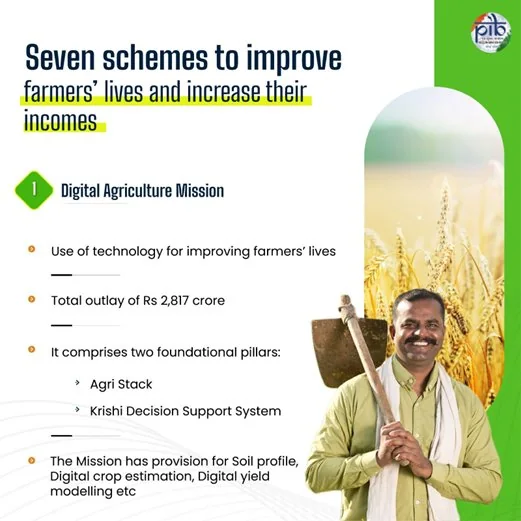
On September 2, the Union Cabinet approved the Rs 2,817-crore Digital Agriculture Mission aimed at creating Digital Public Infrastructure (DPI) in the agricultural sector. This initiative follows the success of similar e-governance projects like Aadhaar and UPI. OBJECTIVES Digital Public Infrastructure (DPI): The DPI Mission will integrate advanced technology into agriculture, including 3 major components: i.
VRAuthor Desk
3 min read
On September 2, the Union Cabinet approved the Rs 2,817-crore Digital Agriculture Mission aimed at creating Digital Public Infrastructure (DPI) in the agricultural sector. This initiative follows the success of similar e-governance projects like Aadhaar and UPI. OBJECTIVES Digital Public Infrastructure (DPI): The DPI Mission will integrate advanced technology into agriculture, including 3 major components: i.
On September 2, the
Union Cabinet approved the Rs 2,817-crore Digital Agriculture Mission aimed at creating Digital Public Infrastructure (DPI) in the agricultural sector.
This
initiative follows the success of similar e-governance projects like Aadhaar and UPI.
OBJECTIVES
Digital Public Infrastructure (DPI):
- The DPI Mission will integrate advanced technology into agriculture, including 3 major components:
i. AgriStack,
ii. Krishi Decision Support System (DSS),
iii. Soil Profile Maps.
- The mission will also establish the Digital General Crop Estimation Survey (DGCES) for accurate agricultural production estimates.
COMPONENTS
1. AgriStack:
- Farmers’ Registry:
- Purpose: Create a digital identity for farmers, similar to Aadhaar, to centralize information on land ownership, crops, livestock, and demographics.
- Implementation: Farmers will receive a digital ID that links to a comprehensive database containing their personal and agricultural details. This system aims to simplify interactions with government schemes and services.
- Pilot Projects: Trials have been conducted in districts such as Farrukhabad (Uttar Pradesh) and Gandhinagar (Gujarat). The goal is to create digital IDs for 11 crore farmers, with 6 crore targeted in the current financial year and the rest in subsequent years.
- Funding: Rs 5,000 crore has been allocated separately for state incentives to develop the Farmers’ Registry.
- Crop Sown Registry:
- Purpose: Track and record crop planting information through digital surveys.
- Method: Mobile-based ground surveys will be used to gather data each crop season. This registry will help in assessing crop patterns and planning agricultural policies.
- Pilot Projects: Conducted across 11 states in 2023-24, with plans to expand to 400 districts in the current financial year and the rest in 2025-26.
- Geo-referenced Village Maps:
- Purpose: Link geographic data with land records to provide accurate mapping of agricultural areas.
- Details: These maps will integrate land records with physical locations, improving land management and agricultural planning.
2. Krishi Decision Support System (DSS):
- Purpose: Develop a geospatial system that integrates information on crops, soil, weather, and water resources.
- Features:
- Crop Mapping: Generate detailed crop maps to identify planting patterns and monitor agricultural trends.
- Disaster Monitoring: Track droughts, floods, and other environmental factors affecting crops.
- Yield Assessment: Use data to estimate crop yields, aiding in insurance claims and policy formulation.
3. Soil Profile Maps:
- Purpose: Create detailed soil maps to enhance soil management and agricultural productivity.
- Details:
- Scale: Maps will be produced on a 1:10,000 scale, covering 142 million hectares of agricultural land.
- Progress: A soil profile inventory of 29 million hectares has already been completed, with further mapping underway.
DIGITAL GENERAL CROP ESTIMATION SURVEY
- Purpose: Improve the accuracy of crop yield estimates to support agricultural policies and services.
- Features:
- Data Collection: Use scientifically designed crop-cutting experiments and remote sensing data to estimate yields.
- Benefits: Provide accurate data for Minimum Support Price (MSP)-based procurement, crop insurance, and credit-linked loans. Facilitate balanced use of fertilizers and improve irrigation practices.
FUNDING & IMPLEMENTATION
- Budget Allocation: Rs 2,817 crore allocated, with Rs 1,940 crore from the central government and the remainder from state governments and Union Territories (UTs).
- Timeline: The mission will be rolled out over 2 years, concluding in 2025-26. Originally planned for 2021-22, the launch was delayed due to the COVID-19 pandemic.
- Current Status: Pilot projects are in progress, and the mission is part of the Agriculture Ministry’s goals for the first 100 days of the Modi government’s third term.
IMPACT ON FARMERS & AGRICULTURE
- Enhanced Efficiency: Streamlined access to services and benefits through digital platforms will reduce paperwork and physical visits.
- Improved Data Accuracy: Better crop estimates and soil profiles will support more effective agricultural policies and resource management.
- Empowerment: Digital tools will empower farmers with accurate information and services, leading to better decision-making and increased productivity.
- Prelims: Key facts, institutions, locations and terminology in the article.
- Mains: Connect the topic with Polity & Governance, Science & Technology.
- Revision: Use the article headings to prepare concise notes and answer-writing points.
Test your understanding
Questions from this article
Prelims practiceWith reference to Digital Agriculture Mission, consider the following statements:
- The DPI Mission will integrate advanced technology into agriculture, including 3 major components:
- The mission will also establish the Digital General Crop Estimation Survey (DGCES) for accurate agricultural production estimates.
- Farmers’ Registry: Purpose: Create a digital identity for farmers, similar to Aadhaar, to centralize information on land ownership, crops, livestock, and demographics. Implementation: Farmers will receive a digital ID…
Which of the statements given above are correct?
- 1 and 2 only
- 2 and 3 only
- 1 and 3 only
- 1, 2 and 3
View answer
Answer: (d) 1, 2 and 3. All three statements are drawn from the article.
Mains practiceDiscuss the background, key issues and significance of Digital Agriculture Mission for India.
Answer in 250 words.
View answer approach
- OBJECTIVES
- Digital Public Infrastructure (DPI):
- COMPONENTS
- 1. AgriStack:
- 2. Krishi Decision Support System (DSS):
Frequently asked questionsFrequently asked questions
Why is Digital Agriculture Mission in the news?
On September 2, the Union Cabinet approved the Rs 2,817-crore Digital Agriculture Mission aimed at creating Digital Public Infrastructure (DPI) in the agricultural sector. This initiative follows the success of similar e-governance projects like Aadhaar and UPI.
What are the key facts about Digital Agriculture Mission?
OBJECTIVES Digital Public Infrastructure (DPI): The DPI Mission will integrate advanced technology into agriculture, including 3 major components: i. Krishi Decision Support System (DSS), iii. The mission will also establish the Digital General Crop Estimation Survey (DGCES) for accurate agricultural production estimates.
Why is Digital Agriculture Mission important for UPSC preparation?
The topic connects current developments with Polity & Governance, Science & Technology and is relevant for both objective revision and analytical answer writing.