UPSC Current Affairs
Delimitation in India: Process, Commission and Concerns
Delimitation redraws electoral constituency boundaries to reflect population and representation requirements. The constitutional framework, independence of the Delimitation Commission and debate over a future readjustment of seats raise important questions of federal balance and democratic representation.
VRAuthor Desk
9 min read
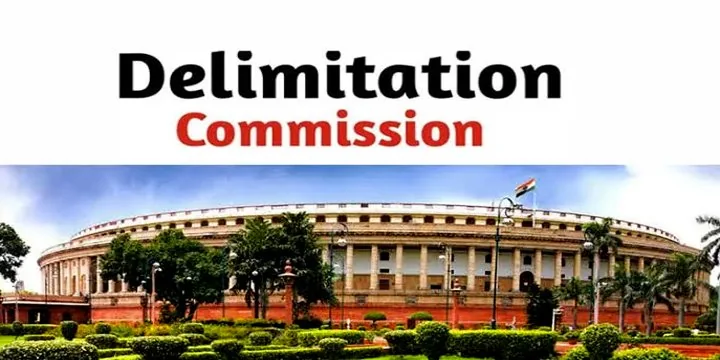
In brief: Delimitation redraws electoral constituency boundaries to reflect population and representation requirements. The constitutional framework, independence of the Delimitation Commission and debate over a future readjustment of seats raise important questions of federal balance and democratic representation.
Delimitation redraws electoral constituency boundaries to reflect population and representation requirements. The constitutional framework, independence of the Delimitation Commission and debate over a future readjustment of seats raise important questions of federal balance and democratic representation.
- What is Delimitation?:
- Delimitation is the process of redrawing constituency boundaries based on population data, carried out after each Census.
- This process ensures equal representation by adjusting the number of seats in Parliament and state Assemblies to reflect population changes.
ROLE OF DELIMITATION COMMISSION
- The Delimitation Commission is a three-member body set up by an act of Parliament.
- Its orders have the force of law and cannot be challenged in any court
- It includes two Supreme Court or High Court judges (one as chairman) and the Chief Election Commissioner as a member.
POWERS OF DELIMITATION COMMISSION
- Its orders are presented to the Lok Sabha and State Assemblies, but they cannot be changed.
- The Commission has the powers of a civil court.
- It has been set up four times: in 1952, 1963, 1973, and 2002.
- Rationale Behind Delimitation:
- States are divided into constituencies so that the population to seat ratio is the same throughout the state.
- This process ensures uniform representation in different states and constituencies within the same state.
- Constitutional Provisions:
- Article 82: Provides for the readjustment of Lok Sabha seats based on population after each Census.
- Article 170: Covers the composition of Legislative Assemblies.
- 42nd Amendment (1976): Frozen the allocation of Lok Sabha seats at the 1971 level until the 2000 Census.
- 84th Amendment (2001): Extended the freeze on seat readjustment for another 25 years until 2026.
- 87th Amendment (2003): Allowed delimitation based on the 2001 Census without changing the number of seats or constituencies.
- In the Kishorchandra Chhaganlal Rathod Case (2024), the Supreme Court ruled that the Delimitation Commission's orders could be reviewed if found to be arbitrary or in violation of constitutional principles.
- Article 329 prevents the courts from questioning laws related to delimitation or seat allotment.
- States with populations under six million were excluded from the population-based delimitation exercise.
DELIMITATION’S IMPACT ON SOUTHERN INDIA
- Kerala CM Pinarayi Vijayan warned that the Union Government’s proposed delimitation of parliamentary constituencies could reduce the representation of southern states in Parliament.
- This reduction, according to Vijayan, punishes states like Kerala for successfully controlling their population.
- Concern Over Political Motives:
- Pinarayi criticized the BJP-led Union Government for pushing delimitation without proper discussions, describing the process as driven by political motives instead of democratic values.
- He argued that delimitation based on population would benefit northern states, where the BJP has more support, while harming southern states, including Kerala.
- Federalism and Democratic Framework:
- The Kerala CM emphasized that federalism is a right of states under the Constitution and should not be weakened by centralization.
- He claimed that the Union Government’s actions, from fiscal to language policies, are disrupting India's federal system and democratic framework.
- Punishment for Population Control:
- Kerala and other southern states, which have successfully controlled their populations since 1973, are being punished even though the government had earlier praised their efforts.
- The reduction in central tax revenue (from 3.875% to 1.925%) is already hurting Kerala, with the state facing increased public health spending.
- Financial and Political Consequences:
- The reduction in parliamentary representation could lead to a loss of political voice and a further drop in the state’s share of national funds.
- This would create an unfair situation where Kerala and other southern states lose both financial support and political representation.
- United Opposition Against Delimitation:
- Kerala, along with Tamil Nadu, Andhra Pradesh, Telangana, Karnataka, Odisha, West Bengal, and Punjab, has come together in protest against the proposed changes.
- The Kerala CPM said that this meeting marked the start of a united resistance.
- Centralization of Power:
- Pinarayi warned that the proposed delimitation could lead to more power being controlled by the center, hurting India’s federal structure.
- States that focused on education, healthcare, and gender equality would be punished, making it harder to continue such progress in the future.
- Constitutional Precedents:
- Pinarayi reminded the Union Government of Dr. R. Ambedkar’s warning about the ‘tyranny of the majority’ and the Sarkaria Commission's support for federalism as a key part of the Constitution.
- Ignoring these principles would be like bringing back the old colonial system, which has always been harmful to India's unity.
- Cultural and Linguistic Diversity:
- Pinarayi highlighted that India’s strength lies in its cultural and linguistic diversity.
- He gave examples of successful state-led programs, like Kerala’s Kudumbashree and Tamil Nadu’s mid-day meal scheme, which became models for the whole country.
- Centralizing power would limit such local solutions.
- Call for Consensus and Clarity:
- The Kerala CM criticized the Union Government for failing to clarify whether the distribution of seats would be based on current parliament numbers or population figures.
- He stressed the need for agreement before moving ahead with delimitation and insisted that southern states should keep their fair share of parliamentary seats.
- Joint Action Committee's Role:
- Pinarayi concluded by saying that the Joint Action Committee will lead the fight, ensuring that democratic and federal values are respected at the national level.
CONCERNS ABOUT UPCOMING DELIMITATION
- Fear of Losing Representation:
- Southern states, with slower population growth compared to northern states, may lose seats in the Lok Sabha if delimitation is purely population-based.
- For example, Kerala may see no increase in seats, Tamil Nadu only a 26% increase, while UP and MP could see significant increases (79%).
- Concerns Over Gerrymandering:
- Southern states fear gerrymandering, the manipulation of constituency boundaries to unfairly benefit one party or group, leading to unfair representation.
- A similar case happened in Nepal (2015), where the Terai region with half the population received fewer seats than the hill regions, benefiting the hill elite.
- Threat to Federalism:
- Delimitation could increase the fiscal burden on southern states, as more seats for northern states may lead to higher central allocations per representative.
- This could lead to less political representation for southern states, making them more likely to accept policies they view as unfair.
- Discouragement to Good Governance:
- Southern states that have successfully controlled their population may face fewer seats, while states with higher fertility rates may benefit.
- This could discourage good governance and undermine policies that promote population control, potentially encouraging larger family incentives.
- North-South Division:
- Southern states may feel a growing political and economic imbalance due to fewer seats, potentially fueling calls for greater autonomy or special status.
- This could increase North-South tensions and strain national unity.
- Skewed Resource Allocation:
- Northern states may gain more central funds and welfare schemes due to increased parliamentary influence, while southern states could receive less despite better governance.
- The Finance Commission allocates funds based on population, which could disadvantage southern states.
- Weakening of Regional Parties:
- Many believe that delimitation may favor parties with a strong northern base, potentially weakening regional parties in southern states.
- This could shift the political dynamics, undermining the influence of southern regional parties.
Nari Shakti Vandan Adhiniyam (Women Reservation Bill) will come into effect
only after the delimitation of constituencies is done by a delimitation commission. The delimitation process
will decide which constituency to be reserved for women. The bill says that the law
will be applicable after an exercise of delimitation is undertaken based on the
data collected from the first census released after the passage of the bill. WHAT IS DELIMITATION?
- According to the Election Commission, the word ‘delimitation’ is defined as “the act or process of fixing limits/boundaries of territorial constituencies in a country or a province having a legislative body”.
- In the Indian context, the exercise of redrawing the boundaries of Lok Sabha and Legislative Assembly Constituencies in a region is known as delimitation.
- In this process, the number of seats allocated to a particular state/UT in Lok Sabha or in the Legislative Assembly may vary.
- For example – Delhi, a union territory with legislative assembly, has 7 Lok Sabha constituencies while in the Legislative Assembly it has 70 constituencies.
CONSTITUTIONAL PROVISIONS
- Article 82 and Article 170 of the Constitution empowers the Parliament to readjust the allocation of seats in the Lok Sabha and the Legislative Assemblies of States respectively, after every census.
- Accordingly, the Parliament enacts a Delimitation Commission Act and an independent high-powered panel known as the Delimitation Commission is constituted to carry out the exercise of delimitation.
- The Parliament has enacted the Delimitation Commission Acts in 1952, 1962, 1972 and 2002 for this purpose. There was no Delimitation Commission Act after the 1981 and 1991 census.
- The present delimitation of constituencies has been done on the basis of 2001 census data under the provisions of Delimitation Commission Act, 2002.
- The next Delimitation Commission is expected to be set up after 2026.
- Further, Article 330 and Article 332 of the Constitution provide for re-fixing the number of seats reserved for Scheduled Castes (SCs) and Scheduled Tribes (STs) in the Lok Sabha and the Legislative Assemblies of the states, on the basis of the 2001 census.
ABOUT DELIMITATION COMMISSION
- The Delimitation Commission is a high-powered committee entrusted with the task of drawing and redrawing of boundaries of different constituencies for state assembly and Lok Sabha election.
- It is appointed by the President and works in collaboration with the Election Commission.
- The Commission consists of –
- A retired or working Supreme Court Judge (chairperson)
- Election Commissioner
- Concerned State Election Commissioners.
THE DELIMITATION EXERCISES TILL NOW Delimitation results in change in the total no. of Assembly & Parliamentary seats.
- Delimitation in 1950s (Post 1951 census): Increased the seats from 489 to 494.
- Delimitation in 1960s (Post 1961 census): Increased the seats from 494 to 522.
- Delimitation in 1970s (Post 1971 census): Increased the seats from 522 to 543.
- Delimitation in 2002 (Post 2001 census): Boundaries redrawn without seat increase.
THE CONCERN The 1970s increase sparked concerns. The constitution mandates that states receive seats on the basis of
Population Ratio. (Has to be maintained uniform largely across the country) This unintentionally implied that those states which were
not undertaking Family Planning Provisions strictly,
were getting incentivised with more seats; Whereas those states which were taking Family planning seriously, were getting disincentivized for something good they were doing. Hence the seats were frozen since 1976.
Why This Topic Matters for UPSC
- Prelims: Revise definitions, institutions, locations, reports and factual features connected with Delimitation in India: Process, Commission and Concerns.
- Mains: Link the topic with Polity, Parliament, Federalism, Elections and organise the answer under background, significance, challenges and way forward.
- Interview: Explain the issue in balanced language and distinguish verified facts from opinion.
Key Takeaway
Delimitation redraws electoral constituency boundaries to reflect population and representation requirements. The constitutional framework, independence of the Delimitation Commission and debate over a future readjustment of seats raise important questions of federal balance and democratic representation.
- Prelims: Revise the key facts and terminology.
- Mains: Connect the topic with Polity, Parliament, Federalism, Elections.
- Revision: Prepare notes under background, features, significance, challenges and way forward.
Test your understanding
Questions from this article
Prelims practiceWith reference to DELIMITATION, consider the following statements:
- According to the Election Commission, the word ‘delimitation’ is defined as “the act or process of fixing limits/boundaries of territorial constituencies in a country or a province having a legislative body”.
- In the Indian context, the exercise of redrawing the boundaries of Lok Sabha and Legislative Assembly Constituencies in a region is known as delimitation.
- In this process, the number of seats allocated to a particular state/UT in Lok Sabha or in the Legislative Assembly may vary. For example – Delhi, a union territory with legislative assembly, has 7 Lok Sabha…
Which of the statements given above are correct?
- 1 and 2 only
- 2 and 3 only
- 1 and 3 only
- 1, 2 and 3
View answer
Answer: (d) 1, 2 and 3. All three statements are drawn from the article.
Mains practiceDiscuss the background, key issues and significance of DELIMITATION for India.
Answer in 250 words.
View answer approach
- WHAT IS DELIMITATION?
- CONSTITUTIONAL PROVISIONS
- ABOUT DELIMITATION COMMISSION
Frequently asked questionsFrequently asked questions
What is Delimitation in India?
Delimitation redraws electoral constituency boundaries to reflect population and representation requirements. The constitutional framework, independence of the Delimitation Commission and debate over a future readjustment of seats raise important questions of federal balance and democratic representation.
Why is Delimitation in India important for UPSC?
It connects current developments with Polity, Parliament, Federalism, Elections and supports factual revision as well as analytical answer writing.
How should aspirants prepare Delimitation in India?
Prepare a short definition, key facts, institutional or legal framework, significance, challenges and a balanced way forward. Revise the specific developments and examples explained in the article.