UPSC Current Affairs
DELHI WATER CRISIS DUE TO AMMONIA SPIKE
In January 2026, Delhi plunged into a massive drinking water crisis as six of its nine major Water Treatment Plants (WTPs) were forced to shut down or operate at minimal capacity. The crisis, which disrupted supply to nearly 50% of the city, was caused by a "double blow": record-breaking ammonia levels in the Yamuna River and the unscheduled closure of the Munak Canal for repairs. IMMEDIATE CAUSES The Ammonia Spike: Ammonia concentrations in the Yamuna surged to 3 ppm, far exceeding the maximum treatable limit of 1 ppm for Delhi’s aging infrastructure.
VRAuthor Desk
3 min read
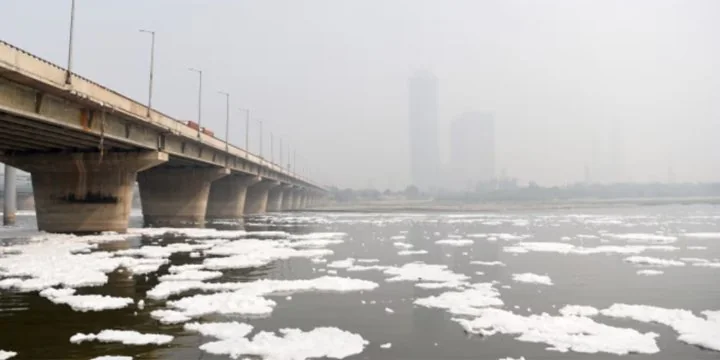
In January 2026, Delhi plunged into a massive drinking water crisis as six of its nine major Water Treatment Plants (WTPs) were forced to shut down or operate at minimal capacity. The crisis, which disrupted supply to nearly 50% of the city, was caused by a "double blow": record-breaking ammonia levels in the Yamuna River and the unscheduled closure of the Munak Canal for repairs. IMMEDIATE CAUSES The Ammonia Spike: Ammonia concentrations in the Yamuna surged to 3 ppm, far exceeding the maximum treatable limit of 1 ppm for Delhi’s aging infrastructure.
Why in News?
- In January 2026, Delhi plunged into a massive drinking water crisis as six of its nine major Water Treatment Plants (WTPs) were forced to shut down or operate at minimal capacity.
- The crisis, which disrupted supply to nearly 50% of the city, was caused by a "double blow": record-breaking ammonia levels in the Yamuna River and the unscheduled closure of the Munak Canal for repairs.
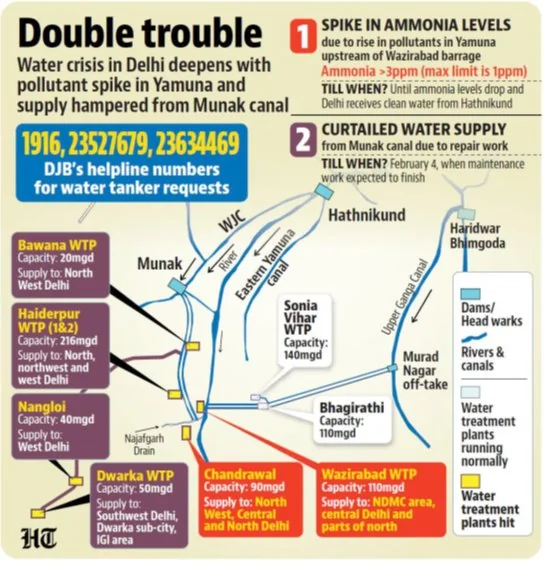
IMMEDIATE CAUSES
- The Ammonia Spike:
- Ammonia concentrations in the Yamuna surged to 3 ppm, far exceeding the maximum treatable limit of 1 ppm for Delhi’s aging infrastructure.
- This forced the immediate shutdown of the Wazirabad and Chandrawal
- Munak Canal Closure: A critical raw water lifeline from Haryana, the Munak Canal, was closed for unscheduled maintenance on January 19, 2026.
- The Impact: Raw water supply was slashed by 50%
- Duration: Disruptions are expected to persist until February 4, 2026.
- Dilution Failure:
- Normally, ammonia is diluted by diverting fresh water from the Munak Canal into the Wazirabad pond.
- Since the canal itself was shut, no dilution was possible, leading to a total system collapse.
SCALE OF IMPACT SUPPLY SHORTFALL
- Volume: Against a normal daily demand of 1000 MGD (Million Gallons per Day), the city faced a shortfall of nearly 400-500 MGD.
- Geographic Spread: Severe shortages hit North, West, Central, and South-West Delhi.
- Lutyens' Delhi: Even the New Delhi Municipal Council (NDMC) areas and VVIP zones experienced 45-50% supply cuts.
ABOUT NH3
- Chemical Nature:
- A colorless, pungent gas composed of nitrogen and hydrogen (NH3).
- It is highly soluble in water, forming aqueous ammonia.
- Industrial Production: Manufactured via the Haber-Bosch process under high pressure and temperature.
- Applications:
- Agriculture: Approximately 90% of global ammonia is used in fertilizers (e.g., Ammonium Nitrate).
- Industry: Used as a refrigerant, in plastics, explosives, dyes, and pharmaceuticals.
- Environmental Hazard:
- It is highly toxic to aquatic life.
- In drinking water, it reacts with chlorine to form chloramines, reducing disinfection efficiency and altering the taste/smell of water.
CHRONIC POLLUTION & GOVERNANCE DEFICIT
- Seasonal Pattern:
- Ammonia spikes are a recurring winter phenomenon (15-22 times annually) due to reduced river flow and the concentration of industrial effluents from Haryana's Panipat and Sonipat regions.
- Infrastructure Lag:
- Despite an announcement in the Delhi Budget 2022-23, a specialized Ammonia Treatment Plant at Wazirabad has not yet been commissioned, leaving the city vulnerable to predictable pollution events.
DELHI’S WATER DEPENDANCE MATRIX
| Source |
Contribution |
Status during Jan 2026 Crisis |
| Yamuna & Related Canals |
40.8% |
Crippled due to high ammonia. |
| Ganga (via UP) |
26.5% |
Operational; only source providing stable supply. |
| Bhakra Storage (via Haryana) |
23.1% |
Reduced due to Munak Canal repairs. |
| Groundwater/Recycled |
9.6% |
Insufficient to meet the massive deficit. |
GOVERNMENT & ADMINISTRATIVE RESPONSE
- Delhi Jal Board (DJB): Rationalized the remaining supply from Ganga-fed plants and deployed water tankers to parched colonies.
- Inter-State Coordination: The Delhi Government petitioned the Haryana Government to increase the release of water from the Hathini Kund Barrage to flush out the ammonia-laden water in the Yamuna.
- Judicial Oversight: The crisis has once again brought the Upper Yamuna River Board (UYRB) under the scanner for failing to ensure pollution-free raw water transit between states.
CONCLUSION
The 2026 water crisis highlights that Delhi’s water security is precariously balanced between trans-boundary river health and local infrastructure readiness. While the Ganga-fed plants provided a slim safety net, the delayed commissioning of the Wazirabad ammonia treatment facility remains a significant governance bottleneck in achieving a "Water-Plus" Delhi.
- Prelims: Key facts, institutions, locations and terminology in the article.
- Mains: Connect the topic with Environment, Polity & Governance, Health.
- Revision: Use the article headings to prepare concise notes and answer-writing points.
Test your understanding
Questions from this article
Prelims practiceWith reference to DELHI WATER CRISIS DUE TO AMMONIA SPIKE, consider the following statements:
- In January 2026, Delhi plunged into a massive drinking water crisis as six of its nine major Water Treatment Plants (WTPs) were forced to shut down or operate at minimal capacity.
- The crisis, which disrupted supply to nearly 50% of the city, was caused by a "double blow": record-breaking ammonia levels in the Yamuna River and the unscheduled closure of the Munak Canal for repairs.
- The Ammonia Spike: Ammonia concentrations in the Yamuna surged to 3 ppm, far exceeding the maximum treatable limit of 1 ppm for Delhi’s aging infrastructure. This forced the immediate shutdown of the Wazirabad and…
Which of the statements given above are correct?
- 1 and 2 only
- 2 and 3 only
- 1 and 3 only
- 1, 2 and 3
View answer
Answer: (d) 1, 2 and 3. All three statements are drawn from the article.
Mains practiceDiscuss the background, key issues and significance of DELHI WATER CRISIS DUE TO AMMONIA SPIKE for India.
Answer in 250 words.
View answer approach
- Why in News?
- IMMEDIATE CAUSES
- SCALE OF IMPACT SUPPLY SHORTFALL
- ABOUT NH3
- CHRONIC POLLUTION & GOVERNANCE DEFICIT
Frequently asked questionsFrequently asked questions
Why is Delhi Water Crisis Due To Ammonia Spike in the news?
In January 2026, Delhi plunged into a massive drinking water crisis as six of its nine major Water Treatment Plants (WTPs) were forced to shut down or operate at minimal capacity. The crisis, which disrupted supply to nearly 50% of the city, was caused by a "double blow": record-breaking ammonia levels in the Yamuna River and the unscheduled closure of the Munak Canal for repairs.
What are the key facts about Delhi Water Crisis Due To Ammonia Spike?
IMMEDIATE CAUSES The Ammonia Spike: Ammonia concentrations in the Yamuna surged to 3 ppm, far exceeding the maximum treatable limit of 1 ppm for Delhi’s aging infrastructure. This forced the immediate shutdown of the Wazirabad and Chandrawal Munak Canal Closure: A critical raw water lifeline from Haryana, the Munak Canal, was closed for unscheduled maintenance on January 19, 2026. The Impact: Raw water supply was slashed by 50% Duration: Disruptions are expected to persist until February 4, 2026.
Why is Delhi Water Crisis Due To Ammonia Spike important for UPSC preparation?
The topic connects current developments with Environment, Polity & Governance, Health and is relevant for both objective revision and analytical answer writing.