Cyclone Remal made landfall between
West Bengal’s Sagar Island and Bangladesh’s Khepupara. It will be the first pre-monsoon tropical cyclone in the Bay of Bengal this year.
WHAT DOES THE NAME MEAN & WHO CHOSE IT?
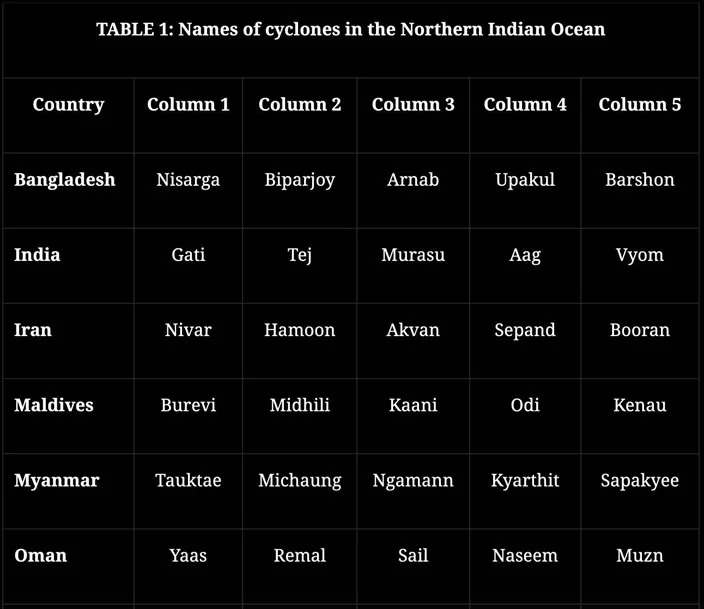
The name Remal, meaning ‘sand’ in Arabic, was chosen Oman, and assigned according to the standard convention of naming tropical cyclones in the region.
NAMING OF CYCLONES
Realising the importance of an effective cyclone warning and disaster mitigation in the
North Indian Ocean region (comprising both the Arabian Sea and the Bay of Bengal),
WMO came together
in 1972 to establish the
Panel on Tropical Cyclones (PTC).
WHO WERE THE MEMBERS IN PTC?
The PTC originally comprised eight member countries — Bangladesh, India, Maldives, Myanmar, Pakistan, Sri Lanka, Sultanate of Oman and Thailand.
WHEN DID THE NAMING START?
In its
27th session held in
2000 in Muscat, Oman, the PTC agreed to assign names to the tropical cyclones in the Bay of Bengal and Arabian Sea. After each country in the panel sent its recommendations, the PTC finalised its list and
started naming cyclones in the region in 2004.
EXPANSION OF PTC:
The PTC, in 2018, expanded to include Iran, Qatar, Saudi Arabia, United Arab Mirates and Yemen.
LIST OF 169 (13*13) CYCLONES:
In April 2020, a list of
169 cyclone names were released — 13 suggestions each from the 13 countries. It is this list that is currently being used to name cyclones.
GUIDELINES WHICH COUNTRIES NEED TO FOLLOW:
There are
some basic guidelines that countries needed to follow while sending in their proposals. These include ensuring that the proposed name is
- Neutral to (a) politics and political figures (b) religious believes, (c) cultures and (d) gender;
- Does not hurt the sentiments of any group of population over the globe;
- Is not very rude and cruel in nature;
- Is short, easy to pronounce, and not offensive to any PTC member;
- Is at most eight letters long;
- Is provided with its pronunciation and voice over; and
- Is not repeated (not before, not after).
These names are allotted to any cyclone, which takes place in the region, on a rotational basis regardless of which country proposed it.
For instance, the first cyclone after the list was named Nisarga which hit Maharashtra, followed by Gati (India’s choice, hit Somalia), Nivar (Iran’s choice, hit Tamil Nadu), and so on.
WHY NAME CYCLONES?
- Adopting names for cyclones makes it easier for people to remember, as opposed to numbers and technical terms.
- Apart from the general public, it also helps the scientific community, the media, disaster managers
- With a name, it is easy to identify individual cyclones, create awareness of its development, rapidly disseminate warnings to increase community preparedness and remove confusion where there are multiple cyclonic systems over a region.
Other regions of the world have similar naming conventions for tropical storms.
Test your understanding
Questions from this article
Prelims practiceWith reference to Cyclone Remal, consider the following statements:
- Neutral to (a) politics and political figures (b) religious believes, (c) cultures and (d) gender;
- Does not hurt the sentiments of any group of population over the globe;
- Is not very rude and cruel in nature;
Which of the statements given above are correct?
- 1 and 2 only
- 2 and 3 only
- 1 and 3 only
- 1, 2 and 3
View answer
Answer: (d) 1, 2 and 3. All three statements are drawn from the article.
Mains practiceDiscuss the background, key issues and significance of Cyclone Remal for India.
Answer in 250 words.
View answer approach
- WHY NAME CYCLONES?
- Background and context
- Key facts and institutional framework
- Significance and way forward
Frequently asked questionsFrequently asked questions
Why is Cyclone Remal in the news?
Cyclone Remal made landfall between West Bengal’s Sagar Island and Bangladesh’s Khepupara. It will be the first pre-monsoon tropical cyclone in the Bay of Bengal this year.
What are the key facts about Cyclone Remal?
WHAT DOES THE NAME MEAN & WHO CHOSE IT? The name Remal, meaning ‘sand’ in Arabic, was chosen Oman, and assigned according to the standard convention of naming tropical cyclones in the region. NAMING OF CYCLONES Realising the importance of an effective cyclone warning and disaster mitigation in the North Indian Ocean region (comprising both the Arabian Sea and the Bay of Bengal), WMO came together in 1972 to establish the Panel on Tropical Cyclones…
Why is Cyclone Remal important for UPSC preparation?
The topic connects current developments with Economy, International Relations and is relevant for both objective revision and analytical answer writing.