UPSC Current Affairs
Ahom burial sites
Why in news: The Centre has decided to nominate Assam’s Charaideo Maidams — the Ahom equivalent of the ancient Egyptian pyramids — for the UNESCO World Heritage Site status this year. There is currently no World Heritage Site in the category of cultural heritage in the northeast. The Maidams, represents the late medieval (13th19th century CE) mound burial tradition of the Tai Ahom community in Assam.
VRAuthor Desk
2 min read
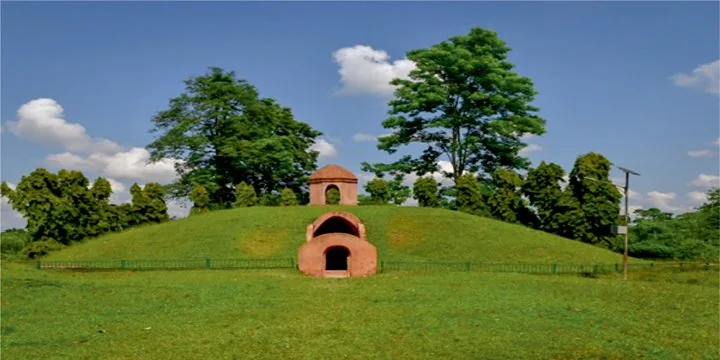
Why in news: The Centre has decided to nominate Assam’s Charaideo Maidams — the Ahom equivalent of the ancient Egyptian pyramids — for the UNESCO World Heritage Site status this year. There is currently no World Heritage Site in the category of cultural heritage in the northeast. The Maidams, represents the late medieval (13th19th century CE) mound burial tradition of the Tai Ahom community in Assam.
Why in news:
- The Centre has decided to nominate Assam’s Charaideo Maidams — the Ahom equivalent of the ancient Egyptian pyramids — for the UNESCO World Heritage Site status this year.
- There is currently no World Heritage Site in the category of cultural heritage in the northeast.
- The Maidams, represents the late medieval (13th19th century CE) mound burial tradition of the Tai Ahom community in Assam.
About Ahom Dynasty:
- The Ahom kingdom (1228–1826) was a late medieval kingdom in the Brahmaputra Valley in Assam.
- It maintained its sovereignty for nearly 600 years having successfully resisted Mughal expansion in Northeast India.
- The Ahom rule lasted for about 600 years until the British annexed Assam in 1826.
- Charaideo, more than 400 km east of Guwahati, was the first capital of the Ahom dynasty founded by Chao Lung SiuKaPha in 1253.
About Maidams:
- The Charaideo Maidams enshrine the mortal remains of the members of the Ahom royalty, who used to be buried with their paraphernalia.
- After the 18th century, the Ahom rulers adopted the Hindu method of cremation and began entombing the cremated bones and ashes in a Maidam at Charaideo.
- Burial is the predominant funeral rite of the Taj people, to which the Ahom peopleoriginally belonged.
- This is opposed to the Hindu system of cremation. After the Ahom kings adopted Hinduism, they chose to bury the ashes after cremation.
- The Ahomcommunity in Assam consider the excavation as an affront to their tradition, because the maidamsare associated with the Ahom ancestor worship and the festival of Me-Dam-Me-Phi.
Syllabus: Prelims + Mains; GS 1 – Art and Culture
- Prelims: Key facts, institutions, locations and terminology in the article.
- Mains: Connect the topic with UPSC Current Affairs.
- Revision: Use the article headings to prepare concise notes and answer-writing points.
Test your understanding
Questions from this article
Prelims practiceWith reference to Ahom burial sites, consider the following statements:
- The Centre has decided to nominate Assam’s Charaideo Maidams — the Ahom equivalent of the ancient Egyptian pyramids — for the UNESCO World Heritage Site status this year.
- There is currently no World Heritage Site in the category of cultural heritage in the northeast.
- The Maidams, represents the late medieval (13th19th century CE) mound burial tradition of the Tai Ahom community in Assam.
Which of the statements given above are correct?
- 1 and 2 only
- 2 and 3 only
- 1 and 3 only
- 1, 2 and 3
View answer
Answer: (d) 1, 2 and 3. All three statements are drawn from the article.
Mains practiceDiscuss the background, key issues and significance of Ahom burial sites for India.
Answer in 250 words.
View answer approach
- Why in news:
- About Ahom Dynasty:
- About Maidams:
Frequently asked questionsFrequently asked questions
Why is Ahom Burial Sites in the news?
Why in news: The Centre has decided to nominate Assam’s Charaideo Maidams — the Ahom equivalent of the ancient Egyptian pyramids — for the UNESCO World Heritage Site status this year. There is currently no World Heritage Site in the category of cultural heritage in the northeast.
What are the key facts about Ahom Burial Sites?
The Maidams, represents the late medieval (13th19th century CE) mound burial tradition of the Tai Ahom community in Assam. About Ahom Dynasty: The Ahom kingdom (1228–1826) was a late medieval kingdom in the Brahmaputra Valley in Assam. It maintained its sovereignty for nearly 600 years having successfully resisted Mughal expansion in Northeast India.
Why is Ahom Burial Sites important for UPSC preparation?
The topic connects current developments with UPSC Current Affairs and is relevant for both objective revision and analytical answer writing.