UPSC Current Affairs
A plan to join the Red Sea with Mediterranean — an alternative to the Suez Canal
A look at the Suez Canal’s salience. When it opened in 1869, the Suez Canal revolutionised global maritime trade. By connecting the Mediterranean and Red Seas through the Isthmus of Suez, it ensured that ships travelling between Europe and Asia would not have to travel all the way around the continent of Africa.
VRAuthor Desk
3 min read
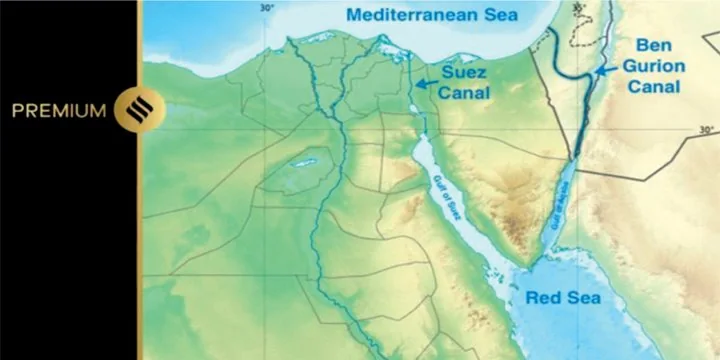
A look at the Suez Canal’s salience. When it opened in 1869, the Suez Canal revolutionised global maritime trade. By connecting the Mediterranean and Red Seas through the Isthmus of Suez, it ensured that ships travelling between Europe and Asia would not have to travel all the way around the continent of Africa.
A look at the Suez Canal’s salience.
- When it opened in 1869, the Suez Canal revolutionised global maritime trade. By connecting the Mediterranean and Red Seas through the Isthmus of Suez, it ensured that ships travelling between Europe and Asia would not have to travel all the way around the continent of Africa.
- The canal cut the distance between London and Bombay (now Mumbai) by a more than 41 per cent.
- In the 2022-23 fiscal year, around 26,000 vessels crossed the Suez Canal, accounting for approximately 13 per cent of global shipping.
The canal, however, has its issues.
- First, the 193 km-long, 205 m-wide, and 24 m-deep Suez Canal is the world’s biggest shipping bottleneck. Despite being widened and deepened over the years, it remains perennially congested, with long queues at either end.
- In March 2021, the mammoth cargo ship Ever Given got stuck in the canal, blocking passage for more than a week. It was estimated that the resulting “traffic jam” held up an estimated $ 9.6 billion of goods every day.
- Also, Egypt’s control over the waterway has been a source of conflict for almost 70 years now. In 1956, after President Gamal Abdel Nasser (1918-70) decided to nationalise the canal, war broke out, with the UK, France, and Israel attacking Egypt in order to regain control.
- The Suez Crisis ended in a military victory for the aggressors but an overwhelming political victory for Egypt, which kept control over the canal, which was shut for more than six months due to the conflict. This was also a pivotal moment in the Cold War, with Soviet threats of intervention key to stopping the allied aggression against Egypt.
- The Suez Canal was also the focal point of both the 1967 and 1973 Arab-Israeli wars, and was shut from 1967-75.
- The canal is, of course, critical to Egypt’s economy. It collects all the toll revenue generated, in addition to the benefits it brings to its local economy. In the 2022-23 fiscal year, Egypt’s Suez Canal Authority saw toll revenues reach a record $ 9.4 billion — accounting for nearly 2 per cent of Egypt’s GDP
Thus, for the West, a shipping lane through Israel would be ideal.
- It remains unclear when the first concrete plan for the alternative was suggested. The documented evidence can be seen in a declassified 1963 US government memorandum. The memo called for the use of nuclear explosives to dig the canal through the Negev Desert in Israel.
- The Ben Gurion Canal Project, named after Israel’s founding father David Ben-Gurion (1886-1973), remains one of the most ambitious infrastructure projects ever planned on paper.
What has stopped Israel from constructing the canal?
- First and foremost, such a project would be extremely complex and almost prohibitively expensive. The estimated cost of such a project may be as high as the $ 100 billion, much more than what it might take to widen the Suez Canal and solve its traffic problem.
- According to the previous cited memo, it was the cost of digging such a canal conventionally that made planners look at the nuclear option. Of course, the risk of nuclear fallout makes this option extremely risky as well.
Conclusion- Costs aside, the planned route of the Ben Gurion Canal is over 100 km longer than the Suez Canal, primarily due to limitations of the terrain and topography. Even if built, many ships might still favour the older, shorter route.Most importantly, however, a canal which will potentially transport billions of dollars worth of freight daily cannot run in land under constant military threat, from Hamas rockets or Israeli attacks.
Syllabus- GS-1; Human Geography
Source- Indian Express
- Prelims: Key facts, institutions, locations and terminology in the article.
- Mains: Connect the topic with Economy, Defence, Polity & Governance.
- Revision: Use the article headings to prepare concise notes and answer-writing points.
Test your understanding
Questions from this article
Prelims practiceWith reference to A plan to join the Red Sea with Mediterranean — an alternative to the Suez Canal, consider the following statements:
- When it opened in 1869, the Suez Canal revolutionised global maritime trade. By connecting the Mediterranean and Red Seas through the Isthmus of Suez, it ensured that ships travelling between Europe and Asia would not…
- The canal cut the distance between London and Bombay (now Mumbai) by a more than 41 per cent.
- In the 2022-23 fiscal year, around 26,000 vessels crossed the Suez Canal, accounting for approximately 13 per cent of global shipping.
Which of the statements given above are correct?
- 1 and 2 only
- 2 and 3 only
- 1 and 3 only
- 1, 2 and 3
View answer
Answer: (d) 1, 2 and 3. All three statements are drawn from the article.
Mains practiceDiscuss the background, key issues and significance of A plan to join the Red Sea with Mediterranean — an alternative to the Suez Canal for India.
Answer in 250 words.
View answer approach
- What has stopped Israel from constructing the canal?
- Background and context
- Key facts and institutional framework
- Significance and way forward
Frequently asked questionsFrequently asked questions
Why is A Plan To Join The Red Sea With Mediterranean — An Alternative To The Suez Canal in the news?
A look at the Suez Canal’s salience. When it opened in 1869, the Suez Canal revolutionised global maritime trade.
What are the key facts about A Plan To Join The Red Sea With Mediterranean — An Alternative To The Suez Canal?
By connecting the Mediterranean and Red Seas through the Isthmus of Suez, it ensured that ships travelling between Europe and Asia would not have to travel all the way around the continent of Africa. The canal cut the distance between London and Bombay (now Mumbai) by a more than 41 per cent. In the 2022-23 fiscal year, around 26,000 vessels crossed the Suez Canal, accounting for approximately 13 per cent of global shipping.
Why is A Plan To Join The Red Sea With Mediterranean — An Alternative To The Suez Canal important for UPSC preparation?
The topic connects current developments with Economy, Defence, Polity & Governance and is relevant for both objective revision and analytical answer writing.