UPSC Current Affairs
10th SCHEDULE
Recently, Maharashtra Assembly Speaker refused to disqualify 40 MLAs of the Eknath Shinde faction after recognising it as the real Shiv Sena party. MORE ABOUT THE ISSUE: In June 2022, there was a split in Shiv Sena party and a faction of the Shiv Sena headed by Eknath Shinde moved with 37 of the 55 MLAs and claimed to be the real Shiv Sena. The new faction appointed Bharat Gogawale as its whip.
VRAuthor Desk
4 min read
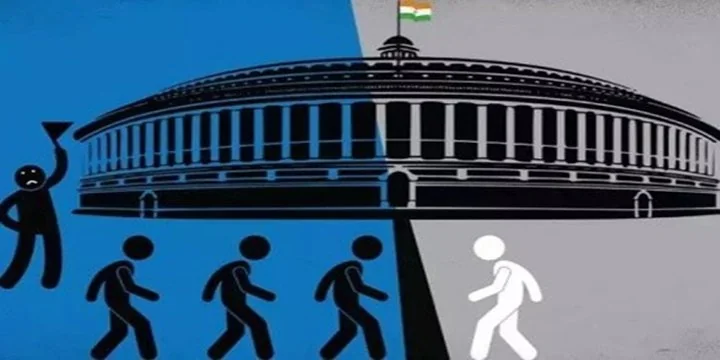
Recently, Maharashtra Assembly Speaker refused to disqualify 40 MLAs of the Eknath Shinde faction after recognising it as the real Shiv Sena party. MORE ABOUT THE ISSUE: In June 2022, there was a split in Shiv Sena party and a faction of the Shiv Sena headed by Eknath Shinde moved with 37 of the 55 MLAs and claimed to be the real Shiv Sena. The new faction appointed Bharat Gogawale as its whip.
WHY IN NEWS?
- Recently, Maharashtra Assembly Speaker refused to disqualify 40 MLAs of the Eknath Shinde faction after recognising it as the real Shiv Sena party.
MORE ABOUT THE ISSUE:
- In June 2022, there was a split in Shiv Sena party and a faction of the Shiv Sena headed by Eknath Shinde moved with 37 of the 55 MLAs and claimed to be the real Shiv Sena.
- The new faction appointed Bharat Gogawale as its whip.
- Recently, Speaker has recognised the Eknath Shinde faction as the real Shiv Sena and held the appointment of whip by this group as valid.
- The Speaker’s decision was based on the strength of members of the Shinde faction and the party’s 1999 constitution.
- The Speaker based on this ruling also refused to disqualify 40 MLAs of the Shinde faction.
GENESIS OF 10TH SCHEDULE:
- The frequent defections during the 1960s and 70s from their parent parties created political instability in many States and thus bringing down elected governments formed by the mandate.
- Therefore, to ensure the stability of elected governments, the 52nd constitutional amendment introduced the ‘anti-defection’ law by inserting Tenth Schedule in 1985.
ABOUT 10TH SCHEDULE:
- It deals with situations of defection in Parliament or state legislatures by:
(a) members of a political party
(b) independent members
(c) nominated members.
- The political party is the entire organisation of a party including the legislators on the other hand, the ‘legislature party’ is only the members of a political party in a House of Parliament or State legislature.
- The instruction with respect to voting is issued by the ‘whip’ of a party.
- A ‘whip’ is a member of the ‘legislature party’ in a House who is appointed as such by the respective ‘political party’.
- If the question arises as to whether a member of a House has become subject to disqualification under this Schedule, the question shall be referred for the decision of the Chairman and the Speaker of such House and his decision shall be final.
GROUNDS OF DISQUALIFICATION:
A Member could be disqualified:
- If he or she voluntarily gives up the membership of a political party or joins any other political party after the election, votes or abstains from any crucial voting contrary to the directive circulated by his/her respective political party.
- A nominated member if he/she joins any political party after six months from the date he/she takes his seat.
EXCEPTIONS FROM DISQUALIFICATIONS:
- The schedule initially provided for two exceptions that would not render the members liable for disqualification.
- First, one-third members of the ‘legislature party’ splitting to form a separate group (para 3).
- Second, merger of their ‘political party’ with another party, approved by two-third members of its ‘legislature party’(para 4).
- Later, in a move to strengthen the ‘anti-defection’ law, provision of one-third members of the ‘legislature party’ splitting to form a separate group was omitted in 2003.
ISSUES IN 10TH SCHEDULE:
- There have been cases of two-third members of a legislature party ‘practically’ defecting but claiming to be the original political party in order to escape disqualification.
- Also cases where more than two-third members of a State ‘legislature party’ of a national political party merged themselves with another political party to escape disqualification.
- As the authority to decide on the disqualification of members is vested in the Speaker of the House. While they are expected to perform this constitutional role in a neutral and transparent manner, past instances have hardly inspired confidence with Speakers favouring the ruling dispensation.
- The Supreme Court in K. M. Singh versus Speaker of Manipur (2020), recommended that Parliament should amend the Constitution to vest these powers in an independent tribunal headed by judges.
REQUIRED REFORMS IN 10TH SCHEDULE:
- The Supreme Court in Sadiq Ali versus Election Commission of India (1971), laid down the three-test formula for determining the original political party in case of split by the Election Commission.
- The 3-test formula comprises of:
- i) aims and objects of the party
- ii) its affairs as per the party’s constitution that reflect inner party democracy
- iii) and majority in the legislative and organisation wings.
- The Supreme Court judgment of setting up of an independent tribunal to decide on disqualification of members will reduce the ambiguities surrounding the Tenth Schedule.
- The real reform required is in institutionalising the internal democracy through regular inner party elections in our political parties under Election Commission’s supervision.
WAY FORWARD:
- Alhough the law has succeeded in a reasonable way but due to countable loopholes, it has not been able to achieve the best it can.
The government should relook at the suggestions of Report of the National Commission to review the working of the Constitution of India (2002), Hashim Abdul Halim committee report ( 2003) and 255th report of the Law Commission of India (2015) and make suitable amendments to the existing law to help it to develop to the best possible extent.
- Prelims: Key facts, institutions, locations and terminology in the article.
- Mains: Connect the topic with Polity & Governance.
- Revision: Use the article headings to prepare concise notes and answer-writing points.
Test your understanding
Questions from this article
Prelims practiceWith reference to 10th SCHEDULE, consider the following statements:
- Recently, Maharashtra Assembly Speaker refused to disqualify 40 MLAs of the Eknath Shinde faction after recognising it as the real Shiv Sena party.
- In June 2022, there was a split in Shiv Sena party and a faction of the Shiv Sena headed by Eknath Shinde moved with 37 of the 55 MLAs and claimed to be the real Shiv Sena.
- The new faction appointed Bharat Gogawale as its whip.
Which of the statements given above are correct?
- 1 and 2 only
- 2 and 3 only
- 1 and 3 only
- 1, 2 and 3
View answer
Answer: (d) 1, 2 and 3. All three statements are drawn from the article.
Mains practiceDiscuss the background, key issues and significance of 10th SCHEDULE for India.
Answer in 250 words.
View answer approach
- WHY IN NEWS?
- MORE ABOUT THE ISSUE:
- GENESIS OF 10TH SCHEDULE:
- ABOUT 10TH SCHEDULE:
- EXCEPTIONS FROM DISQUALIFICATIONS:
Frequently asked questionsFrequently asked questions
Why is 10Th Schedule in the news?
Recently, Maharashtra Assembly Speaker refused to disqualify 40 MLAs of the Eknath Shinde faction after recognising it as the real Shiv Sena party. MORE ABOUT THE ISSUE: In June 2022, there was a split in Shiv Sena party and a faction of the Shiv Sena headed by Eknath Shinde moved with 37 of the 55 MLAs and claimed to be the real Shiv Sena.
What are the key facts about 10Th Schedule?
The new faction appointed Bharat Gogawale as its whip. Recently, Speaker has recognised the Eknath Shinde faction as the real Shiv Sena and held the appointment of whip by this group as valid. The Speaker’s decision was based on the strength of members of the Shinde faction and the party’s 1999 constitution.
Why is 10Th Schedule important for UPSC preparation?
The topic connects current developments with Polity & Governance and is relevant for both objective revision and analytical answer writing.