UPSC Current Affairs
20TH EAST ASIA SUMMIT
The 20th East Asia Summit (EAS) was held in Kuala Lumpur, Malaysia, reaffirming its enduring commitment to multilateralism, international law, and collective peacebuilding. The summit adopted the Kuala Lumpur Declaration on Peace and Stability (2025) — a landmark reaffirmation of the EAS’s founding principles and its role in maintaining peace, stability, and prosperity in the Indo-Pacific region. It also commemorated 20 years of the EAS, reaffirming earlier milestone declarations that have shaped its evolution.
VRAuthor Desk
3 min read
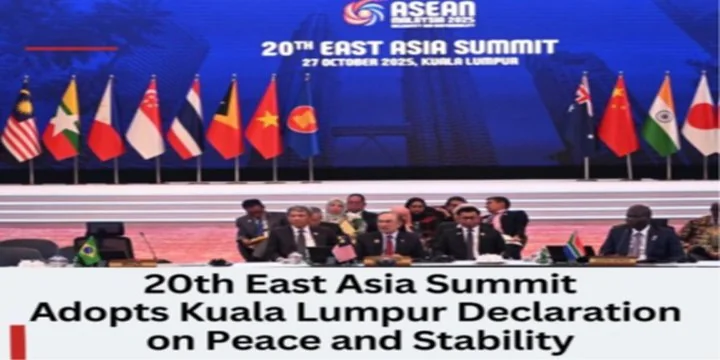
The 20th East Asia Summit (EAS) was held in Kuala Lumpur, Malaysia, reaffirming its enduring commitment to multilateralism, international law, and collective peacebuilding. The summit adopted the Kuala Lumpur Declaration on Peace and Stability (2025) — a landmark reaffirmation of the EAS’s founding principles and its role in maintaining peace, stability, and prosperity in the Indo-Pacific region. It also commemorated 20 years of the EAS, reaffirming earlier milestone declarations that have shaped its evolution.
- The 20th East Asia Summit (EAS) was held in Kuala Lumpur, Malaysia, reaffirming its enduring commitment to multilateralism, international law, and collective peacebuilding.
- The summit adopted the Kuala Lumpur Declaration on Peace and Stability (2025) — a landmark reaffirmation of the EAS’s founding principles and its role in maintaining peace, stability, and prosperity in the Indo-Pacific region.
- It also commemorated 20 years of the EAS, reaffirming earlier milestone declarations that have shaped its evolution.
CONTINUITY OF COMMITMENTS
The 2025 Declaration reaffirmed earlier foundational instruments:
- 2005 Kuala Lumpur Declaration – Vision and principles establishing the EAS.
- 2010 Ha Noi Declaration – 5th Anniversary of EAS.
- 2015 Kuala Lumpur Declaration – 10th Anniversary.
- 2020 Ha Noi Declaration – 15th Anniversary.
- 2011 Bali Principles Declaration – Principles for Mutually Beneficial Relations.
These collectively form the
core constitutional framework of the East Asia Summit.
ABOUT EAST ASIA SUMMIT
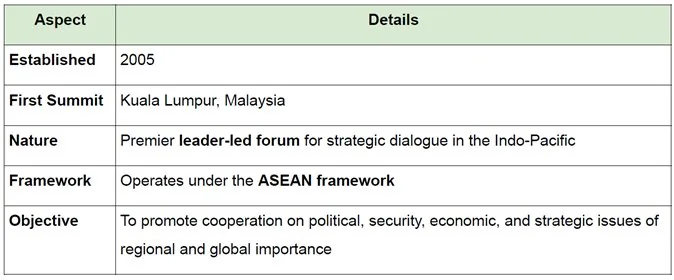
MEMBERSHIP
- ASEAN-10: Brunei, Cambodia, Indonesia, Laos, Malaysia, Myanmar, the Philippines, Singapore, Thailand, and Vietnam.
- Plus 8 Partners: Australia, China, India, Japan, New Zealand, South Korea, Russia, and the United States.
Collective Stats (2024):
- ~53% of the world’s population
- ~60% of global GDP
INDIA & EAST ASIA SUMMIT
- Founding Member of the EAS (since 2005).
- Considers EAS a key pillar of its Act East Policy and Indo-Pacific vision.
- Platform for India to engage major powers and promote free, open, and rules-based Indo-Pacific cooperation.
- At the 22nd ASEAN–India Summit (Kuala Lumpur, 2025), India declared 2026 as the ASEAN–India Year of Maritime Cooperation to deepen ties in:
- Blue Economy
- Maritime Security & Connectivity
- Sustainable Fisheries and Disaster Management.
MAJOR HIGHLIGHTS OF 2025 DECLARATION
| Theme |
Key Provisions |
| 1. Commitment to Multilateralism & International Law |
Reaffirmed dedication to UN Charter, ASEAN Charter, and the Treaty of Amity and Cooperation (TAC) as guiding instruments. |
| 2. Recognition of Global Challenges |
Acknowledged the impact of geopolitical tensions, economic uncertainties, security threats, and transboundary issues; called for collective global response. |
| 3. ASEAN Unity & Centrality |
Reaffirmed ASEAN as the driving force within the EAS and the broader regional architecture. |
| 4. Peaceful Dispute Resolution |
Emphasized dialogue, mutual respect, and adherence to international law — including UNCLOS 1982 — to resolve regional disputes. |
| 5. Strengthening EAS Framework |
Called for continued implementation of the EAS Plan of Action (2024–2028) and maintenance of the forum’s informal, consultative nature. |
| 6. Roles of EAS Mechanisms |
Acknowledged the work of the EAS Foreign Ministers, Senior Officials, EAS Ambassadors in Jakarta, and the EAS Unit within ASEAN Secretariat for coordination and policy continuity. |
| 7. Economic Cooperation & Resilience |
Reaffirmed cooperation to enhance regional resilience, sustainable development, and reduction of development gaps. |
| 8. ASEAN Outlook on Indo-Pacific (AOIP) |
Reiterated support for the ASEAN Outlook on the Indo-Pacific (AOIP) — promoting inclusivity, connectivity, and community-building in the Indo-Pacific. |
| 9. Dialogue & Cooperation |
Emphasized that the EAS will remain a leader-led, open forum for candid, constructive, and cooperative dialogue on political, economic, and strategic issues. |
| 10. Vision for the Future |
Reaffirmed the EAS as a cornerstone of regional peace, committed to upholding mutual respect, equality, partnership, and consultation. |
SIGNIFICANCE OF THE DECLARATION
| Domain |
Significance |
| Strategic |
Reinforces ASEAN’s central role in Indo-Pacific security architecture. |
| Diplomatic |
Provides a platform for major powers (India, US, China, Russia, Japan) to engage constructively. |
| Legal |
Reaffirms the UN Charter and international law as non-negotiable principles. |
| Economic |
Encourages regional cooperation, resilient supply chains, and sustainable growth. |
| Maritime |
Strengthens regional commitment to freedom of navigation, Blue Economy, and maritime cooperation. |
INDIA’S TAKEAWAYS
- India reiterated its support for ASEAN centrality and rules-based order in the Indo-Pacific.
- India’s 2026 Year of Maritime Cooperation aligns with EAS’s renewed focus on peaceful maritime governance.
- EAS complements India’s broader engagements — Quad, IORA, and ASEAN-led mechanisms.
- Prelims: Key facts, institutions, locations and terminology in the article.
- Mains: Connect the topic with Economy, International Relations, Polity & Governance.
- Revision: Use the article headings to prepare concise notes and answer-writing points.
Test your understanding
Questions from this article
Prelims practiceWith reference to 20TH EAST ASIA SUMMIT, consider the following statements:
- The 20th East Asia Summit (EAS) was held in Kuala Lumpur, Malaysia, reaffirming its enduring commitment to multilateralism, international law, and collective peacebuilding.
- The summit adopted the Kuala Lumpur Declaration on Peace and Stability (2025) — a landmark reaffirmation of the EAS’s founding principles and its role in maintaining peace, stability, and prosperity in the Indo-Pacific…
- It also commemorated 20 years of the EAS, reaffirming earlier milestone declarations that have shaped its evolution.
Which of the statements given above are correct?
- 1 and 2 only
- 2 and 3 only
- 1 and 3 only
- 1, 2 and 3
View answer
Answer: (d) 1, 2 and 3. All three statements are drawn from the article.
Mains practiceDiscuss the background, key issues and significance of 20TH EAST ASIA SUMMIT for India.
Answer in 250 words.
View answer approach
- ABOUT EAST ASIA SUMMIT
- MEMBERSHIP
- Collective Stats (2024):
- INDIA & EAST ASIA SUMMIT
- MAJOR HIGHLIGHTS OF 2025 DECLARATION
Frequently asked questionsFrequently asked questions
Why is 20Th East Asia Summit in the news?
The 20th East Asia Summit (EAS) was held in Kuala Lumpur, Malaysia, reaffirming its enduring commitment to multilateralism, international law, and collective peacebuilding. The summit adopted the Kuala Lumpur Declaration on Peace and Stability (2025) — a landmark reaffirmation of the EAS’s founding principles and its role in maintaining peace, stability, and prosperity in the Indo-Pacific region.
What are the key facts about 20Th East Asia Summit?
It also commemorated 20 years of the EAS, reaffirming earlier milestone declarations that have shaped its evolution. CONTINUITY OF COMMITMENTS The 2025 Declaration reaffirmed earlier foundational instruments: 2005 Kuala Lumpur Declaration – Vision and principles establishing the EAS. 2010 Ha Noi Declaration – 5th Anniversary of EAS.
Why is 20Th East Asia Summit important for UPSC preparation?
The topic connects current developments with Economy, International Relations, Polity & Governance and is relevant for both objective revision and analytical answer writing.