Buddhism is a part of Shramana tradition originated in northeastern India during the 6th to 5th centuries BCE. It developed during a period of major social and economic change in the Gangetic plain. This period was marked by urbanisation, the growth of trade, the rise of the Mahajanapadas and dissatisfaction with certain ritualistic practices of Vedic religion. The founder of Buddhism is Siddhartha Gautama, also known as The Buddha after enlightenment.
Life of Gautam Buddha
Gautama Buddha was born around the 6th–5th century BCE at Lumbini, in present-day Nepal. He belonged to the Shakya clan, and his father, Suddhodana, was the chief of the Shakya community, while his mother was Queen Maya. Siddhartha lived a comfortable life in his early years and married Yashodhara, with whom he had a son named Rahula.
Despite living a life of luxury, Siddhartha was deeply troubled by the suffering of human existence. According to Buddhist tradition, he encountered the Four Great Sights: an old man, a sick person, a dead body and an ascetic. These experiences made him realise that old age, illness and death were unavoidable realities of life.
- At the age of 29, Siddhartha renounced his royal life in an event known as the Mahabhinishkramana (Great Renunciation).
- Siddhartha subsequently adopted the Middle Path, which avoids both luxury and extreme self-mortification.
- At Bodh Gaya, in present-day Bihar, he meditated under a Bodhi tree and attained enlightenment at the age of 35.
- After this experience, he came to be known as the Buddha, meaning “the Enlightened One.”
- He delivered his first sermon at Sarnath, near Varanasi, an event known as Dharmachakra Pravartana or the Turning of the Wheel of Dharma.
- In this sermon, he explained the Four Noble Truths and the Eightfold Path, which form the foundation of Buddhist teachings.
- Gautama Buddha attained Mahaparinirvana at Kushinagar, in present-day Uttar Pradesh, at approximately 80 years of age.
A. Four Noble Truths- Dukkha: Truth of Suffering – Life involves suffering and dissatisfaction.
- Samudaya: Origin of Suffering – Craving (tanha), attachment and ignorance cause suffering.
- Nirodha: Cessation of Suffering – Suffering can cease through the elimination of craving.
- Magga: Path to the Cessation of Suffering – The Noble Eightfold Path provides the way to liberation.
B. Noble Eightfold Path- Right View
- Right Intention
- Right Speech
- Right Action
- Right Livelihood
- Right Effort
- Right Mindfulness
- Right Concentration
|
Reasons for the Rise and Growth of Buddhism
Buddhism emerged in ancient India around the 6th century BCE, during a period of significant social, religious, economic and intellectual transformation.
- Religious factors: The growing importance of elaborate Vedic rituals, sacrifices and priestly authority encouraged the search for simpler spiritual paths. Buddhism questioned ritualism and emphasised personal conduct and wisdom.
- Rejection of the Caste System: Brahmanical society was rigidly organized around the Varna system. Buddhism declared that spiritual liberation was open to everyone regardless of birth. This egalitarian framework drew immense support from oppressed social classes.
- Use of the Vernacular Language: Gautama Buddha broke the Sanskrit barrier by preaching in Pali and Prakrit, the popular dialects spoken by the common masses. This enabled his message to spread rapidly across rural and urban communities.
- Protection of Cattle: The new iron-plough agriculture required bullocks and animal husbandry. The Buddhist concept of Ahimsa (non-violence) strictly opposed animal sacrifices, which directly protected the cattle wealth necessary for farmers.
- Elevation of the Vaishya Class: Wealthy merchants and traders (Vaishyas) occupied a lower tier in the traditional Hindu caste hierarchy, and Vedic laws banned money-lending. Buddhism, however, welcomed trade and was free of these restrictions. Consequently, wealthy merchant communities heavily financed Buddhist monasteries, schools, and missionary work along trade routes.
- Royal Patronage: Buddhism received crucial political backing from powerful contemporary kings. Early rulers like Bimbisara and Ajatashatru of Magadha supported the faith, but it was Emperor Ashoka of the Maurya Dynasty who transformed Buddhism from a local sect into a global religion.
Buddhist Councils
The Buddhist Councils were important gatherings of Buddhist monks held to preserve, compile and organise the teachings of Gautama Buddha.
Major Buddhist Councils:
| Council | Location | Patronage | Significance |
| First Buddhist Council | Rajagriha | Patron – King Ajatashatru Presided over by Mahakassapa | - The First Buddhist Council was held shortly after the death of Gautama Buddha.
- During the council, Ananda is associated with reciting Buddha's teachings, while Upali recited the monastic rules, known as the Vinaya.
- The council aimed to preserve Buddha's teachings.
|
| Second Buddhist Council | Vaishali | Patron – kalashoka Presided over by Sabbakami | - The Second Buddhist Council was held a century after Buddha's death.
- It was convened to address differences among monks regarding the interpretation of monastic discipline.
- The disputes contributed to the development of divisions within the Buddhist community over time.
|
| Third Buddhist Council | Pataliputra | Patron- Ashoka Presided over by Moggaliputta tissa | - The council aimed to address disputes within the Sangha and clarify Buddhist teachings.
- Buddhist tradition associates it with the dispatch of missionary groups to different regions, including Sri Lanka.
|
| Fourth Buddhist Council | Kashmir | Patron – Kanishka Presided over by Vasumitra | - This council is linked to the systematisation and commentary of Buddhist philosophical teachings.
|
Major Buddhist Sects
Buddhism gradually developed into different sects due to differences in religious beliefs, monastic rules, philosophical interpretations and the ideal of salvation. Historically, early Buddhist schools such as Sthaviravada and Mahasanghika played a significant role in the evolution of Buddhist thought.
1. Theravada Buddhism
- Theravada, meaning the “Teaching of the Elders,” is generally regarded as the tradition that most closely preserves the early teachings and monastic discipline.
- It emphasises the Four Noble Truths, the Noble Eightfold Path, meditation, moral discipline and the attainment of Nirvana.
- The ideal of spiritual achievement is commonly represented by the Arhat, who overcomes ignorance and craving and attains liberation.
- Theravada is widely practised in Sri Lanka and Southeast Asia.
2. Mahayana Buddhism
- Mahayana, meaning the “Great Vehicle,” emerged around the last centuries BCE and the early centuries CE.
- It places special emphasis on the Bodhisattva ideal, according to which practitioners seek enlightenment while working for the liberation of all beings.
- Mahayana spread widely across East Asia.
3. Vajrayana Buddhism
- Vajrayana, meaning the “Diamond Vehicle,” developed within the broader Mahayana tradition.
- It incorporates tantric practices prevalent in mountainous regions.
- It became particularly influential in Tibet, Bhutan, Mongolia and Himalayan regions.
Buddhist Literature
| Text | About |
| Vinaya Pitaka | Rules and discipline of the monastic community. |
| Sutta Pitaka | Discourses attributed to the Buddha and his major disciples. |
| Abhidhamma Pitaka | Systematic analysis of Buddhist teachings, especially in the Theravada tradition. |
| Jataka Tales | Stories of the Buddha's previous births. |
| Milindapanho | Dialogue between King Menander(Milinda) and the monk Nagasena. |
| Buddhacharita | Sanskrit poetic biography of the Buddha by Ashvaghosha. |
Art and Architecture
Buddhism made a significant contribution to the development of Indian art, architecture, sculpture, painting and literature. Buddhist art initially focused on symbolic representations of the Buddha and later evolved towards anthropomorphic images.
1. Buddhist Architecture
| Architecture | Image | Features |
| A. Stupa | 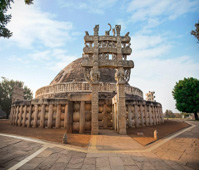 | - A stupa is a dome-shaped Buddhist monument originally associated with the preservation of relics and the commemoration of the Buddha.
- Example: The Great Stupa at Sanchi
|
| B. Chaitya | 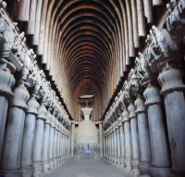 | - A chaitya-griha was a Buddhist prayer or worship hall, usually containing a stupa at one end.
- Important examples include the Karla, Bhaja and Ajanta caves in Maharashtra.
|
| C. Vihara |  | - A vihara was a residential monastery where Buddhist monks lived.
- Early viharas generally consisted of a hall surrounded by small cells.
- Example: Ajanta and Ellora caves.
|
2. Buddhist Sculpture
| Sculptures | Image | Features |
| A. Gandhara School | 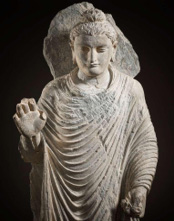 | - The Gandhara school flourished particularly under Kushana patronage.
- It is known for its grey schist sculptures, wavy hair, realistic facial features and heavy, flowing robes.
|
| B. Mathura School | 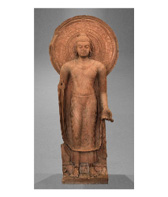 | - The Mathura school developed an indigenous Indian sculptural style, using primarily red sandstone.
- Its Buddha images often display a robust physique, broad shoulders, a relatively transparent monastic robe and a spiritual expression.
|
| C. Amaravati School | 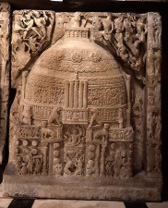 | - The Amaravati school is famous for intricate limestone reliefs, dynamic human figures, elaborate ornamentation and narrative scenes from Buddhist traditions.
- Its sculptural panels depict Jataka stories, events associated with the Buddha and Buddhist symbols.
|
Causes of the Decline of Buddhism in India
From the early medieval period onwards, its influence gradually declined in India. Buddhism did not disappear suddenly, its decline was gradual due to many factors:
1. Religious and Philosophical Factors: The growing complexity of certain Buddhist rituals make it less accessible to ordinary followers. The revival and development of Brahmanical traditions, primarily through the Bhakti movement, also offered people accessible forms of religious worship.
2. Assimilation into Hinduism: Buddhist ideas, symbols and ethical principles were incorporated into broader Indian religious traditions. The Buddha was also regarded as an avatar of Vishnu in some Puranic traditions. This assimilation reduced the distinct religious identity of Buddhism.
3. Decline in Royal Patronage: After the Mauryas there was the rise of brahmanical dynasties like Shunga, Kanvas and Satvahanas, thus buddhism lost the original patronage.
4. Internal Divisions: The emergence of different Buddhist schools like Theravada, Mahayana and Vajrayana created institutional fragmentation.
5. Foreign Invasions and Destruction of Monasteries: The destruction and disruption of major monastic centres, including Nalanda and Vikramashila, weakened Buddhist education and institutional networks.
6. Decline of Urban Centres and Trade Networks: Buddhism had strong historical connections with merchants, urban settlements and trade routes. Donations from traders and urban communities helped support monasteries situated along important commercial routes. With the decline of trade and merchants, Buddhism lost popular support.
Although Buddhism declined from its place of origin, it contributed significantly to Indian civilisation through ethical philosophy, art, architecture, literature, education and international cultural exchange. Its emphasis on compassion, moderation, moral conduct and critical reflection remains relevant to discussions on social harmony and ethical governance.