UPSC Current Affairs
Excavation In Ratnagiri
Excavation Site: The Archaeological Survey of India (ASI) resumed excavations at the Ratnagiri Buddhist Complex in Jajpur District, Odisha, in December 2024, after a 60-year gap. The aim was two-fold: to discover more of the ancient complex and to explore Odisha’s historical connections with Southeast Asia. KEY FINDINGS Colossal Buddha Head: Approximately 3-4 feet tall, this discovery is a significant symbol of Buddhism’s presence and influence in the region.
VRAuthor Desk
4 min read
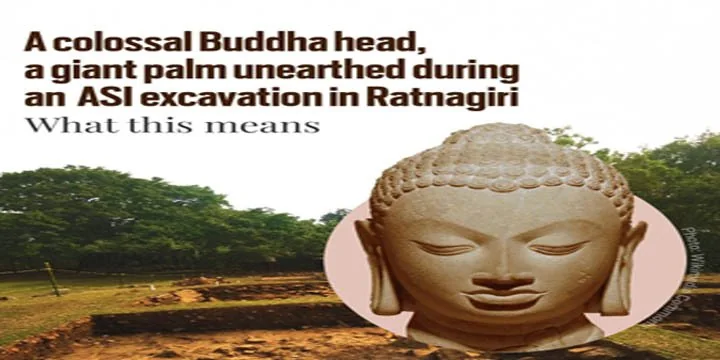
Excavation Site: The Archaeological Survey of India (ASI) resumed excavations at the Ratnagiri Buddhist Complex in Jajpur District, Odisha, in December 2024, after a 60-year gap. The aim was two-fold: to discover more of the ancient complex and to explore Odisha’s historical connections with Southeast Asia. KEY FINDINGS Colossal Buddha Head: Approximately 3-4 feet tall, this discovery is a significant symbol of Buddhism’s presence and influence in the region.
- Excavation Site: The Archaeological Survey of India (ASI) resumed excavations at the Ratnagiri Buddhist Complex in Jajpur District, Odisha, in December 2024, after a 60-year gap.
- The aim was two-fold:
- to discover more of the ancient complex and
- to explore Odisha’s historical connections with Southeast Asia.
KEY FINDINGS
- Colossal Buddha Head: Approximately 3-4 feet tall, this discovery is a significant symbol of Buddhism’s presence and influence in the region.
- Massive Palm: Measuring 5 feet in length, this unusual find adds to the mystery and significance of the site.
- Ancient Wall and Buddhist Relics: Remnants of structures and inscribed Buddhist relics dating back to the 8th-9th Century AD were also discovered.
HISTORICAL SIGNIFICANCE
- Location and Background: Ratnagiri, part of the Diamond Triangle of Odisha (along with Udaygiri and Lalitgiri), is located about 100 km northeast of Bhubaneswar. It has been a prominent Buddhist site for centuries.
- Previous Excavations: The last major excavations were between 1958 and 1961 by archaeologist Debala Mitra, which unearthed significant structures like a brick stupa, monastic complexes, and numerous votive stupas.
- Current Goals: The current excavation focuses on exploring partially visible structures, potential shrine complexes or chaitya halls (Buddhist prayer halls), and the ceramic assemblage to further understand the site’s cultural context.
CULTURAL & TRADE LINKS WITH SOUTH EAST ASIA
- Historical Context: Odisha, historically known as the kingdom of Kalinga, had extensive maritime and trade links with Southeast Asian countries.
- Trade Goods: Items such as pepper, cinnamon, silk, and jewelry were exchanged between Kalinga and regions like Bali, Java, Sumatra, and Burma (Myanmar).
- Baliyatra Festival: Odisha celebrates an annual festival, Baliyatra, to commemorate these ancient maritime links.
- Role of Kalinga: While there is no direct evidence of Buddha visiting Odisha, Kalinga played a pivotal role in spreading Buddhism across Southeast Asia due to its trade links.
- Notably, Tapassu and Bhallika, two merchant brothers from Odisha, are believed to be among the first disciples of Buddha.
RATNAGIRI & LEGACY OF BUDDHISM
- Buddhism in Odisha: Odisha, particularly during the reign of Mauryan Emperor Ashoka (261-232 BCE), saw the rise of Buddhism.
- Ashoka, after his conquest of Kalinga, embraced Buddhism and helped spread it across his empire, influencing Southeast Asia, Sri Lanka, and Central Asia.
- Flourishing Under the Bhaumakara Dynasty: Buddhism thrived in Odisha under the Bhaumakara dynasty (8th-10th Century), and Ratnagiri became a major center of Buddhist learning.
- Scholarly Significance: Scholars believe that Ratnagiri rivaled Nalanda as a center of Buddhist learning.
- The region was significant for the development of Mahayana and Tantrayana (Vajrayana) sects, which incorporated mystical elements of Buddhism.
RATNAGIRI’S ROLE IN ANCIENT BUDDHIST STUDIES
- Centers of Learning: Experts like Thomas Donaldson suggest that Ratnagiri was comparable to Nalanda in its role as a learning hub.
- Some of the texts studied here were related to Mahayana and Tantrayana
- Historical Visitors: The renowned Chinese monk Xuanzang (Hiuen Tsang), who visited India in the 7th century, might have visited Ratnagiri, highlighting its prominence as a Buddhist educational site.
FOCUS ON SOUTHEAST ASIAN MATERIAL CULTURE
- Material Evidence: The current excavation seeks to discover more material culture from Southeast Asia, which has been less explored in previous digs.
- This could provide valuable insights into the cultural exchanges between India and Southeast Asia, especially through trade and religion.
- Buddhist Cultural Framework: ASI officials aim to better understand the cultural framework of the site, particularly in relation to the Buddha head and other relics.
FUTURE PROSPECTS OF EXCAVATION
- Continued Excavation: The excavation efforts will continue for another month or two, with plans for further exploration depending on the findings.
- If the current findings justify it, additional excavation steps will be taken.
- Further Insights Expected: Experts hope that the discoveries will provide more information about the lifestyle, religion, art, and architecture of the Buddhist community in ancient Odisha.
- The excavations may also reveal whether the site holds even older relics, predating the 5th century.
- Prelims: Key facts, institutions, locations and terminology in the article.
- Mains: Connect the topic with UPSC Current Affairs.
- Revision: Use the article headings to prepare concise notes and answer-writing points.
Test your understanding
Questions from this article
Prelims practiceWith reference to Excavation In Ratnagiri, consider the following statements:
- Excavation Site: The Archaeological Survey of India (ASI) resumed excavations at the Ratnagiri Buddhist Complex in Jajpur District, Odisha, in December 2024, after a 60-year gap.
- The aim was two-fold: to discover more of the ancient complex and to explore Odisha’s historical connections with Southeast Asia.
- to discover more of the ancient complex and
Which of the statements given above are correct?
- 1 and 2 only
- 2 and 3 only
- 1 and 3 only
- 1, 2 and 3
View answer
Answer: (d) 1, 2 and 3. All three statements are drawn from the article.
Mains practiceDiscuss the background, key issues and significance of Excavation In Ratnagiri for India.
Answer in 250 words.
View answer approach
- KEY FINDINGS
- HISTORICAL SIGNIFICANCE
- CULTURAL & TRADE LINKS WITH SOUTH EAST ASIA
- RATNAGIRI & LEGACY OF BUDDHISM
- RATNAGIRI’S ROLE IN ANCIENT BUDDHIST STUDIES
Frequently asked questionsFrequently asked questions
Why is Excavation In Ratnagiri in the news?
Excavation Site: The Archaeological Survey of India (ASI) resumed excavations at the Ratnagiri Buddhist Complex in Jajpur District, Odisha, in December 2024, after a 60-year gap. The aim was two-fold: to discover more of the ancient complex and to explore Odisha’s historical connections with Southeast Asia.
What are the key facts about Excavation In Ratnagiri?
KEY FINDINGS Colossal Buddha Head: Approximately 3-4 feet tall, this discovery is a significant symbol of Buddhism’s presence and influence in the region. Massive Palm: Measuring 5 feet in length, this unusual find adds to the mystery and significance of the site. Ancient Wall and Buddhist Relics: Remnants of structures and inscribed Buddhist relics dating back to the 8th-9th Century AD were also discovered.
Why is Excavation In Ratnagiri important for UPSC preparation?
The topic connects current developments with UPSC Current Affairs and is relevant for both objective revision and analytical answer writing.