WHY IN NEWS?
- The Zoji-La Tunnel Project achieved a major milestone with the final breakthrough of the main tunnel on 11 June 2026.
- Union Minister for Road Transport and Highways Nitin Gadkari triggered the final blast at Minamarg (Ladakh), connecting both ends of the tunnel for the first time.
- The breakthrough marks a historic step towards realizing the long-standing objective of all-weather connectivity between the Kashmir Valley and Ladakh.
- The tunnel is scheduled to be commissioned by February 2028 and is expected to significantly strengthen connectivity, defence preparedness, tourism and economic development in the region.
ABOUT THE TUNNEL
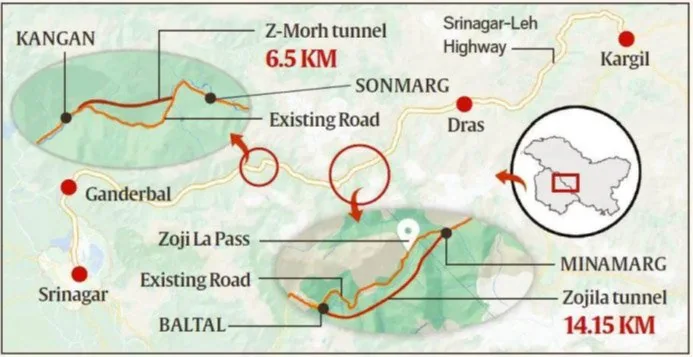
- The Zoji-La Tunnel is a high-altitude road tunnel being constructed beneath the Zoji-La Pass on National Highway-1 (NH-1).
- It will connect:
- Baltal (Kashmir Valley)
- Minamarg (Drass Region, Ladakh)
- The project aims to provide year-round road connectivity between Srinagar, Kargil and Leh, overcoming the seasonal closure of the existing highway during winters.
ABOUT ZOJILA PASS
- Zoji La is a high mountain pass located in the Kargil district of Ladakh.
- It connects:
- Srinagar
- Sonamarg
- Drass
- Kargil
- Leh
- The pass serves as the principal gateway between the Kashmir Valley and Ladakh.
MOUNTAIN PASS OF BLIZZARDS
- Zoji La is popularly known as the "Mountain Pass of Blizzards" because of:
- Heavy snowfall
- Frequent avalanches
- Harsh weather conditions
- Strong snowstorms
- As a result, the pass remains closed for nearly five to six months every year, cutting off Ladakh from the rest of the country.
| Feature |
Details |
| Location |
Between Baltal and Minamarg |
| Highway |
National Highway-1 (NH-1) |
| Length |
Approximately 13.15 km |
| Altitude |
Around 11,578 feet above sea level |
| Type |
Single-Tube, Bi-Directional Road Tunnel |
| Status |
Main Tunnel Breakthrough Achieved |
| Expected Completion |
February 2028 |
The project includes:
- 13.15 km Main Tunnel
- Escape Tunnel
- Three Vertical Ventilation Shafts
- Nearly 18 km of Approach Roads
Together, these components will ensure safe and efficient movement through the difficult Himalayan terrain.
WHY WAS THE TUNNEL NEEDED?
Seasonal Isolation of Ladakh
The existing
Srinagar–Leh Highway passes through Zoji La and remains closed during winter because of:
- Heavy snowfall
- Avalanches
- Landslides
- Extreme weather conditions
As a result:
- Ladakh remains isolated for several months.
- Transportation of goods becomes difficult.
- Emergency services face disruptions.
- Military logistics are affected.
CONNECTIVITY CHALLENGES
The closure of the Zoji La route has historically caused difficulties in:
- Education
- Healthcare access
- Tourism
- Trade and commerce
- Supply of essential goods
The tunnel is expected to eliminate these challenges by ensuring uninterrupted movement throughout the year.
STRATEGIC IMPORTANCE OF THE ZOJILA TUNNEL
Strengthening National Security
The Zoji-La Tunnel is among India's most strategically important infrastructure projects. It will significantly improve the movement of:
- Defence personnel
- Military vehicles
- Ammunition
- Essential supplies
towards sensitive border areas.
Importance for LoC and LAC
The tunnel will improve logistical support for troops deployed near:
- Line of Control (LoC) with Pakistan.
- Line of Actual Control (LAC) with China.
Faster troop mobilization can be crucial during emergencies and military operations.
LESSONS FROM THE KARGIL WAR (1999)
During the
Kargil War, the Srinagar–Kargil highway became vulnerable to Pakistani shelling. This created serious difficulties in:
- Transporting troops.
- Moving military equipment.
- Maintaining supply lines.
The Zoji-La Tunnel is expected to address such vulnerabilities by providing a safer and more reliable route.
PART OF INDIA’S STRATEGIC HIMALAYAN CONNECTIVITY NETWORK
- The Zoji-La Tunnel forms part of India's broader strategy to improve connectivity in the Himalayan region.
- It is one of the three major corridors connecting Ladakh:
- Zoji-La Corridor
-
- Srinagar – Kargil – Leh Route
- Rohtang Corridor
- Shinku La Corridor
-
- Connects Himachal Pradesh with Zanskar Valley in Ladakh
Together, these corridors strengthen India's strategic and economic integration with Ladakh.
MAJOR BENEFITS OF ZOJILA TUNNEL
1. All-Weather Connectivity
The most significant benefit is the establishment of
year-round road connectivity between:
- Kashmir
- Kargil
- Leh
- Ladakh
This will end the seasonal isolation of Ladakh.
2. Reduced Travel Time
Currently, crossing Zoji La takes:
- More than 3 hours
- Often longer during adverse weather
After completion:
- Travel time will reduce to approximately 15 minutes.
This will greatly improve transportation efficiency.
3. Boost to Tourism
The tunnel is expected to significantly boost tourism by ensuring uninterrupted access to:
- Sonamarg
- Drass
- Kargil
- Leh
- Other Himalayan destinations
Benefits
- Increased tourist arrivals.
- Growth of hospitality sector.
- Higher local income generation.
- Expansion of adventure tourism.
4. Economic Development
Year-round connectivity will strengthen:
- Trade
- Commerce
- Freight transportation
- Agricultural supply chains
It will also improve access to markets for local communities.
5. Improved Access to Essential Services
The tunnel will help residents of remote areas gain better access to:
- Healthcare facilities
- Educational institutions
- Government services
- Emergency assistance
6. Better Freight Movement
Reliable transportation throughout the year will:
- Reduce transportation costs.
- Ensure uninterrupted supply of essential commodities.
- Improve economic integration of Ladakh with the rest of India.
ENGINEERING SIGNIFICANCE
The breakthrough of the tunnel represents a major engineering achievement because construction was undertaken:
- At an altitude of over 11,500 feet.
- In extremely difficult geological conditions.
- In a region characterized by:
- Heavy snowfall.
-
- Harsh winters.
- Rugged Himalayan terrain.
Upon completion, it is expected to become
Asia's longest bi-directional road tunnel and one of the world's longest high-altitude road tunnels.
CHALLENGES FACED DURING CONSTRUCTION
The project had to overcome multiple challenges:
- Extreme weather conditions.
- Heavy snowfall.
- Avalanche-prone zones.
- Geological instability.
- High-altitude construction difficulties.
- Limited working season during winters.
The successful breakthrough demonstrates India's growing capability in executing complex mountain infrastructure projects.
SIGNIFICANCE FOR J&K & LADAKH
For
Jammu & Kashmir and
Ladakh, the project is expected to become a transformative infrastructure asset.
It will:
- Strengthen regional integration.
- Improve connectivity between Kashmir and Ladakh.
- Promote socio-economic development.
- Reduce regional isolation.
- Enhance national security.
WAY FORWARD
With the breakthrough completed, attention will now shift towards:
- Tunnel lining and finishing works.
- Installation of ventilation systems.
- Safety infrastructure.
- Electrical and communication systems.
- Testing and commissioning.
The project is expected to become operational by
February 2028.
CONCLUSION
The breakthrough of the
Zoji-La Tunnel marks a landmark achievement in India's infrastructure development journey. By providing all-weather connectivity between Kashmir and Ladakh, the tunnel will strengthen national security, improve military logistics, boost tourism, facilitate economic development and enhance the quality of life for people living in remote Himalayan regions. Once completed, it will stand as one of India's most important strategic infrastructure projects and a symbol of engineering excellence in the Himalayas.
Test your understanding
Questions from this article
Prelims practiceWith reference to ZOJILA TUNNEL, consider the following statements:
- The Zoji-La Tunnel Project achieved a major milestone with the final breakthrough of the main tunnel on 11 June 2026.
- Union Minister for Road Transport and Highways Nitin Gadkari triggered the final blast at Minamarg (Ladakh), connecting both ends of the tunnel for the first time.
- The breakthrough marks a historic step towards realizing the long-standing objective of all-weather connectivity between the Kashmir Valley and Ladakh.
Which of the statements given above are correct?
- 1 and 2 only
- 2 and 3 only
- 1 and 3 only
- 1, 2 and 3
View answer
Answer: (d) 1, 2 and 3. All three statements are drawn from the article.
Mains practiceDiscuss the background, key issues and significance of ZOJILA TUNNEL for India.
Answer in 250 words.
View answer approach
- WHY IN NEWS?
- ABOUT THE TUNNEL
- ABOUT ZOJILA PASS
- MOUNTAIN PASS OF BLIZZARDS
- WHY WAS THE TUNNEL NEEDED?
Frequently asked questionsFrequently asked questions
Why is Zojila Tunnel in the news?
The Zoji-La Tunnel Project achieved a major milestone with the final breakthrough of the main tunnel on 11 June 2026. Union Minister for Road Transport and Highways Nitin Gadkari triggered the final blast at Minamarg (Ladakh), connecting both ends of the tunnel for the first time.
What are the key facts about Zojila Tunnel?
The breakthrough marks a historic step towards realizing the long-standing objective of all-weather connectivity between the Kashmir Valley and Ladakh. The tunnel is scheduled to be commissioned by February 2028 and is expected to significantly strengthen connectivity, defence preparedness, tourism and economic development in the region. ABOUT THE TUNNEL The Zoji-La Tunnel is a high-altitude road tunnel being constructed beneath the Zoji-La Pass on National Highway-1 (NH-1).
Why is Zojila Tunnel important for UPSC preparation?
The topic connects current developments with Economy, Defence, Polity & Governance and is relevant for both objective revision and analytical answer writing.