UPSC Current Affairs
UNGA 80: INDIA’S BILATERAL ENGAGEMENTS
Context: External Affairs Minister (EAM) S. Jaishankar conducted a series of bilateral meetings on the sidelines of the 80th Session of the United Nations General Assembly (UNGA 80) in New York (September 2025). These meetings reaffirmed India’s commitment to multilateralism and global partnerships, especially in the Global South.
VRAuthor Desk
6 min read
Context: External Affairs Minister (EAM) S. Jaishankar conducted a series of bilateral meetings on the sidelines of the 80th Session of the United Nations General Assembly (UNGA 80) in New York (September 2025). These meetings reaffirmed India’s commitment to multilateralism and global partnerships, especially in the Global South.
Context:
- External Affairs Minister (EAM) S. Jaishankar conducted a series of bilateral meetings on the sidelines of the 80th Session of the United Nations General Assembly (UNGA 80) in New York (September 2025).
- These meetings reaffirmed India’s commitment to multilateralism and global partnerships, especially in the Global South.
KEY BILATERAL MEETINGS HELD
India–Mexico:
- Counterpart: Juan Ramon de la Fuente, Secretary of Foreign Affairs.
- Venue: Meeting held in New Delhi (before UNGA).
- Focus Areas:
- Strengthening bilateral political and economic ties.
- Creation of a fresh roadmap for cooperation, building on past diplomatic exchanges.
- Emphasis on strategic alignment, trade, and cooperation in multilateral forums (e.g., UN, G20).
India–Cyprus:
- Counterpart: Constantinos Kombos, Foreign Minister of Cyprus.
- Focus Areas:
- Review of bilateral ties after PM Modi’s visit to Cyprus earlier in 2025.
- Discussed regional developments in Europe.
- India reaffirmed support for:
- A comprehensive and lasting solution to the Cyprus issue.
- Adherence to the UN-agreed framework and UNSC resolutions.
INDIA FIPIC ENGAGEMENT
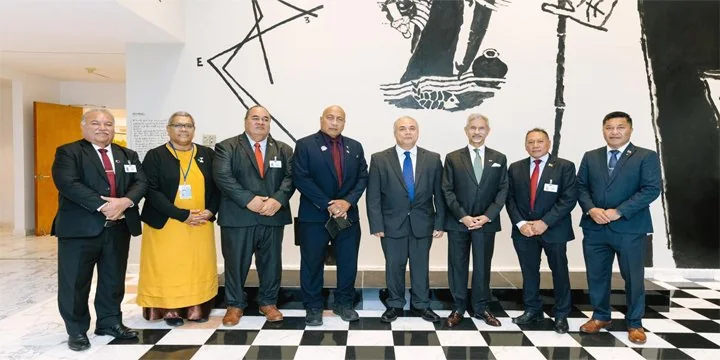
Held on the sidelines of the
Forum for India-Pacific Islands Cooperation (FIPIC) Foreign Ministers' Meeting (FMM) in New York.
- Countries Engaged:
- Marshall Islands: FM Kalani Kaneko
- Tuvalu: FM Paulson Panapa
- Palau: Minister of State Gustav Aitaro
- Solomon Islands: FM Peter Shanel Agovaka
- Tonga: PM Dr. Aisake Valu Eke
FOCUS AREAS
- Strengthening India's Act East & Indo-Pacific policies.
- Reaffirmed India’s commitment to developmental partnerships, climate resilience, and capacity-building in the Pacific region.
- Promoting cooperation in areas like:
- Renewable energy
- Healthcare
- Education
- Disaster risk reduction
SIGNIFICANCE
| Aspect |
Significance |
| Multilateralism |
India continues to push for reformed multilateralism and South-South cooperation. |
| Pacific Outreach (FIPIC) |
Reflects India's long-term interest in the Indo-Pacific as a free, open, and inclusive region. |
| Europe Relations |
Ties with Cyprus reflect India’s nuanced stance on sensitive international issues. |
| Mexico Engagement |
Strengthening Global South partnerships and expanding India’s presence in Latin America. |
WHAT IS UNGA?
| Feature |
Details |
| Established |
1945, under the UN Charter |
| Inaugural Session |
January 10, 1946 (51 member states) |
| Headquarters |
New York City, USA (permanent HQ from 1951) |
| Current Membership |
193 member states |
| Significance |
Main deliberative, policymaking, and representative organ of the United Nations |
FOUNDATION OF UNGA
- Created after the failure of the League of Nations, to uphold collective peace and cooperation.
- UNGA embodies the principle of sovereign equality, giving each member one vote.
| Component |
Details |
| Annual Sessions |
Begins every September; Special Sessions held as needed. |
| One Vote per Member |
Every member has equal voting rights, regardless of size or power. |
| Presidency |
Rotates yearly among five regional groups: Africa, Asia-Pacific, Eastern Europe, Latin America and Caribbean, Western Europe and others. |
| Observers |
Holy See, Palestine, and international organisations participate without voting rights. |
| Decision-Making |
- Two-thirds majority required for key issues: peace & security, elections, budget.
- Simple majority for other matters. |
| Seating Arrangement |
Alphabetical order; heads of states sit in the first row during general debate. |
6 MAIN COMMITTEES OF UNGA
| Committee |
Function |
| 1st – Disarmament and International Security (DISEC) |
Deals with disarmament and global security. |
| 2nd – Economic and Financial |
Focuses on economic growth and development. |
| 3rd – Social, Humanitarian, and Cultural |
Covers human rights and humanitarian issues. |
| 4th – Special Political and Decolonization |
Addresses colonial legacy, peacekeeping, and special missions. |
| 5th – Administrative and Budgetary |
Manages UN budgeting and administrative issues. |
| 6th – Legal |
Handles international legal matters and treaty interpretation. |
| Body |
Role |
| General Committee |
Coordinates session agendas (President + Vice Presidents + Chairs of committees). |
| UN Disarmament Commission |
Provides recommendations on disarmament. |
| International Law Commission |
Develops and codifies international law. |
| UN Peacebuilding Commission |
Advises on post-conflict recovery. |
| Human Rights Council |
Promotes and protects human rights globally. |
| Others |
UN Environment Assembly, Commission on the Status of Women, Commission on Population and Development. |
FUNCTIONS & POWERS
| Function |
Explanation |
| Deliberative Role |
Debates on global issues: peace, security, human rights, development. |
| Recommendations |
Issues non-binding recommendations to states and the UNSC. |
| Budget Approval |
Approves UN budget, assesses member contributions. |
| Appointments |
- Elects non-permanent UNSC members.
- Appoints Secretary-General (on UNSC recommendation).
- Elects judges to ICJ and members of UNHRC, ECOSOC. |
| Subsidiary Organs |
Can create bodies/commissions to address specific global concerns. |
| Uniting for Peace Resolution (1950) |
Allows UNGA to act when UNSC is blocked by veto (e.g., in Syria, Palestine). |
| Special Sessions |
Convenes special sessions for urgent global matters. |
| Equal Representation |
All countries, large or small, have equal voting power. |
UNGA’S MAJOR ACHIEVEMENTS
| Achievement |
Impact |
| Universal Declaration of Human Rights (1948) |
Foundation of global human rights; inspired 80+ international treaties. |
| UN Peacekeeping (since 1948) |
Over 70 missions to support peace and protect civilians. |
| Decolonization Declaration (1960) |
Helped over 80 nations gain independence. |
| Convention Against Apartheid (1973) |
Declared apartheid a crime against humanity. |
| Millennium Development Goals (2000) |
Lifted 1+ billion people out of poverty by 2015. |
| 2030 Agenda for Sustainable Development (2015) |
Adopted 17 SDGs for poverty, planet, and prosperity. |
| Treaty on Prohibition of Nuclear Weapons (2017) |
First binding treaty banning nuclear weapons. |
| Global Compacts on Refugees & Migration (2018) |
Principles for managing large-scale migration and refugee protection. |
CHALLENGES FACED
| Challenge |
Description |
| Lack of Enforcement Power |
Resolutions are non-binding; no compulsory compliance. |
| Consensus Difficulties |
193 members = slow, watered-down outcomes. |
| Geopolitical Tensions |
Rivalries (e.g., US-China-Russia) block action on crises. |
| Resource Constraints |
Funding gaps delay implementation of key programs. |
| Global Divisions |
Ideological blocs like G77, NAM, Western powers cause fragmentation. |
| Dependency on Member States |
Political interference can sideline critical issues. |
| UNSC Paralysis |
Vetoes in UNSC limit coordination with UNGA. |
| Rising Complex Crises |
Climate change, pandemics, and cyber threats demand better coordination. |
| Reform Area |
Suggestion |
| Internal Functioning |
Improve accountability, transparency, and evaluation. |
| Funding Models |
Develop independent funding mechanisms to reduce dependency. |
| Legal Follow-Up |
Monitor implementation of resolutions more effectively. |
| UNSC-UNGA Coordination |
Promote synergy and resolve deadlocks in peace and security issues. |
| Reduce Political Interference |
Insulate decision-making from powerful nations' agendas. |
| Broader UN Reform |
Push for more inclusive global governance, especially in the Security Council. |
INDIA & UNGA
| Contribution |
Detail |
| Founding Member |
India joined the UN in 1945; a long-standing supporter of multilateralism. |
| Anti-Colonial Voice |
Co-sponsored the 1960 Decolonization Declaration. |
| Historic Leadership |
Vijaya Laxmi Pandit became the first woman UNGA President in 1953. |
| Security Council Membership |
Served 8 times; last in 2021–2022, leading debates on maritime security. |
| Push for UNSC Reform |
Advocates permanent membership for India, Germany, Brazil, and Japan. |
| Global Peacekeeping |
Major contributor to UN peacekeeping missions. |
| Climate Action |
Champion of climate justice and launched International Solar Alliance (ISA). |
| Counterterrorism |
India has pushed for Comprehensive Convention on International Terrorism (CCIT) since 1996. |
| 2028-29 Bid |
India is seeking a non-permanent seat in UNSC for the 2028-29 term. |
- Prelims: Key facts, institutions, locations and terminology in the article.
- Mains: Connect the topic with Environment, Economy, International Relations.
- Revision: Use the article headings to prepare concise notes and answer-writing points.
Test your understanding
Questions from this article
Prelims practiceWith reference to UNGA 80: INDIA’S BILATERAL ENGAGEMENTS, consider the following statements:
- External Affairs Minister (EAM) S. Jaishankar conducted a series of bilateral meetings on the sidelines of the 80th Session of the United Nations General Assembly (UNGA 80) in New York (September 2025).
- These meetings reaffirmed India’s commitment to multilateralism and global partnerships, especially in the Global South.
- Counterpart: Juan Ramon de la Fuente, Secretary of Foreign Affairs.
Which of the statements given above are correct?
- 1 and 2 only
- 2 and 3 only
- 1 and 3 only
- 1, 2 and 3
View answer
Answer: (d) 1, 2 and 3. All three statements are drawn from the article.
Mains practiceDiscuss the background, key issues and significance of UNGA 80: INDIA’S BILATERAL ENGAGEMENTS for India.
Answer in 250 words.
View answer approach
- Context:
- KEY BILATERAL MEETINGS HELD
- India–Mexico:
- India–Cyprus:
- FOCUS AREAS
Frequently asked questionsFrequently asked questions
Why is Unga 80: India’S Bilateral Engagements in the news?
Context: External Affairs Minister (EAM) S. Jaishankar conducted a series of bilateral meetings on the sidelines of the 80th Session of the United Nations General Assembly (UNGA 80) in New York (September 2025).
What are the key facts about Unga 80: India’S Bilateral Engagements?
These meetings reaffirmed India’s commitment to multilateralism and global partnerships, especially in the Global South. KEY BILATERAL MEETINGS HELD India–Mexico: Counterpart: Juan Ramon de la Fuente, Secretary of Foreign Affairs. Venue: Meeting held in New Delhi (before UNGA).
Why is Unga 80: India’S Bilateral Engagements important for UPSC preparation?
The topic connects current developments with Environment, Economy, International Relations and is relevant for both objective revision and analytical answer writing.