UPSC Current Affairs
TECHNOLOGY DEVELOPMENT & INVESTMENT PROMOTION SCHEME
Why in News The Union Minister for Communications Jyotiraditya Scindia released the revised guidelines of the Technology Development and Investment Promotion (TDIP) Scheme. Implemented by the Department of Telecommunications. Scheme period: 2026–2031 with an outlay of ₹203 crore.
VRAuthor Desk
2 min read
Why in News The Union Minister for Communications Jyotiraditya Scindia released the revised guidelines of the Technology Development and Investment Promotion (TDIP) Scheme. Implemented by the Department of Telecommunications. Scheme period: 2026–2031 with an outlay of ₹203 crore.
Why in News
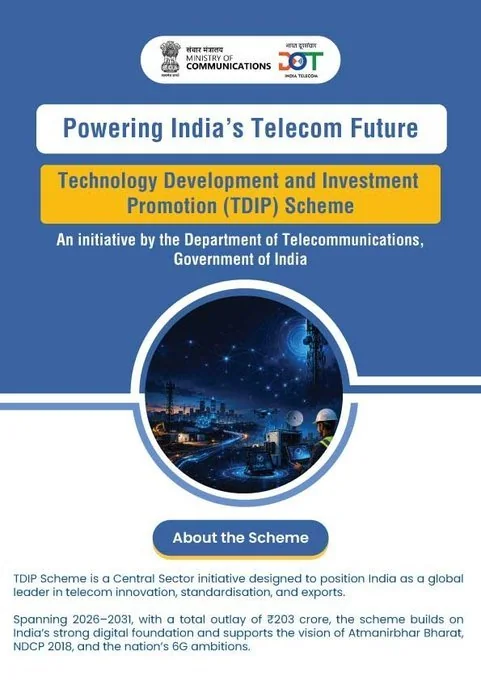
- The Union Minister for Communications Jyotiraditya Scindia released the revised guidelines of the Technology Development and Investment Promotion (TDIP) Scheme.
- Implemented by the Department of Telecommunications.
- Scheme period: 2026–2031 with an outlay of ₹203 crore.
- Aim: Strengthen India’s role in global telecom standards, indigenous innovation, and 6G ecosystem development.
ABOUT TDIP SCHEME
- A telecom technology development and investment promotion framework.
- Focuses on building India’s capacity in next-generation telecom technologies such as 5G Advanced and 6G.
- Aims to shift India from a technology adopter ? global standard setter.
KEY OBJECTIVES
- Increase India’s participation in global telecom standardisation
- Promote indigenous telecom innovation and intellectual property creation
- Enhance export competitiveness of Indian telecom products
- Accelerate 6G ecosystem development
- Strengthen industry–academia–government collaboration
STRENGTHENING GLOBAL STANDARDISATION ROLE
- Focus on participation in key international bodies:
- International Telecommunication Union (ITU)
- 3GPP
- oneM2M
- Support provided for:
- Participation in global meetings
- Submission of technical contributions
- Leadership roles in study groups
- Hosting international standardisation events in India
EXPANDED ECOSYSTEM COVERAGE
- Inclusion of:
- Startups
- MSMEs
- Academia and research institutions
- Telecom service providers
- Industry players
- Supports pilot projects and proof-of-concept (PoC) initiatives
- Focus on bridging research ? real-world deployment
INSTITUTIONAL FRAMEWORK FOR IMPLEMENTATION
- Implementing agencies include:
- Telecommunications Standards Development Society, India (TSDSI)
- Telecom Centres of Excellence (TCoE India)
- Telecommunications Consultants India Limited (TCIL)
- Functions:
- Facilitate coordination and capacity building
- Promote industry participation in global standards
- Enable structured engagement with global telecom ecosystem
COMPLEMENTARY POLICY ECOSYSTEM
- Works alongside:
- Telecom Technology Development Fund (TTDF)
- Bharat 6G Mission
- Together aim to create a complete R&D-to-deployment telecom innovation pipeline
STRATEGIC SIGNIFICANCE
For India’s Telecom Sector
- Strengthens India’s position in global telecom governance
- Promotes indigenous IP creation and innovation ecosystem
- Enhances export potential of telecom technologies
- Supports development of secure and resilient digital infrastructure
6G and Future Technologies
- Positions India as a potential leader in 6G and future communication systems
- Encourages early-stage standard-setting participation
- Builds capability in next-generation wireless technologies
OVERALL SIGNIFICANCE
- Transition from technology consumer ? technology standard setter
- Strengthens digital sovereignty and strategic autonomy
- Promotes innovation-led growth in telecom sector
- Integrates India into global technology governance structures
CHALLENGES
- High cost of R&D and global participation
- Competition from advanced economies in standard-setting bodies
- Need for stronger industry–academia coordination
- Bridging research-to-commercialisation gap
WAY FORWARD
- Increase public–private collaboration in telecom R&D
- Strengthen domestic manufacturing under telecom ecosystem
- Expand funding for deep-tech startups and universities
- Build long-term global leadership in 6G standards
- Prelims: Key facts, institutions, locations and terminology in the article.
- Mains: Connect the topic with Economy, Polity & Governance, Science & Technology.
- Revision: Use the article headings to prepare concise notes and answer-writing points.
Test your understanding
Questions from this article
Prelims practiceWith reference to TECHNOLOGY DEVELOPMENT & INVESTMENT PROMOTION SCHEME, consider the following statements:
- The Union Minister for Communications Jyotiraditya Scindia released the revised guidelines of the Technology Development and Investment Promotion (TDIP) Scheme.
- Implemented by the Department of Telecommunications.
- Scheme period: 2026–2031 with an outlay of ₹203 crore.
Which of the statements given above are correct?
- 1 and 2 only
- 2 and 3 only
- 1 and 3 only
- 1, 2 and 3
View answer
Answer: (d) 1, 2 and 3. All three statements are drawn from the article.
Mains practiceDiscuss the background, key issues and significance of TECHNOLOGY DEVELOPMENT & INVESTMENT PROMOTION SCHEME for India.
Answer in 250 words.
View answer approach
- ABOUT TDIP SCHEME
- KEY OBJECTIVES
- STRENGTHENING GLOBAL STANDARDISATION ROLE
- EXPANDED ECOSYSTEM COVERAGE
- INSTITUTIONAL FRAMEWORK FOR IMPLEMENTATION
Frequently asked questionsFrequently asked questions
Why is Technology Development & Investment Promotion Scheme in the news?
Why in News The Union Minister for Communications Jyotiraditya Scindia released the revised guidelines of the Technology Development and Investment Promotion (TDIP) Scheme. Implemented by the Department of Telecommunications.
What are the key facts about Technology Development & Investment Promotion Scheme?
Scheme period: 2026–2031 with an outlay of ₹203 crore. Aim: Strengthen India’s role in global telecom standards, indigenous innovation, and 6G ecosystem development. ABOUT TDIP SCHEME A telecom technology development and investment promotion framework.
Why is Technology Development & Investment Promotion Scheme important for UPSC preparation?
The topic connects current developments with Economy, Polity & Governance, Science & Technology and is relevant for both objective revision and analytical answer writing.