UPSC Current Affairs
PROPOSED AMENDMENTS IN FCRA
Foreign Contribution (Regulation) Amendment Bill, 2026, introduced in the Lok Sabha on March 25, 2026, seeks to significantly tighten government control over foreign-funded non-governmental organisations (NGOs). PRIMARY FOCUS The Bill's primary focus is addressing "legal and operational gaps" in how assets created from foreign funds are managed when an organisation's registration is cancelled, surrendered, or expires. KEY CHANGES Designated Authority for Assets: The Bill introduces a new Chapter IIIA, establishing a "Designated Authority" to take over, manage, or liquidate assets (property, equipment, funds) if an organization's FCRA registration is cancelled, surrendered…
VRAuthor Desk
4 min read
Foreign Contribution (Regulation) Amendment Bill, 2026, introduced in the Lok Sabha on March 25, 2026, seeks to significantly tighten government control over foreign-funded non-governmental organisations (NGOs). PRIMARY FOCUS The Bill's primary focus is addressing "legal and operational gaps" in how assets created from foreign funds are managed when an organisation's registration is cancelled, surrendered, or expires. KEY CHANGES Designated Authority for Assets: The Bill introduces a new Chapter IIIA, establishing a "Designated Authority" to take over, manage, or liquidate assets (property, equipment, funds) if an organization's FCRA registration is cancelled, surrendered…
Foreign Contribution (Regulation) Amendment Bill, 2026, introduced in the Lok Sabha on March 25, 2026, seeks to significantly
tighten government control over foreign-funded non-governmental organisations (NGOs).
PRIMARY FOCUS
The Bill's primary focus is
addressing "legal and operational gaps" in how assets created from foreign funds are managed when an organisation's registration is cancelled, surrendered, or expires.
KEY CHANGES
- Designated Authority for Assets: The Bill introduces a new Chapter IIIA, establishing a "Designated Authority" to take over, manage, or liquidate assets (property, equipment, funds) if an organization's FCRA registration is cancelled, surrendered, or expires.
- Broadening "Key Functionary" Definition: The term now covers not just office-bearers, but also trustees, members of governing bodies, partners, and any person in control of the organization.
- Automatic Cessation & Asset Seizure: A registration is deemed to have ceased if not renewed on time, empowering the state to take over assets immediately.
- Tightening Compliance: It strengthens rules around the receipt and utilization of foreign contributions to plug potential loopholes.
WHY THE BILL IS CONTROVERSIAL?
- Asset Seizure and Regulatory Discretion: The primary fear is that the "Designated Authority" can seize buildings, hospitals, and educational institutions run by NGOs, even in cases of minor, non-malicious procedural failures or delays.
- Targeting Minorities and Independent NGOs: Opposition parties argue the bill is designed to disproportionately target Christian and other minority-run NGOs, schools, and charities, potentially hindering their philanthropic work.
- Erosion of Civil Society Autonomy: The extensive powers of the "Designated Authority" are seen as a tool to stifle dissent and tighten state control over civil society organizations.
- Legal Uncertainty: Critics allege that the new framework creates "administrative uncertainty" and fails to define a clear process for handling assets created with a mix of foreign and domestic funds, potentially leading to total forfeiture of mixed-fund properties.
- Political Misuse: The bill faces accusations of being used to align NGOs with the ruling establishment's interests.
What is the FCRA?
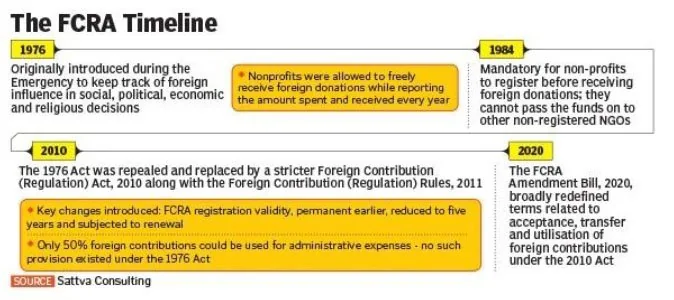
- The Foreign Contribution (Regulation) Act (FCRA) was enacted in 1976 during the Emergency period to regulate the flow of foreign contributions into India.
- Its primary purpose is to ensure that foreign donations to Indian NGOs do not adversely affect national interests, sovereignty, or internal security.
Key Objectives of FCRA:
- To regulate the acceptance and utilization of foreign funds by NGOs.
- To ensure that foreign funds do not negatively impact India's sovereignty, democratic values, or internal security.
NOTE:
- No Foreign Contributions from NRIs: Contributions from Non-Resident Indians (NRIs) using their personal savings through normal banking channels are not considered foreign contributions.
- Transparency & Monitoring: NGOs are required to disclose the full details of foreign donations and how the funds are used to ensure transparency.
ABOUT FCRA
AMENDMENTS IN FCRA (OVER THE YEARS)
- 2010 Amendment:
- Streamlined regulations for receiving foreign contributions.
- Prohibited the use of foreign donations for activities harmful to national interests.
- 2020 Amendment:
- Aadhaar Mandate: Required Aadhaar numbers for key functionaries of NGOs.
- Designated Bank Account: Foreign funds must be routed through an FCRA-approved account at the State Bank of India.
- Domestic Transfer Ban: Prohibited NGOs from transferring foreign funds to other domestic entities.
- Administrative Expense Limit: Reduced the cap on administrative expenses from 50% to 20% of foreign funds received.
WHO NEEDS FCRA REGISTRATION?
Any organization,
association, or NGO wishing to receive foreign donations must be registered under the FCRA. This includes a variety of NGOs working in social, educational, economic, or religious fields.
- Validity & Renewal: FCRA registration is valid for 5 years and can be renewed if the organization complies with FCRA norms.
- Permissible Uses of Foreign Contributions: Foreign funds can only be used for activities that serve social, educational, cultural, or economic purposes and contribute positively to the nation.
MONITORING AUTHORITY
The
Ministry of Home Affairs (MHA) is the regulatory body responsible for ensuring FCRA compliance by NGOs.
Key Developments in FCRA Implementation:
- In 2015, NGOs were required to maintain their bank accounts with core banking facilities for better monitoring.
- In 2023, an amendment mandated that NGOs disclose assets created with foreign funds in their annual returns.
- Prelims: Key facts, institutions, locations and terminology in the article.
- Mains: Connect the topic with Economy, International Relations, Polity & Governance.
- Revision: Use the article headings to prepare concise notes and answer-writing points.
Test your understanding
Questions from this article
Prelims practiceWith reference to PROPOSED AMENDMENTS IN FCRA, consider the following statements:
- Designated Authority for Assets: The Bill introduces a new Chapter IIIA, establishing a "Designated Authority" to take over, manage, or liquidate assets (property, equipment, funds) if an organization's FCRA registration…
- Broadening "Key Functionary" Definition: The term now covers not just office-bearers, but also trustees, members of governing bodies, partners, and any person in control of the organization.
- Automatic Cessation & Asset Seizure: A registration is deemed to have ceased if not renewed on time, empowering the state to take over assets immediately.
Which of the statements given above are correct?
- 1 and 2 only
- 2 and 3 only
- 1 and 3 only
- 1, 2 and 3
View answer
Answer: (d) 1, 2 and 3. All three statements are drawn from the article.
Mains practiceDiscuss the background, key issues and significance of PROPOSED AMENDMENTS IN FCRA for India.
Answer in 250 words.
View answer approach
- KEY CHANGES
- WHY THE BILL IS CONTROVERSIAL?
- What is the FCRA?
- Key Objectives of FCRA:
- NOTE:
Frequently asked questionsFrequently asked questions
Why is Proposed Amendments In Fcra in the news?
Foreign Contribution (Regulation) Amendment Bill, 2026, introduced in the Lok Sabha on March 25, 2026, seeks to significantly tighten government control over foreign-funded non-governmental organisations (NGOs). PRIMARY FOCUS The Bill's primary focus is addressing "legal and operational gaps" in how assets created from foreign funds are managed when an organisation's registration is cancelled, surrendered, or expires.
What are the key facts about Proposed Amendments In Fcra?
KEY CHANGES Designated Authority for Assets: The Bill introduces a new Chapter IIIA, establishing a "Designated Authority" to take over, manage, or liquidate assets (property, equipment, funds) if an organization's FCRA registration is cancelled, surrendered… Broadening "Key Functionary" Definition: The term now covers not just office-bearers, but also trustees, members of governing bodies, partners, and any person in control of the organization. Automatic Cessation & Asset Seizure: A registration is deemed to have ceased if not renewed on time, empowering the state to take over assets immediately.
Why is Proposed Amendments In Fcra important for UPSC preparation?
The topic connects current developments with Economy, International Relations, Polity & Governance and is relevant for both objective revision and analytical answer writing.