UPSC Current Affairs
PROJECT CHEETAH: THE THIRD WAVE
late February 2026, India’s cheetah reintroduction program reached a historic milestone with the arrival of nine cheetahs from Botswana at Kuno National Park, Madhya Pradesh. This is the first intercontinental translocation from Botswana, which holds the world's second-largest cheetah population. These new arrivals are considered "vanguard" animals because they are uniquely adapted to living in human-dominated landscapes, which is critical for the next phase of the project's success.
VRAuthor Desk
2 min read
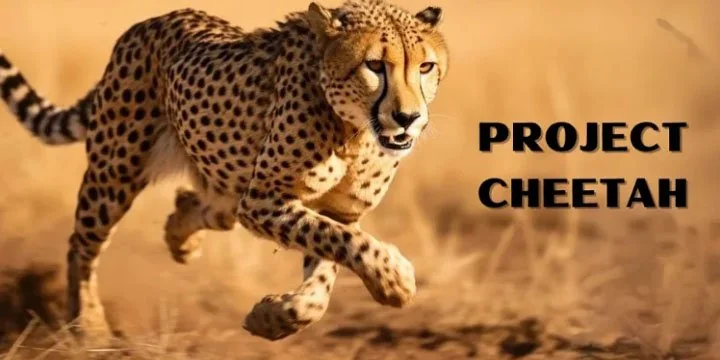
late February 2026, India’s cheetah reintroduction program reached a historic milestone with the arrival of nine cheetahs from Botswana at Kuno National Park, Madhya Pradesh. This is the first intercontinental translocation from Botswana, which holds the world's second-largest cheetah population. These new arrivals are considered "vanguard" animals because they are uniquely adapted to living in human-dominated landscapes, which is critical for the next phase of the project's success.
late February 2026, India’s cheetah reintroduction program reached a historic milestone with the arrival of
nine cheetahs from Botswana at
Kuno National Park, Madhya Pradesh.
This is the
first intercontinental translocation from Botswana, which holds the world's
second-largest cheetah population.
These new arrivals are considered
"vanguard" animals because they are uniquely adapted to living in human-dominated landscapes, which is critical for the next phase of the project's success.
CURRENT POPULATION STATUS
- Total Count: With the nine Botswana cheetahs, India’s total population has risen to 48 individuals.
- Success Indicator: This figure includes 29 Indian-born cubs, proving that the translocated cheetahs have successfully adapted to the local prey base and climate for breeding.
- Translocation History:
- September 2022: 8 Cheetahs from Namibia.
- February 2023: 12 Cheetahs from South Africa.
- February 2026: 9 Cheetahs from Botswana.
STRATEGIC SIGNIFICANCE OF BOTSWANA CHEETAHS
- Global Hub: Botswana hosts approximately 24% of the world’s 7,100 cheetahs.
- Co-existence Specialists: Unlike those in South Africa, 76.9% of Botswana’s cheetahs live outside protected fences on commercial and community farmlands.
- Human-Wildlife Conflict: These cheetahs are "pre-adapted" to sharing landscapes with livestock and humans, making them the ideal candidates for the eventual release into the open, non-fenced corridors of the Kuno-Palpur
PROJECT CHEETAH FRAMEWORK
- Objective: Launched in 2022 under the umbrella of Project Tiger, it seeks to restore the only large carnivore that went extinct in India (declared extinct in 1952).
- Implementing Agency: The National Tiger Conservation Authority (NTCA), supported by the Wildlife Institute of India (WII).
- Expanded Landscape: * Kuno National Park: The primary site.
- Gandhi Sagar Wildlife Sanctuary: Recently prepared as the second home for cheetahs to prevent over-crowding at Kuno.
- Nauradehi Wildlife Sanctuary: Identified for future expansion to create a meta-population.
COMMUNITY & GRASSROOT SUPPORT
- Cheetah Mitras: Over 350 local volunteers known as 'Cheetah Mitras' (Friends of the Cheetah) work in surrounding villages.
- Awareness: Their role is to sensitize local communities, dispel myths about cheetahs being man-eaters (which they are not), and report sightings to the forest department to minimize conflict.
CONCLUSION
The 2026 induction of Botswana cheetahs marks a transition from
"survival" to "stabilization" for Project Cheetah.
By introducing animals that are genetically diverse and behaviorally adapted to open landscapes, India is laying the groundwork for a self-sustaining population. The high survival rate of the Indian-born cubs remains the most significant biological victory for the project as it moves into its fourth year.
- Prelims: Key facts, institutions, locations and terminology in the article.
- Mains: Connect the topic with Environment.
- Revision: Use the article headings to prepare concise notes and answer-writing points.
Test your understanding
Questions from this article
Prelims practiceWith reference to PROJECT CHEETAH: THE THIRD WAVE, consider the following statements:
- Total Count: With the nine Botswana cheetahs, India’s total population has risen to 48 individuals.
- Success Indicator: This figure includes 29 Indian-born cubs, proving that the translocated cheetahs have successfully adapted to the local prey base and climate for breeding.
- Translocation History: September 2022: 8 Cheetahs from Namibia. February 2023: 12 Cheetahs from South Africa. February 2026: 9 Cheetahs from Botswana.
Which of the statements given above are correct?
- 1 and 2 only
- 2 and 3 only
- 1 and 3 only
- 1, 2 and 3
View answer
Answer: (d) 1, 2 and 3. All three statements are drawn from the article.
Mains practiceDiscuss the background, key issues and significance of PROJECT CHEETAH: THE THIRD WAVE for India.
Answer in 250 words.
View answer approach
- CURRENT POPULATION STATUS
- STRATEGIC SIGNIFICANCE OF BOTSWANA CHEETAHS
- PROJECT CHEETAH FRAMEWORK
- COMMUNITY & GRASSROOT SUPPORT
Frequently asked questionsFrequently asked questions
Why is Project Cheetah: The Third Wave in the news?
late February 2026, India’s cheetah reintroduction program reached a historic milestone with the arrival of nine cheetahs from Botswana at Kuno National Park, Madhya Pradesh. This is the first intercontinental translocation from Botswana, which holds the world's second-largest cheetah population.
What are the key facts about Project Cheetah: The Third Wave?
These new arrivals are considered "vanguard" animals because they are uniquely adapted to living in human-dominated landscapes, which is critical for the next phase of the project's success. CURRENT POPULATION STATUS Total Count: With the nine Botswana cheetahs, India’s total population has risen to 48 individuals. Success Indicator: This figure includes 29 Indian-born cubs, proving that the translocated cheetahs have successfully adapted to the local prey base and climate for breeding.
Why is Project Cheetah: The Third Wave important for UPSC preparation?
The topic connects current developments with Environment and is relevant for both objective revision and analytical answer writing.