UPSC Current Affairs
NATIONAL FAMILY HEALTH SURVEY-6 (2023-24)
The Ministry of Health and Family Welfare (MoHFW) released the findings of National Family Health Survey-6 (NFHS-6) for the period 2023–24. The survey reveals major improvements in maternal health, child nutrition, immunization coverage, women's empowerment and healthcare access. However, it also highlights emerging concerns such as rising obesity, non-communicable diseases (NCDs), excessive Caesarean deliveries, and the removal of several important indicators from the survey framework.
VRAuthor Desk
6 min read
The Ministry of Health and Family Welfare (MoHFW) released the findings of National Family Health Survey-6 (NFHS-6) for the period 2023–24. The survey reveals major improvements in maternal health, child nutrition, immunization coverage, women's empowerment and healthcare access. However, it also highlights emerging concerns such as rising obesity, non-communicable diseases (NCDs), excessive Caesarean deliveries, and the removal of several important indicators from the survey framework.
Why in News?
- The Ministry of Health and Family Welfare (MoHFW) released the findings of National Family Health Survey-6 (NFHS-6) for the period 2023–24.
- The survey reveals major improvements in maternal health, child nutrition, immunization coverage, women's empowerment and healthcare access.
- However, it also highlights emerging concerns such as rising obesity, non-communicable diseases (NCDs), excessive Caesarean deliveries, and the removal of several important indicators from the survey framework.
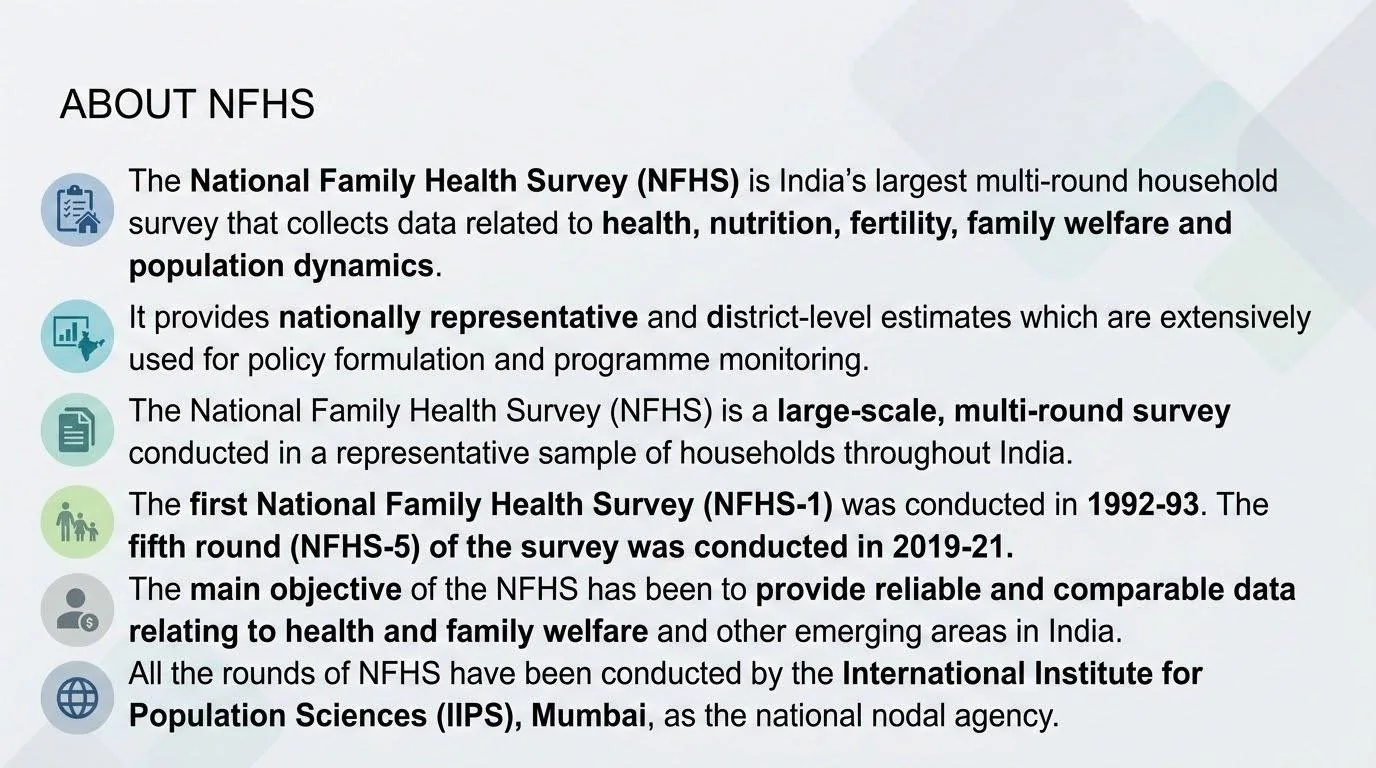
| Particular |
Details |
| First Survey |
1992–93 (NFHS-1) |
| Latest Survey |
NFHS-6 (2023–24) |
| Nodal Agency |
International Institute for Population Sciences (IIPS), Mumbai |
| Commissioned By |
Ministry of Health and Family Welfare |
| Coverage |
6.79 lakh households |
| Districts Covered |
715 districts |
| Exclusion |
Manipur |
MAJOR FINDINGS
1. Significant Improvement in Maternal Healthcare
- Maternal healthcare indicators have shown steady improvement, indicating better access to healthcare services and stronger implementation of government programmes.
Institutional Deliveries
- The proportion of births occurring in healthcare facilities increased from 88.6% in NFHS-5 to 90.6% in NFHS-6.
- This indicates that India is moving closer to achieving universal safe childbirth.
Skilled Birth Attendance
- Births attended by trained health personnel increased from 89.4% to 91.3%, reducing risks associated with childbirth complications.
Antenatal Care (ANC)
- The survey reports that 95.9% of pregnant women registered for antenatal care, while registration during the crucial first trimester increased from 70% to 76.2%.
- The proportion of women receiving at least four ANC visits also improved significantly, reflecting better continuity of maternal care.
Postnatal Care
- Postnatal care for newborns within two days of delivery increased from 79.1% to 85.3%, ensuring timely identification of complications among mothers and infants.
Improved Iron-Folic Acid Consumption
- Consumption of Iron Folic Acid (IFA) tablets for more than 100 days during pregnancy increased from 44.1% to 54.9%, while consumption for over 180 days increased from 26% to 37.8%.
GOVERNMENT PROGRAMS BEHIND THE PROGRESS
The improvement in maternal health indicators is linked to the implementation of:
- Janani Suraksha Yojana (JSY)
- Janani Shishu Suraksha Karyakram (JSSK)
- Pradhan Mantri Surakshit Matritva Abhiyan (PMSMA)
- SUMAN (Surakshit Matritva Aashwasan)
- Pradhan Mantri Matru Vandana Yojana (PMMVY 2.0)
2. Child Nutrition Indicators Show Improvement
- The survey records a decline in major forms of child malnutrition, suggesting positive outcomes from nutrition-focused interventions.
Reduction in Stunting
- The proportion of children under five suffering from stunting (low height-for-age) declined significantly from 35.5% to 29.3%.
Reduction in Severe Wasting
- Severe wasting (low weight-for-height) reduced from 7.7% to 5.2%, indicating improvement in acute nutritional status.Underweight Children
- The proportion of underweight children declined marginally from 32.1% to 31.8%.
Better Complementary Feeding Practices
- The percentage of children aged 6–8 months receiving complementary food along with breastmilk increased from 45.9% to 59.5%.
GOVERNMENT PROGRAMS BEHIND THE PROGRESS
These improvements are attributed to:
- Integrated Child Development Services (ICDS)
3. Expansion of Immunization Coverage
- NFHS-6 records significant progress in childhood immunization.
- Full vaccination coverage among children aged 12–23 months increased from 83.8% to 87.1%, while 95.6% of vaccinations were administered through public healthcare facilities.
Vaccine-Specific Improvements
- Rotavirus vaccination coverage increased from 36.4% to 85.4%.
- Second dose of Measles vaccine coverage increased from 58.6% to 71.8%.
GOVERNMENT PROGRAMS BEHIND THE PROGRESS
The gains are linked to:
- Universal Immunization Programme (UIP)
- U-WIN Digital Platform
- Strengthening of cold-chain infrastructure
As a result, the prevalence of
Acute Respiratory Infections (ARI) and severe diarrhoea among children also declined.
4. Population Stabilisation Continues
- India's Total Fertility Rate (TFR) remains stable at 2.0, which is below the replacement-level fertility rate of 2.1.
- This indicates that India has largely entered a phase of population stabilisation.
- The Contraceptive Prevalence Rate (CPR) increased from 66.7% to 69.1%, suggesting improved access to family planning services.
5. Women's Empowerment Indicators Improve
- One of the most striking findings of NFHS-6 is the rapid improvement in indicators related to women's empowerment.
Digital Inclusion
- The proportion of women who have ever used the internet nearly doubled from 33.3% to 64.3%.
- Similarly, women owning and using a personal mobile phone increased from 53.9% to 63.6%.
Financial Inclusion
- Women operating their own bank or savings accounts increased from 78.6% to 89%, reflecting greater financial autonomy.
Menstrual Hygiene
- Use of hygienic menstrual products among young women increased from 77.6% to 79.2%.
Reduced Spousal Violence
- Women reporting spousal violence declined from 29.3% to 22.3%, indicating gradual improvement in gender-related outcomes.
6. Health Insurance Coverage Expands Rapidly
- The share of households covered by health insurance increased from 41% to 60.2%.
- A major contributor to this growth has been Ayushman Bharat – Pradhan Mantri Jan Arogya Yojana (PM-JAY), which aims to reduce out-of-pocket healthcare expenditure.
MAJOR CONCERNS HIGHLIGHTED BY NFHS 6
Rising Caesarean Section Deliveries
- The proportion of births delivered through Caesarean Section (C-Section) increased sharply from 21.5% to 27.2%, significantly exceeding the World Health Organization's recommended range of 10–15%.
- Private hospitals reported an exceptionally high C-section rate of 54.1%, compared to 16.9% in public hospitals, raising concerns regarding commercialization of maternal healthcare.
Dual Burden of Malnutrition
- Despite improvements, India continues to face a dual challenge.
- While nearly one-third of children remain stunted, obesity levels among adults have increased sharply.
- Among women, obesity increased from 24% to 30.7%, while among men it increased from 22.9% to 27.3%.
- This indicates that India simultaneously faces problems of undernutrition and overnutrition.
Rising Non-Communicable Diseases (NCDs)
Increasing obesity is accompanied by rising prevalence of:
- Diabetes
- Hypertension
- Other lifestyle-related diseases
This reflects India's ongoing epidemiological transition from infectious diseases to chronic diseases.
Controversy: Removal of Important Indicators
- One of the most debated aspects of NFHS-6 is the reduction in the number of indicators.
- The preliminary NFHS-6 fact sheet contains only 101 indicators, compared to 131 indicators in NFHS-5.
- Overall, 43 indicators were removed, while only 13 new indicators were added.
Important Indicators Removed
The following indicators have been excluded:
Health Indicators
- Anaemia
- Neonatal Mortality Rate (NMR)
- Infant Mortality Rate (IMR)
- Under-Five Mortality Rate (U5MR)
Gender Indicators
- Sex Ratio at Birth
- Overall Sex Ratio
Social Development Indicators
- Sanitation Coverage
- Clean Cooking Fuel Usage
Public Health Indicators
- Cancer Screening
- Several HIV Awareness Indicators
WHY WAS ANAEMIA REMOVED?
- The removal of anaemia data generated significant debate.
- NFHS traditionally measured haemoglobin using a finger-prick blood sample, which several researchers argued tended to overestimate anaemia prevalence.
- Consequently, anaemia measurement has been shifted to the Diet and Biomarkers Survey in India (DBSI) conducted by the Indian Council of Medical Research and National Institute of Nutrition.
- Unlike NFHS, this survey uses venous blood samples, which are considered more accurate.
- However, the absence of anaemia data from NFHS weakens direct monitoring of the Anaemia Mukt Bharat Mission.
NEW AREAS ADDED IN NFHS 6
NFHS-6 introduces several new themes reflecting India's digital transformation. These include:
- Direct Benefit Transfers (DBTs)
- Self-Help Groups (SHGs)
- Digital Literacy
- Digital Financial Transactions
- Hepatitis-B Testing
- Hepatitis-C Testing
- Reintroduction of HIV Testing
| Indicator Domain |
Key Metric |
NFHS-5 (2019-2021) |
NFHS-6 (2023-2024) |
| Maternal & Child Health |
Institutional births |
88.6% |
90.6% |
| |
Full immunization (12-23 months) |
83.8% |
87.1% |
| |
Exclusive breastfeeding (<6 months) |
63.7% |
55.8% |
| |
First-trimester ANC registration |
70.0% |
76.2% |
| Nutrition & Growth |
Child stunting (<5 years) |
35.5% |
29.3% |
| |
Child wasting (<5 years) |
19.3% |
Data varied locally |
| |
Underweight prevalence (<5 years) |
32.1% |
31.8% |
| Fertility & Family |
Total Fertility Rate (TFR) |
2.0 |
1.9 |
| |
Married before age 18 (women 20-24) |
23.3% |
16.7% |
| Empowerment & Inclusion |
Women having their own bank account |
78.6% |
89.0% |
| |
Women who have ever used the internet |
33.3% |
64.3% |
| |
Women owning a mobile phone |
53.9% |
63.6% |
| Healthcare Access |
Household covered by health insurance |
41.0% |
60.2% |
- Prelims: Key facts, institutions, locations and terminology in the article.
- Mains: Connect the topic with Economy, Polity & Governance, Health.
- Revision: Use the article headings to prepare concise notes and answer-writing points.
Test your understanding
Questions from this article
Prelims practiceWith reference to NATIONAL FAMILY HEALTH SURVEY-6 (2023-24), consider the following statements:
- The Ministry of Health and Family Welfare (MoHFW) released the findings of National Family Health Survey-6 (NFHS-6) for the period 2023–24.
- The survey reveals major improvements in maternal health, child nutrition, immunization coverage, women's empowerment and healthcare access.
- However, it also highlights emerging concerns such as rising obesity, non-communicable diseases (NCDs), excessive Caesarean deliveries, and the removal of several important indicators from the survey framework.
Which of the statements given above are correct?
- 1 and 2 only
- 2 and 3 only
- 1 and 3 only
- 1, 2 and 3
View answer
Answer: (d) 1, 2 and 3. All three statements are drawn from the article.
Mains practiceDiscuss the background, key issues and significance of NATIONAL FAMILY HEALTH SURVEY-6 (2023-24) for India.
Answer in 250 words.
View answer approach
- MAJOR FINDINGS
- MAJOR CONCERNS HIGHLIGHTED BY NFHS 6
- WHY WAS ANAEMIA REMOVED?
Frequently asked questionsFrequently asked questions
Why is National Family Health Survey-6 (2023-24) in the news?
The Ministry of Health and Family Welfare (MoHFW) released the findings of National Family Health Survey-6 (NFHS-6) for the period 2023–24. The survey reveals major improvements in maternal health, child nutrition, immunization coverage, women's empowerment and healthcare access.
What are the key facts about National Family Health Survey-6 (2023-24)?
However, it also highlights emerging concerns such as rising obesity, non-communicable diseases (NCDs), excessive Caesarean deliveries, and the removal of several important indicators from the survey framework. Particular Details First Survey 1992–93 (NFHS-1) Latest Survey NFHS-6 (2023–24) Nodal Agency International Institute for Population Sciences (IIPS), Mumbai Commissioned By Ministry of Health and Family Welfare Coverage 6.79 lakh households Districts Covered… Significant Improvement in Maternal Healthcare Maternal healthcare indicators have shown steady improvement, indicating better access to healthcare services and stronger implementation of government programmes.
Why is National Family Health Survey-6 (2023-24) important for UPSC preparation?
The topic connects current developments with Economy, Polity & Governance, Health and is relevant for both objective revision and analytical answer writing.