UPSC Current Affairs
NASA's Punch Mission
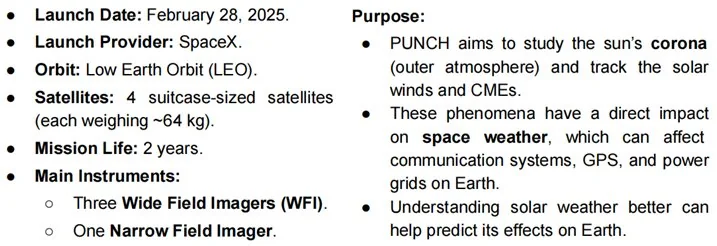
NASA is launching a new mission called PUNCH (Polarimetry to Unify the Corona and Heliosphere) to study the sun’s outer atmosphere and understand solar winds and Coronal Mass Ejections (CMEs). These solar events affect space weather and can impact systems on Earth like satellite communication and GPS. The mission will launch on February 28, 2025, using SpaceX to carry four small satellites into Low Earth Orbit (LEO).
VRAuthor Desk
2 min read
NASA is launching a new mission called PUNCH (Polarimetry to Unify the Corona and Heliosphere) to study the sun’s outer atmosphere and understand solar winds and Coronal Mass Ejections (CMEs). These solar events affect space weather and can impact systems on Earth like satellite communication and GPS. The mission will launch on February 28, 2025, using SpaceX to carry four small satellites into Low Earth Orbit (LEO).
- NASA is launching a new mission called PUNCH (Polarimetry to Unify the Corona and Heliosphere) to study the sun’s outer atmosphere and understand solar winds and Coronal Mass Ejections (CMEs).
- These solar events affect space weather and can impact systems on Earth like satellite communication and GPS.
- The mission will launch on February 28, 2025, using SpaceX to carry four small satellites into Low Earth Orbit (LEO).
MISSION DETAILS
KEY FEATURES OF PUNCH
- Polarisation Measurement:
- PUNCH will use polarised light to study the sun.
- It will use polarising filters to measure how sunlight is scattered by particles in the corona, giving scientists detailed information about solar activity.
- 3D Imaging:
- PUNCH will use four cameras working together to create 3D images of the sun’s corona, offering a unique look at solar winds and CMEs.
- Continuous Imaging:
- The cameras will take images of the sun every four minutes and capture both polarised and unpolarised light at different times.
- Wide and Narrow Field Imaging:
- The Wide Field Imagers (WFI) will capture a large area of the sun’s atmosphere, while the Narrow Field Imager will focus on specific regions for more detailed observations.
SCIENTIFIC IMPACT
- Tracking Solar Winds and CMEs:
- PUNCH will help scientists understand how solar winds and CMEs form, evolve, and move through space.
- This information is important for predicting when these solar events might reach Earth.
- Space Weather Prediction:
- Data from PUNCH will help improve predictions of space weather events.
- This will help reduce the impact of solar storms on Earth and space missions.
WHY IT MATTERS?
- Impact on Earth: Solar events can disrupt satellite communication, GPS systems, and power grids on Earth.
- Space Exploration: Solar weather can also affect spacecraft, so understanding it is important for protecting both Earth’s technology and future space missions.
- Better Predictions: The mission will improve our ability to predict space weather, helping us prepare for its effects.
- Prelims: Key facts, institutions, locations and terminology in the article.
- Mains: Connect the topic with Economy, Polity & Governance, Science & Technology.
- Revision: Use the article headings to prepare concise notes and answer-writing points.
Test your understanding
Questions from this article
Prelims practiceWith reference to NASA's Punch Mission, consider the following statements:
- NASA is launching a new mission called PUNCH (Polarimetry to Unify the Corona and Heliosphere) to study the sun’s outer atmosphere and understand solar winds and Coronal Mass Ejections (CMEs).
- These solar events affect space weather and can impact systems on Earth like satellite communication and GPS.
- The mission will launch on February 28, 2025, using SpaceX to carry four small satellites into Low Earth Orbit (LEO).
Which of the statements given above are correct?
- 1 and 2 only
- 2 and 3 only
- 1 and 3 only
- 1, 2 and 3
View answer
Answer: (d) 1, 2 and 3. All three statements are drawn from the article.
Mains practiceDiscuss the background, key issues and significance of NASA's Punch Mission for India.
Answer in 250 words.
View answer approach
- MISSION DETAILS
- KEY FEATURES OF PUNCH
- SCIENTIFIC IMPACT
- WHY IT MATTERS?
Frequently asked questionsFrequently asked questions
Why is Nasa'S Punch Mission in the news?
NASA is launching a new mission called PUNCH (Polarimetry to Unify the Corona and Heliosphere) to study the sun’s outer atmosphere and understand solar winds and Coronal Mass Ejections (CMEs). These solar events affect space weather and can impact systems on Earth like satellite communication and GPS.
What are the key facts about Nasa'S Punch Mission?
The mission will launch on February 28, 2025, using SpaceX to carry four small satellites into Low Earth Orbit (LEO). MISSION DETAILS KEY FEATURES OF PUNCH Polarisation Measurement: PUNCH will use polarised light to study the sun. It will use polarising filters to measure how sunlight is scattered by particles in the corona, giving scientists detailed information about solar activity.
Why is Nasa'S Punch Mission important for UPSC preparation?
The topic connects current developments with Economy, Polity & Governance, Science & Technology and is relevant for both objective revision and analytical answer writing.