UPSC Current Affairs
LIPULEKH PASS DISPUTE
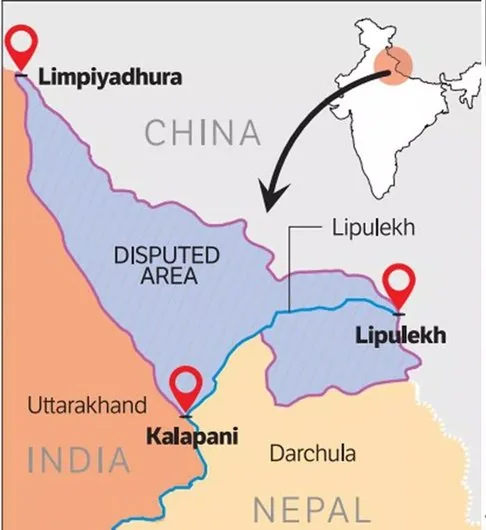
On 20 August 2025, India rejected Nepal’s objections to the resumption of border trade between India and China through the Lipulekh Pass, located in Uttarakhand. Nepal had raised formal objections after China’s Foreign Minister Wang Yi visited India on 19 August 2025, during which both countries announced reopening of key Himalayan trade routes: Lipulekh Pass – Uttarakhand Shipki La Pass – Himachal Pradesh Nathu La… Nepal reaffirmed its position, citing its official map enshrined in the Constitution, which claims Limpiyadhura, Lipulekh, and Kalapani as its territory.
VRAuthor Desk
3 min read
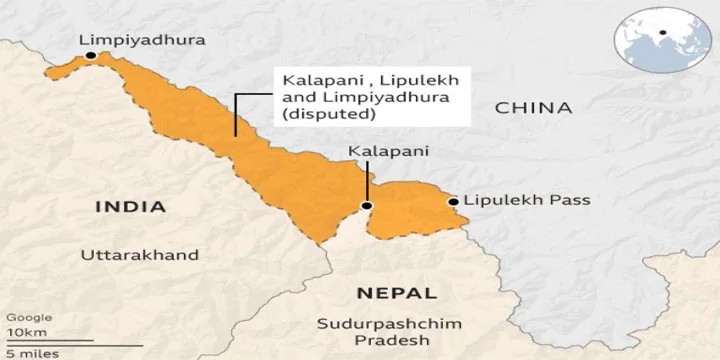
On 20 August 2025, India rejected Nepal’s objections to the resumption of border trade between India and China through the Lipulekh Pass, located in Uttarakhand. Nepal had raised formal objections after China’s Foreign Minister Wang Yi visited India on 19 August 2025, during which both countries announced reopening of key Himalayan trade routes: Lipulekh Pass – Uttarakhand Shipki La Pass – Himachal Pradesh Nathu La… Nepal reaffirmed its position, citing its official map enshrined in the Constitution, which claims Limpiyadhura, Lipulekh, and Kalapani as its territory.
- On 20 August 2025, India rejected Nepal’s objections to the resumption of border trade between India and China through the Lipulekh Pass, located in Uttarakhand.
- Nepal had raised formal objections after China’s Foreign Minister Wang Yi visited India on 19 August 2025, during which both countries announced reopening of key Himalayan trade routes:
- Lipulekh Pass – Uttarakhand
- Shipki La Pass – Himachal Pradesh
- Nathu La Pass – Sikkim
- India stated that Nepal’s territorial claims are not supported by historical facts or evidence.
- Nepal reaffirmed its position, citing its official map enshrined in the Constitution, which claims Limpiyadhura, Lipulekh, and Kalapani as its territory.
| Feature |
Details
|
| Geographical Location |
In the Kumaon region of Uttarakhand, near the India-Nepal-China trijunction |
| Altitude |
Approximately 5,334 meters or 17,500 feet above sea level |
| Connectivity |
Connects Uttarakhand (India) with Tibet Autonomous Region (China) |
| District |
Located in Pithoragarh district, Uttarakhand |
| Strategic Use |
Important trade route and access point for Kailash Mansarovar Yatra pilgrimage |
| Historical Trade Use |
Trade through this pass began in 1954; formally reopened in 1992 as India’s first trade post with China |
INDIA CHINA TRADE THROUGH HIMALAYAN PASSES
| Border Pass |
State |
Year Opened for Trade |
Significance |
| Lipulekh Pass |
Uttarakhand |
1992 |
First border trade post with China; religious and strategic |
| Shipki La Pass |
Himachal Pradesh |
1994 |
Connects Kinnaur district with Tibet; trade in wool, salt |
| Nathu La Pass |
Sikkim |
2006 |
High-volume trade; links Gangtok to Lhasa |
GEOPOLITICAL SIGNIFICANCE OF LIPULEKH PASS
- Trijunction Point: Close to where India, Nepal, and China meet.
- Strategic Height: Provides surveillance advantage and access to the higher Himalayas.
- Pilgrimage Route: Part of the Kailash Mansarovar Yatra, attracting religious pilgrims from India.
- Border Infrastructure: Presence of military roads, border outposts, and ongoing infrastructure development by India.
INDIA’S OFFICIAL POSITION
- Trade History:
- India-China border trade through Lipulekh has been ongoing since 1954.
- Recent disruptions were due to COVID-19 and other developments, not related to territorial disputes.
- Territorial Claims:
- Nepal’s claim over Lipulekh, Limpiyadhura, and Kalapani is not based on historical facts or legal treaties.
- India rejects unilateral and artificial expansion of territorial claims.
- Diplomatic Stance:
- India remains open to constructive dialogue with Nepal on agreed outstanding boundary issues, through bilateral mechanisms.
NEPAL’S OBJECTIONS & CLAIMS
- Nepal’s Ministry of Foreign Affairs objected to the resumption of trade through Lipulekh.
- Cited the official map of Nepal, adopted in 2020, which shows:
- Limpiyadhura
- Kalapani
- Lipulekh
...as lying
east of the Mahakali River, thereby claimed as part of
Nepali territory.
- The Nepalese Constitution has been amended to include this revised map.
HISTORICAL BACKGROUND
- Treaty of Sugauli (1815–1816):
- Signed between British India and the Kingdom of Nepal.
- Mahakali River (called Kali River) was designated as the western boundary of Nepal.
- Interpretational Dispute:
- India claims that the origin of the Mahakali River lies east of Kalapani, placing the area within Indian territory.
- Nepal claims the river originates near Limpiyadhura, placing Kalapani, Lipulekh, and Limpiyadhura within Nepal.
- Status of Dispute:
- Boundary disputes have remained unresolved, but were previously handled through bilateral dialogue.
RELIGIOUS & CULTURAL IMPORTANCE
- Lipulekh is part of the route for Kailash Mansarovar Yatra, undertaken by Hindu pilgrims to Mount Kailash and Lake Mansarovar in Tibet.
- The Vyas Valley, where the pass is located, is associated with ancient Indian texts and mythology.
WAY FORWARD
- Bilateral Dialogue:
- Revive India-Nepal Boundary Working Group to resolve issues through facts and evidence.
- Cartographic Restraint:
- Avoid unilateral actions such as map revisions without mutual agreement.
- Public Diplomacy:
- Educate citizens in both countries about historical treaties and maps to avoid misinformation.
- Strategic Clarity:
- Maintain open channels with both Nepal and China, balancing sovereignty and diplomacy.
- Infrastructure Development:
- Continue border infrastructure upgrades to improve logistics and monitoring without escalating tensions.
- Prelims: Key facts, institutions, locations and terminology in the article.
- Mains: Connect the topic with Environment, Economy, International Relations.
- Revision: Use the article headings to prepare concise notes and answer-writing points.
Test your understanding
Questions from this article
Prelims practiceWith reference to LIPULEKH PASS DISPUTE, consider the following statements:
- On 20 August 2025, India rejected Nepal’s objections to the resumption of border trade between India and China through the Lipulekh Pass, located in Uttarakhand.
- Nepal had raised formal objections after China’s Foreign Minister Wang Yi visited India on 19 August 2025, during which both countries announced reopening of key Himalayan trade routes: Lipulekh Pass – Uttarakhand Shipki…
- Lipulekh Pass – Uttarakhand
Which of the statements given above are correct?
- 1 and 2 only
- 2 and 3 only
- 1 and 3 only
- 1, 2 and 3
View answer
Answer: (d) 1, 2 and 3. All three statements are drawn from the article.
Mains practiceDiscuss the background, key issues and significance of LIPULEKH PASS DISPUTE for India.
Answer in 250 words.
View answer approach
- INDIA CHINA TRADE THROUGH HIMALAYAN PASSES
- GEOPOLITICAL SIGNIFICANCE OF LIPULEKH PASS
- INDIA’S OFFICIAL POSITION
- NEPAL’S OBJECTIONS & CLAIMS
- HISTORICAL BACKGROUND
Frequently asked questionsFrequently asked questions
Why is Lipulekh Pass Dispute in the news?
On 20 August 2025, India rejected Nepal’s objections to the resumption of border trade between India and China through the Lipulekh Pass, located in Uttarakhand. Nepal had raised formal objections after China’s Foreign Minister Wang Yi visited India on 19 August 2025, during which both countries announced reopening of key Himalayan trade routes: Lipulekh Pass – Uttarakhand Shipki La Pass – Himachal Pradesh Nathu La…
What are the key facts about Lipulekh Pass Dispute?
Nepal reaffirmed its position, citing its official map enshrined in the Constitution, which claims Limpiyadhura, Lipulekh, and Kalapani as its territory. Feature Details Geographical Location In the Kumaon region of Uttarakhand, near the India-Nepal-China trijunction Altitude Approximately 5,334 meters or 17,500 feet above sea level Connectivity Connects Uttarakhand (India) with Tibet Autonomous Region (China)… Strategic Height: Provides surveillance advantage and access to the higher Himalayas.
Why is Lipulekh Pass Dispute important for UPSC preparation?
The topic connects current developments with Environment, Economy, International Relations and is relevant for both objective revision and analytical answer writing.