UPSC Current Affairs
KALA SANSKRITI VIKAS YOJANA
Context The Ministry of Culture implements the Kala Sanskriti Vikas Yojana (KSVY) to promote, preserve, and develop India's rich cultural heritage. The scheme provides financial assistance to eligible cultural organisations, individual artists, tribal artists, rural artists, and performing arts groups across the country. The scheme supports the preservation of traditional art forms while encouraging emerging artists to pursue cultural activities as sustainable livelihoods.
VRAuthor Desk
5 min read
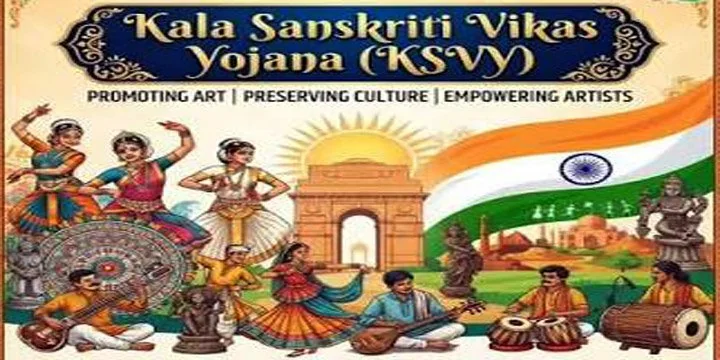
Context The Ministry of Culture implements the Kala Sanskriti Vikas Yojana (KSVY) to promote, preserve, and develop India's rich cultural heritage. The scheme provides financial assistance to eligible cultural organisations, individual artists, tribal artists, rural artists, and performing arts groups across the country. The scheme supports the preservation of traditional art forms while encouraging emerging artists to pursue cultural activities as sustainable livelihoods.
Context
- The Ministry of Culture implements the Kala Sanskriti Vikas Yojana (KSVY) to promote, preserve, and develop India's rich cultural heritage.
- The scheme provides financial assistance to eligible cultural organisations, individual artists, tribal artists, rural artists, and performing arts groups across the country.
- The scheme supports the preservation of traditional art forms while encouraging emerging artists to pursue cultural activities as sustainable livelihoods.
ABOUT KSVY
- Kala Sanskriti Vikas Yojana (KSVY) is a Central Sector Scheme implemented by the Ministry of Culture.
- Financial assistance is released directly from the Consolidated Fund of India through annual budgetary allocations.
- The scheme aims to preserve India's tangible and intangible cultural heritage by supporting artists, scholars, cultural institutions, and infrastructure.
- It promotes performing arts, folk traditions, tribal culture, literature, research, cultural infrastructure, and capacity building.
OBJECTIVES
- To preserve and promote India's diverse cultural heritage.
- To provide financial assistance to artists and cultural organisations.
- To protect traditional folk, tribal, and indigenous art forms.
- To strengthen the Guru–Shishya Parampara (traditional teacher-disciple system).
- To encourage research, documentation, and dissemination of cultural knowledge.
- To create and modernise cultural infrastructure across the country.
- To support young artists, researchers, and veteran artists.
- To strengthen India's cultural and creative economy.
MAJOR COMPONENTS OF KSVY
Financial Assistance for Promotion of Guru–Shishya Parampara (Repertory Grant)
- The scheme provides financial support to organisations engaged in training artists through the traditional Guru–Shishya Parampara.
- It covers theatre groups, music ensembles, dance institutions, children's theatre, and other performing arts organisations.
- Assistance is provided for:
- One Guru
- Up to 18 Shishyas (students).
- Financial assistance includes:
- Guru: ₹15,000 per month.
- Shishya: ₹2,000–₹10,000 per month depending upon age.
Financial Assistance for Promotion of Art and Culture
(a) Financial Assistance to Cultural Organisations with National Presence
- Financial support is provided to registered cultural organisations having a pan-India presence.
- Eligible organisations should have spent at least ₹1 crore on cultural activities during three of the last five years.
- Financial assistance:
- Normally up to ₹1 crore.
- Up to ₹5 crore in exceptional cases.
(b) Cultural Function and Production Grant (CFPG)
- Assistance is provided to NGOs, Trusts, Universities, and Societies for organising:
- Seminars.
- Conferences.
- Workshops.
- Festivals.
- Exhibitions.
- Research programmes.
- Dance, drama, theatre, and music productions.
- Financial assistance:
- Up to ₹5 lakh.
- Up to ₹20 lakh in exceptional cases.
Preservation and Development of Cultural Heritage of the Himalayas
- The scheme promotes preservation of the cultural heritage of Himalayan States through:
- Research.
- Documentation.
- Training
- Audio-visual dissemination.
- Applicable States:
- Jammu & Kashmir.
- Himachal Pradesh.
- Uttarakhand.
- Sikkim
- Arunachal Pradesh.
- Financial assistance:
- Up to ₹10 lakh annually.
- Up to ₹30 lakh in exceptional cases.
Preservation and Development of Buddhist/Tibetan Organisations
- Financial support is provided to Buddhist and Tibetan organisations, including monasteries.
- The scheme promotes:
- Buddhist cultural traditions.
- Scientific research.
- Cultural preservation.
- Financial assistance:
- Up to ₹30 lakh annually.
- Up to ₹1 crore in exceptional cases.
Building Grants Including Studio Theatres
- Financial assistance is provided for creating cultural infrastructure such as:
- Auditoriums.
- Studio theatres.
- Rehearsal halls.
- Classrooms.
- Exhibition spaces.
- Assistance also covers:
- Air-conditioning.
- Acoustics.
- Electrical systems.
- Lighting and sound facilities.
- Financial assistance:
- ₹50 lakh in metro cities.
- ₹25 lakh in non-metro cities.
Domestic Festivals and Fairs
- The scheme supports organisation of Rashtriya Sanskriti Mahotsavs (RSMs) through Zonal Cultural Centres (ZCCs).
- These festivals showcase artists from different regions and promote India's cultural diversity.
- Since 2015, 14 Rashtriya Sanskriti Mahotsavs have been organised.
Financial Assistance for Construction of Tagore Cultural Complexes (TCC)
- The scheme supports the construction and modernization of:
- Auditoriums.
- Cultural complexes.
- Rabindra Bhawans.
- Rangshalas.
- Exhibition halls.
- Green rooms.
- Eligible beneficiaries include:
- State Governments.
- Universities.
- Municipal bodies.
- NGOs.
- Cultural organisations.
- Financial assistance:
- Up to ₹15 crore per project.
- Funding Pattern:
- 90:10 (Centre: Recipient) for North Eastern Region projects.
- 60:40 (Centre: State/Organisation) for other States.
Scholarship and Fellowship Schemes
(a) Fellowship to Outstanding Persons in Culture
- Up to 400 Fellowships are awarded in each batch.
- Categories:
- Junior (25–40 years).
- Senior (Above 40 years).
- Fellowship amount:
- Junior: ₹10,000 per month.
- Senior: ₹20,000 per month.
- Duration:
(b) Scholarships for Young Artists
- Up to 400 scholarships are awarded.
- Eligible age:
- Fields covered:
- Classical music.
- Classical dance.
- Theatre.
- Mime.
- Folk arts.
- Indigenous arts.
- Visual arts.
- Scholarship amount:
- ₹5,000 per month for two years.
(c) Tagore National Fellowship for Cultural Research
- Supports research in cultural institutions under the Ministry of Culture.
- Provides:
- Up to 15 Fellowships.
- Up to 25 Scholarships.
- Fellowship:
- ₹80,000 per month plus contingency.
- Scholarship:
- ₹50,000 per month plus contingency.
- Duration:
Financial Assistance for Veteran Artists
- Financial assistance is provided to senior artists and scholars aged 60 years or above.
- Eligibility:
- Annual income should not exceed ₹72,000.
- Assistance:
- In case of the beneficiary's death, assistance may be transferred to the surviving spouse.
ROLE OF ZONAL CULTURAL CENTRES
The Government has established
seven Zonal Cultural Centres (ZCCs) to preserve and promote regional and tribal culture.
Headquarters
- Patiala.
- Nagpur.
- Udaipur.
- Prayagraj.
- Kolkata.
- Dimapur.
- Thanjavur.
Functions
- Organise cultural festivals and exhibitions.
- Promote tribal and folk art.
- Conduct workshops and cultural exchange programmes.
- Provide platforms for emerging artists.
- Preserve regional cultural traditions.
RACHNATMAK BHARAT INITIATIVE
- The Ministry of Culture has introduced Rachnatmak Bharat, a Cultural and Creative Economy initiative.
- The programme focuses on:
- Capacity building.
- Innovation
- Market access.
- Digital enablement.
- Institutional strengthening.
- Promotion of creative industries.
- It aims to strengthen India's cultural economy and improve livelihood opportunities for artists and creative professionals.
SIGNIFICANCE
- KSVY preserves India's diverse cultural heritage and traditional knowledge systems.
- It strengthens the Guru–Shishya Parampara, ensuring continuity of traditional performing arts.
- The scheme provides financial security to artists, scholars, and cultural organisations.
- It promotes tribal, folk, and indigenous art forms that are vulnerable to decline.
- Investment in cultural infrastructure encourages tourism, education, and local economic development.
- The initiative contributes to India's soft power by promoting cultural diplomacy and preserving intangible cultural heritage.
CHALLENGES
- Many artists in remote areas remain unaware of available financial assistance.
- Documentation and preservation of endangered art forms require sustained efforts.
- Monitoring the effective utilisation of grants remains challenging.
- Limited digital access may restrict participation by artists from rural and tribal regions.
- Cultural institutions require greater institutional capacity and infrastructure support.
- Prelims: Key facts, institutions, locations and terminology in the article.
- Mains: Connect the topic with Economy, Polity & Governance, Science & Technology.
- Revision: Use the article headings to prepare concise notes and answer-writing points.
Test your understanding
Questions from this article
Prelims practiceWith reference to KALA SANSKRITI VIKAS YOJANA, consider the following statements:
- The Ministry of Culture implements the Kala Sanskriti Vikas Yojana (KSVY) to promote, preserve, and develop India's rich cultural heritage.
- The scheme provides financial assistance to eligible cultural organisations, individual artists, tribal artists, rural artists, and performing arts groups across the country.
- The scheme supports the preservation of traditional art forms while encouraging emerging artists to pursue cultural activities as sustainable livelihoods.
Which of the statements given above are correct?
- 1 and 2 only
- 2 and 3 only
- 1 and 3 only
- 1, 2 and 3
View answer
Answer: (d) 1, 2 and 3. All three statements are drawn from the article.
Mains practiceDiscuss the background, key issues and significance of KALA SANSKRITI VIKAS YOJANA for India.
Answer in 250 words.
View answer approach
- ABOUT KSVY
- OBJECTIVES
- MAJOR COMPONENTS OF KSVY
- RACHNATMAK BHARAT INITIATIVE
- SIGNIFICANCE
Frequently asked questionsFrequently asked questions
Why is Kala Sanskriti Vikas Yojana in the news?
Context The Ministry of Culture implements the Kala Sanskriti Vikas Yojana (KSVY) to promote, preserve, and develop India's rich cultural heritage. The scheme provides financial assistance to eligible cultural organisations, individual artists, tribal artists, rural artists, and performing arts groups across the country.
What are the key facts about Kala Sanskriti Vikas Yojana?
The scheme supports the preservation of traditional art forms while encouraging emerging artists to pursue cultural activities as sustainable livelihoods. ABOUT KSVY Kala Sanskriti Vikas Yojana (KSVY) is a Central Sector Scheme implemented by the Ministry of Culture. Financial assistance is released directly from the Consolidated Fund of India through annual budgetary allocations.
Why is Kala Sanskriti Vikas Yojana important for UPSC preparation?
The topic connects current developments with Economy, Polity & Governance, Science & Technology and is relevant for both objective revision and analytical answer writing.