UPSC Current Affairs
JAN VISHWAS (AMENDMENT) ACT, 2026
Jan Vishwas (Amendment of Provisions) Bill, 2026, passed by Parliament in April 2026, aims to improve ease of doing business and living by decriminalizing 717 minor offenses and amending 784 provisions across 79 central laws. It replaces imprisonment with penalties for minor errors, promoting "trust-based governance". KEY FEATURES OF THE 2026 BILL Decriminalization: Replaces imprisonment with civil penalties/fines for minor offences under various acts.
VRAuthor Desk
2 min read
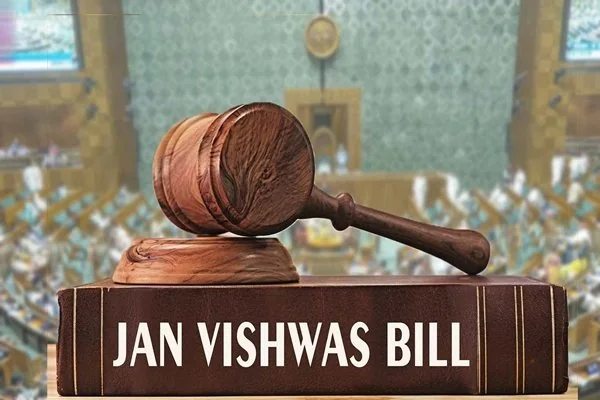
Jan Vishwas (Amendment of Provisions) Bill, 2026, passed by Parliament in April 2026, aims to improve ease of doing business and living by decriminalizing 717 minor offenses and amending 784 provisions across 79 central laws. It replaces imprisonment with penalties for minor errors, promoting "trust-based governance". KEY FEATURES OF THE 2026 BILL Decriminalization: Replaces imprisonment with civil penalties/fines for minor offences under various acts.
Jan Vishwas (Amendment of Provisions) Bill, 2026, passed by Parliament in April 2026, aims to
improve ease of doing business and living by
decriminalizing 717 minor offenses and amending 784 provisions across 79 central laws.
It
replaces imprisonment with penalties for minor errors, promoting
"trust-based governance".
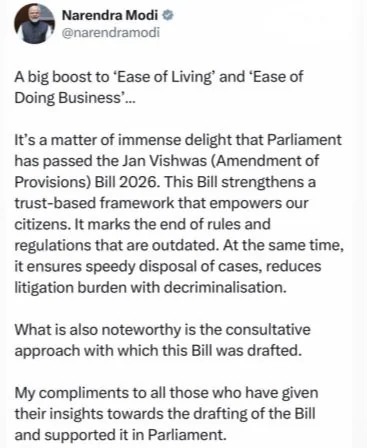
KEY FEATURES OF THE 2026 BILL
- Decriminalization: Replaces imprisonment with civil penalties/fines for minor offences under various acts.
- Scope: Affects 79 Central Acts administered by 23 Ministries.
- Adjudicating Officers: Introduces administrative officers to impose penalties, reducing court burden.
- Periodic Penalty Increase: Fines will increase by 10% every three years.
- Objective: To reduce compliance burden, reduce litigation, and promote a business-friendly environment.
BACKGROUND
- 2023: The original Jan Vishwas (Amendment of Provisions) Act, 2023 was enacted.
- 2025/2026: The 2025 Bill was introduced in August 2025, referred to a committee, and later replaced by the Jan Vishwas (Amendment of Provisions) Bill, 2026 to include broader reforms (79 acts vs. 17 initially).
- State-Level Adoption: Following the central government's lead, states like Maharashtra and Gujarat have also enacted their own "Jan Vishwas" legislation to rationalise state-specific laws.
WHAT IS JAN VISHWAS BILL OF 2023?
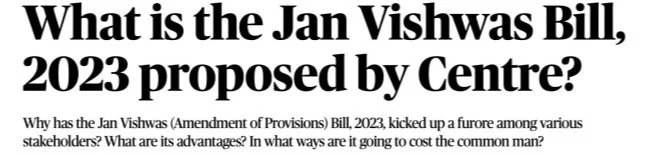 The Jan Vishwas (Amendment of Provisions) Bill, 2023
 was passed in Parliament recently. The Bill aims at giving
further boost to ease of living and ease of doing business. It proposes to amend 183 provisions to be decriminalised in 42 Central Acts administered by 19 Ministries/Departments.
ABOUT THE BILL
The Jan Vishwas (Amendment of Provisions) Bill, 2022 amends
42 laws, across multiple sectors, including:
- Agriculture
- Environment
- Media and Publication and
- Health.
The Bill converts several fines to penalties, meaning that court prosecution is not necessaryto administer punishments. It also removes imprisonment as a punishment for many offences.
MAJOR ACTS WHERE CHANGES ARE PROPOSED
- Drugs and Cosmetics Act, 1940.
(The Act regulates the
import, manufacture, distribution and sale of drugs and cosmetics in the country)
- The Food Safety and Standards Act, 2006 and
- The Pharmacy Act, 1948.
- Prelims: Key facts, institutions, locations and terminology in the article.
- Mains: Connect the topic with Economy, Polity & Governance, Health.
- Revision: Use the article headings to prepare concise notes and answer-writing points.
Test your understanding
Questions from this article
Prelims practiceWith reference to JAN VISHWAS (AMENDMENT) ACT, 2026, consider the following statements:
- Decriminalization: Replaces imprisonment with civil penalties/fines for minor offences under various acts.
- Scope: Affects 79 Central Acts administered by 23 Ministries.
- Adjudicating Officers: Introduces administrative officers to impose penalties, reducing court burden.
Which of the statements given above are correct?
- 1 and 2 only
- 2 and 3 only
- 1 and 3 only
- 1, 2 and 3
View answer
Answer: (d) 1, 2 and 3. All three statements are drawn from the article.
Mains practiceDiscuss the background, key issues and significance of JAN VISHWAS (AMENDMENT) ACT, 2026 for India.
Answer in 250 words.
View answer approach
- KEY FEATURES OF THE 2026 BILL
- BACKGROUND
- WHAT IS JAN VISHWAS BILL OF 2023?
- ABOUT THE BILL
- MAJOR ACTS WHERE CHANGES ARE PROPOSED
Frequently asked questionsFrequently asked questions
Why is Jan Vishwas (Amendment) Act, 2026 in the news?
Jan Vishwas (Amendment of Provisions) Bill, 2026, passed by Parliament in April 2026, aims to improve ease of doing business and living by decriminalizing 717 minor offenses and amending 784 provisions across 79 central laws. It replaces imprisonment with penalties for minor errors, promoting "trust-based governance".
What are the key facts about Jan Vishwas (Amendment) Act, 2026?
KEY FEATURES OF THE 2026 BILL Decriminalization: Replaces imprisonment with civil penalties/fines for minor offences under various acts. Scope: Affects 79 Central Acts administered by 23 Ministries. Adjudicating Officers: Introduces administrative officers to impose penalties, reducing court burden.
Why is Jan Vishwas (Amendment) Act, 2026 important for UPSC preparation?
The topic connects current developments with Economy, Polity & Governance, Health and is relevant for both objective revision and analytical answer writing.