Why in News?
- India's Ethanol Blended Petrol (EBP) Programme has become a key pillar of the country's energy transition and biofuel policy.
- The programme aims to:
- Strengthen energy security.
- Reduce dependence on imported crude oil.
- Support farmers through an additional source of income.
- Lower greenhouse gas emissions.
- Promote domestically produced renewable fuels.
- Recently, E20 petrol has attracted public attention due to concerns regarding:
- Vehicle mileage.
- Engine compatibility.
- Running costs.
- Consumer choice at fuel stations.
KEY POINTS
- India's transition towards cleaner mobility is being driven through multiple technologies, including:
- Ethanol blending
- Flex-fuel vehicles
- Hybrid vehicles
- Electric Vehicles (EVs)
- CNG
- Compressed Biogas (CBG)
- Hydrogen fuel
- Among these, ethanol blending offers one of the quickest and most cost-effective pathways to reduce transport-sector emissions while improving energy security.
- However, concerns relating to fuel efficiency, vehicle compatibility, sustainability, water usage, pricing, and future blending targets beyond E20 require scientific assessment and policy clarity.
WHAT IS INDIA’S ETHANOL BLENDING PROGRAM?
Ethanol (Ethyl Alcohol) is a renewable biofuel produced through:
- Fermentation of sugars using yeast.
- Petrochemical processes.
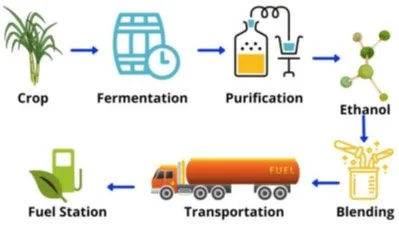
MAJOR FEEDSTOCKS IN INDIA
- Sugarcane molasses
- Sugarcane juice
- Maize
- Surplus rice
- Damaged food grains
COMMON BLENDS
| Blend |
Ethanol Content |
Remarks |
| E10 |
10% |
Suitable for most existing vehicles |
| E20 |
30% |
Requires compatible engines; slight reduction in mileage possible |
- Reduce crude oil imports.
- Improve energy security.
- Lower greenhouse gas emissions.
- Increase farmers' income.
- Promote renewable fuels.
GENERATIONS OF BIOFUELS
| Generation |
Feedstock |
Key Characteristics |
| First Generation (1G) |
Sugarcane, Corn, Wheat |
Mature technology but competes with food production |
| Second Generation (2G) |
Crop residues, Paddy straw, Bamboo |
Converts agricultural waste into fuel; reduces stubble burning |
| Third Generation (3G) |
Algae |
High productivity; does not require agricultural land; under research |
| Fourth Generation (4G) |
Genetically modified organisms |
Designed for higher carbon capture; currently at experimental stage |
- India achieved its 20% Ethanol Blending Target (E20) in 2025, five years ahead of the original target of 2030.
Current Status (April 2026)
- All petrol sold across India must contain:
- 20% ethanol (E20)
- Minimum Research Octane Number (RON) of 95
EXPANSION OF ETHANOL PRODUCTION CAPACITY
| Year |
Production Capacity |
| 2014 |
Less than 2 Billion Litres |
| 2026 |
Nearly 20 Billion Litres |
Current capacity significantly exceeds the
required for nationwide E20 implementation.
Role of National Biofuel Coordination Committee (NBCC)
The
NBCC oversees:
- Feedstock selection.
- Allocation based on surplus availability.
- Coordination among ministries.
KEY POLICY REFORMS SUPPORTING EBP
1. Ethanol Interest Subvention Scheme (EISS)
- Operational during 2018–2022.
- Financial assistance for:
- Molasses-based ethanol plants.
- Grain-based ethanol plants.
2. Long-Term Offtake Agreements (LTOAs)
Public Sector Oil Marketing Companies (OMCs) signed long-term agreements with ethanol producers to ensure:
- Assured demand.
- Timely payments.
- Stable markets.
3. Administered Pricing Mechanism
Government-fixed ethanol prices ensured:
- Investment certainty.
- Private sector participation.
- Stable ethanol supply.
4. GST Rationalisation
GST on ethanol was reduced:
Result:
- Lower production costs.
- Increased blending.
5. Legislative Reforms
- Amendments in the Industries (Development & Regulation) Act facilitated:
- Interstate movement of ethanol.
- Easier transportation and distribution.
IMPACT OF ETHANOL BLENDING PROGRAM
- Energy Security
The programme has:
- Reduced crude oil imports.
- Saved over ₹1.4 lakh crore in foreign exchange since 2014.
- Reduced vulnerability to global oil price fluctuations.
2: Farmer Empowerment
| Beneficiary |
Earnings (Till 2025) |
| Farmers |
₹1.18 lakh crore |
| Distilleries |
₹1.96 lakh crore |
The programme has transformed farmers from:
to
Urjadata (Energy Provider).
3. Rural Employment
The expansion of:
- Distilleries
- Agro-processing industries
has created employment opportunities, particularly in:
- Uttar Pradesh
- Maharashtra
- Bihar
4. Climate Action
Ethanol:
- Burns more completely than petrol.
- Produces lower emissions.
Environmental Benefits
- Reduction of approximately 832 lakh metric tonnes of CO2 emissions.
- Supports India's Net Zero by 2070
- Contributes towards India's Panchamrit Commitments.
5. Waste-to-Wealth
Grain-based ethanol production generates:
DDGS (Dried Distillers Grain with Solubles)
Uses:
- Premium cattle feed.
- Reduces fodder shortages.
- Supports the circular economy.
ISSUES RELATED TO E20
1. Reduced Mileage
Since ethanol contains lower energy than petrol:
- Fuel efficiency may decline.
- Consumers may experience higher running costs.
2. Compatibility with Older Vehicles
Older vehicles designed for:
may experience:
- Reduced performance.
- Increased maintenance.
- Durability issues.
3. Material Corrosion
Ethanol is
hygroscopic, meaning it absorbs moisture.
Possible effects:
- Corrosion of metal components.
- Damage to rubber and plastic parts.
- Wear in fuel pumps and valves.
4. Lack of Consumer Choice
Unlike Brazil, Indian consumers generally cannot choose between:
- E10
- E20
- Pure petrol at fuel stations.
5. Limited Price Incentive
Consumers do not receive visible price benefits despite ethanol blending.
Reasons include:
- Ethanol attracts 5% GST.
- Petrol remains outside GST.
- Retail prices remain largely unchanged.
6. Concerns Beyond E20
Future transition to:
It would require:
- Fresh engine testing.
- Material compatibility assessment.
- Vehicle certification.
-
7. Water Usage
Critics argue ethanol production requires significant water.
Although modern plants:
- Use around 3–5 litres of processed water per litre of ethanol.
- Operate under Zero Liquid Discharge (ZLD)
Concerns remain regarding:
- Water-intensive crops.
- Sustainable feedstock selection.
GLOBAL EXPERIENCE IN ETHANOL BLENDING
| Country |
Ethanol Blending Status |
| United States |
E10 widely used; E15 expanding; large flex-fuel market |
| Brazil |
High ethanol blending; over 80% new cars are flex-fuel vehicles |
| Japan |
Gradual rollout of E10 |
| Canada |
Ethanol blending under clean fuel policies |
| Thailand |
Extensive biofuel programme |
| European Countries |
Ethanol blended fuels widely promoted |
MEASURES NEEDED TO STRENGTHEN INDIA’S EBP
1. Greater Consumer Choice
Fuel stations should provide:
with proper labelling.
2. Scientific Testing
Before moving beyond E20:
Comprehensive testing should cover:
- Engine durability
- Fuel efficiency
- Emissions
- Corrosion resistance
- Certification
3. Promote Flex-Fuel Vehicles
Government support should include:
- PLI incentives
- Tax benefits
- Assured ethanol availability
- Support for advanced engine technologies
4. Retrofit Existing Vehicles
Develop:
- Certified compatibility kits
- Affordable retrofitting solutions
- Financial assistance for older vehicle owners
5. Promote Sustainable Feedstocks
Reduce dependence on sugarcane by encouraging:
- Maize
- Agricultural residues
- Surplus grains
- Damaged food grains
- Second-generation ethanol
Strengthen:
- Farmer Producer Organisations (FPOs)
- Cooperatives
- District procurement centres
6. Transparent Pricing
Government should:
- Provide visible consumer price benefits.
- Improve pricing transparency.
- Protect farmer incomes.
7. Strengthen Infrastructure
Invest in:
- Moisture-controlled storage.
- Dedicated ethanol pipelines.
- Blending facilities.
- Transportation infrastructure.
8. Improve Public Awareness
Consumers should receive clear information regarding:
- Vehicle compatibility.
- Expected mileage changes.
- Warranty validity.
- Insurance coverage.
- Fuel availability.
CONCLUSION
India's
Ethanol Blended Petrol (EBP) Programme has emerged as a cornerstone of the country's clean energy transition by reducing crude oil imports, improving energy security, lowering greenhouse gas emissions, and creating new income opportunities for farmers. Achieving the
E20 target ahead of schedule demonstrates significant policy success. However, long-term sustainability will depend on addressing consumer concerns related to mileage, vehicle compatibility, pricing, infrastructure, and water use through scientific research, transparent communication, diversified feedstocks, and supportive regulatory measures. A balanced and evidence-based approach can position ethanol blending as an effective bridge towards a cleaner, more self-reliant, and resilient transport fuel ecosystem while complementing India's broader transition to electric mobility, hydrogen, and other low-carbon technologies.
Test your understanding
Questions from this article
Prelims practiceWith reference to INDIA’S ETHANOL BLENDED PETROL PROGRAM, consider the following statements:
- India's Ethanol Blended Petrol (EBP) Programme has become a key pillar of the country's energy transition and biofuel policy.
- The programme aims to: Strengthen energy security. Reduce dependence on imported crude oil. Support farmers through an additional source of income. Lower greenhouse gas emissions. Promote domestically produced renewable…
- Strengthen energy security.
Which of the statements given above are correct?
- 1 and 2 only
- 2 and 3 only
- 1 and 3 only
- 1, 2 and 3
View answer
Answer: (d) 1, 2 and 3. All three statements are drawn from the article.
Mains practiceDiscuss the background, key issues and significance of INDIA’S ETHANOL BLENDED PETROL PROGRAM for India.
Answer in 250 words.
View answer approach
- Why in News?
- KEY POINTS
- WHAT IS INDIA’S ETHANOL BLENDING PROGRAM?
- MAJOR FEEDSTOCKS IN INDIA
- COMMON BLENDS
Frequently asked questionsFrequently asked questions
Why is India’S Ethanol Blended Petrol Program in the news?
India's Ethanol Blended Petrol (EBP) Programme has become a key pillar of the country's energy transition and biofuel policy. The programme aims to: Strengthen energy security.
What are the key facts about India’S Ethanol Blended Petrol Program?
Reduce dependence on imported crude oil. Support farmers through an additional source of income. Promote domestically produced renewable fuels.
Why is India’S Ethanol Blended Petrol Program important for UPSC preparation?
The topic connects current developments with Environment, Economy, International Relations and is relevant for both objective revision and analytical answer writing.