1. Why in News?
- The Supreme Court said that farmers should not be blamed alone for the air pollution crisis in Delhi–NCR.
- The Court asked why the sky was clear during the COVID lockdown even though stubble burning still happened, but vehicles and industries were mostly shut.
- The Court warned authorities not to turn this into a political blame game.
KEY OBSERVATIONS OF SC
A. Farmers not the only source
- Stubble burning dropped from 88,000 cases to 5,500, yet pollution levels stayed high.
- The Court said this clearly shows other sources are major contributors.
B. During
COVID, air improved
- Stubble burning continued.
- But vehicles, industries, and construction were off ? sky turned blue.
- So, pollution is multi-source, not just from farms.
C. Farmers need support, not blame
The Court said:
- Farmers must be sensitised, not punished.
- Crop stubble should be turned into an asset (for fuel, energy, fodder), not treated as waste.
WHAT DID CAQM & GOVT. SAY?
- CAQM told the Court that the goal for 2025 was “zero stubble burning”.
- But the ground reality did not match the target.
- The Bench questioned whether action plans were actually being implemented.
Justice Bagchi said:
- Pollution also comes from vehicles, road dust, and construction debris.
- Paper plans are not enough — what matters is execution.
SC’s QUESTION TO CAQM
The Court asked:
- If pollution control is not working,
- Should CAQM revisit and revise its action plan?
The Court reminded that pollution affects
everyone in NCR and even beyond.
5. Previous Directions
- Earlier, a Bench led by Justice Gavai had allowed CAQM to take any proactive measure to reduce pollution — even before the formal GRAP (Graded Response Action Plan) stages required it.
EXAMPLES OF CAQM PROPOSALS
- Advancing GRAP-IV restrictions to GRAP-III (like work-from-home, 50% office attendance).
- Restricting old vehicles (BS-III diesel, BS-IV petrol).
- Adding staggered office timings earlier in the GRAP stages.
- Increasing metro and bus services.
- Raising environmental charges on luxury diesel SUVs.
ROLE OF CAQM
- Establishment: The CAQM was formed under the Commission for Air Quality Management in NCR and Adjoining Areas Act, 2021, to coordinate air quality management efforts across Delhi and neighboring states.
- Mandate: It aims to improve air quality through research, problem identification, and pollution control initiatives.
- Powers: The CAQM can issue binding directions, conduct investigations, and develop guidelines related to air pollution.
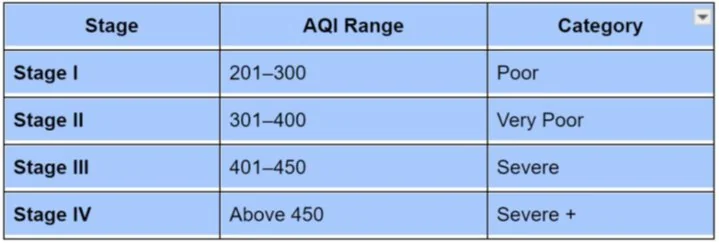
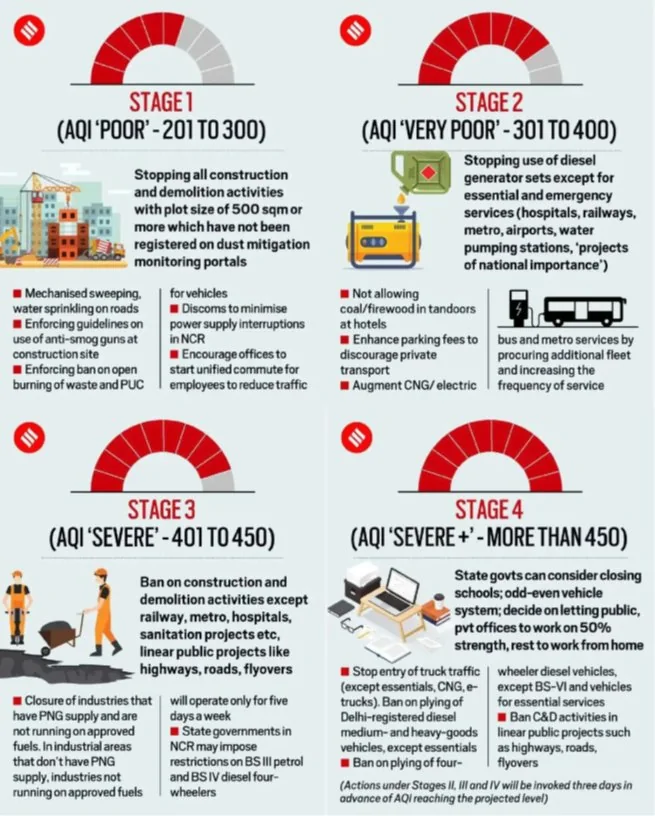
WHAT IS GRAP?
GRAP is an emergency action plan used in
Delhi–NCR to control air pollution during winter. It gives step-by-step rules based on how bad the
Air Quality Index (AQI) becomes.
GRAP has
four stages:
 2. What Changed Recently?
Some strict measures that were earlier applied
only in Stage IV (AQI >450) have now been
shifted to Stage III (AQI 401–450).
This means strong actions will begin earlier, at lower pollution levels.
3. Key Advanced Measures Moved to Stage III
4. Work From Home (WFH) Rules
- Govt offices, private companies, and municipal bodies may be told to:
- Call only 50% staff to office.
- Allow the remaining 50% to work from home.
RESTRICTIONS
Vehicle Restrictions
- Ban on:
- BS-III petrol cars
- BS-IV diesel cars
- These rules apply strictly in Delhi and NCR districts.
Construction Ban (Expanded)
Earlier, construction bans did
not include major public projects.
Now even
linear public projects are stopped under Stage III:
- Highways
- Roads
- Flyovers
- Power transmission lines
- Pipelines
This is a big shift because these projects were earlier allowed to continue.
Truck Entry Restrictions
- Entry of non-essential trucks and medium/heavy goods vehicles into Delhi-NCR is blocked.
- Only the following are allowed:
- CNG trucks
- Electric trucks
- BS-VI diesel vehicles
WHY DELHI STILL STRUGGLES WITH POLLUTION?
The article explains why India finds it difficult to clean its air, even after years of action.
A. Pattern of Quick Fixes
Every winter, authorities repeat short-term measures:
- Smog towers
- Water sprinkling
- Odd-even
- Crackdowns during festivals
- Anti-smog guns :
- But these steps do not reduce pollution permanently.
They are “visible” actions, not long-term solutions.
Why quick fixes dominate
Governments prefer short-term steps because:
- They show immediate action.
- They avoid upsetting powerful sectors (construction, transport, agriculture).
- They fit inside yearly budgets.
- They avoid political risk.
But these actions
help politics, not public health.
B. Fragmented Governance
India’s air pollution system has
too many agencies:
- Environment Ministry
- CPCB
- State Pollution Boards
- CAQM
- Delhi municipal bodies
- Transport, industry, energy departments
- Highway authority, PWD, power companies, etc.
Each controls
only one slice of the problem. No single agency has
full authority or clear accountability.
This leads to:
- Slow enforcement
- Poor coordination
- Conflicting orders
- Weak long-term planning
TWO MAJOR ‘TRAPS’ IN INDIA’S POLLUTION POLICY
1. The Intellectual Trap
- Solutions come from elite experts or think tanks.
- They are good on paper but hard to implement in cities with:
- low staff,
- weak records,
- informal economy,
- budget limits.
Ideas don’t match ground realities ? so policies fail to scale.
2. The Western Trap
- Importing foreign “best practices” without adapting them to Indian conditions.
- Western models assume:
- strong enforcement,
- reliable public transport,
- low informal activity,
- high administrative capacity.
- These assumptions do not hold in Indian cities.
So imported ideas often fail or fade out.
INDIA’S REAL CONSTRAINTS
- Uneven municipal capacity
- Informal labour markets
- Budget gaps
- Political pressures
- Different priorities across states
Policies must match
Indian realities, not global models.
WHAT INDIA ACTUALLY NEEDS?
A. Clear leadership
A modern clean-air law that clearly says:
- Who is responsible?
- Who enforces?
- How do different levels of government coordinate?
B. Strong implementing institutions
- Stable funding
- Skilled staff
- Reliable monitoring
- Transparent data
- Long-term programmes
C. “Science managers”
People who can:
- understand science,
- understand administration,
- convert ideas into workable ground-level action.
D. Policies designed for India
Solutions must match:
- local budgets
- local capacity
- local behaviour
- local political realities
Only then will clean-air efforts survive beyond one season.
CONCLUSION
The Supreme Court’s message is clear:
Farmers cannot be blamed alone for Delhi’s pollution. Air pollution comes from many sources — vehicles, dust, construction, industries, and governance failures. India needs
long-term, India-specific, and well-coordinated solutions, not seasonal quick fixes. True progress will come only when ideas, institutions, and ground realities finally align.
Test your understanding
Questions from this article
Prelims practiceWith reference to DELHI POLLUTION: FARMERS CANNOT BE MADE SCAPEGOATS, consider the following statements:
- The Supreme Court said that farmers should not be blamed alone for the air pollution crisis in Delhi–NCR.
- The Court asked why the sky was clear during the COVID lockdown even though stubble burning still happened, but vehicles and industries were mostly shut.
- The Court warned authorities not to turn this into a political blame game.
Which of the statements given above are correct?
- 1 and 2 only
- 2 and 3 only
- 1 and 3 only
- 1, 2 and 3
View answer
Answer: (d) 1, 2 and 3. All three statements are drawn from the article.
Mains practiceDiscuss the background, key issues and significance of DELHI POLLUTION: FARMERS CANNOT BE MADE SCAPEGOATS for India.
Answer in 250 words.
View answer approach
- 1. Why in News?
- KEY OBSERVATIONS OF SC
- WHAT DID CAQM & GOVT. SAY?
- EXAMPLES OF CAQM PROPOSALS
- ROLE OF CAQM
Frequently asked questionsFrequently asked questions
Why is Delhi Pollution: Farmers Cannot Be Made Scapegoats in the news?
The Supreme Court said that farmers should not be blamed alone for the air pollution crisis in Delhi–NCR. The Court asked why the sky was clear during the COVID lockdown even though stubble burning still happened, but vehicles and industries were mostly shut.
What are the key facts about Delhi Pollution: Farmers Cannot Be Made Scapegoats?
The Court warned authorities not to turn this into a political blame game. Farmers not the only source Stubble burning dropped from 88,000 cases to 5,500, yet pollution levels stayed high. The Court said this clearly shows other sources are major contributors.
Why is Delhi Pollution: Farmers Cannot Be Made Scapegoats important for UPSC preparation?
The topic connects current developments with Economy, International Relations, Polity & Governance and is relevant for both objective revision and analytical answer writing.