UPSC Current Affairs
Chennai Vladivostok Maritime Corridor
Overview: The Chennai-Vladivostok Eastern Maritime Corridor became fully operational by the end of 2023. This maritime route facilitates the transportation of goods, such as oil, food, and machinery, between India and Far East Russia. The announcement was made by Sarbananda Sonowal, the Minister of Ports, Shipping, and Waterways, on November 18, 2024.
VRAuthor Desk
4 min read
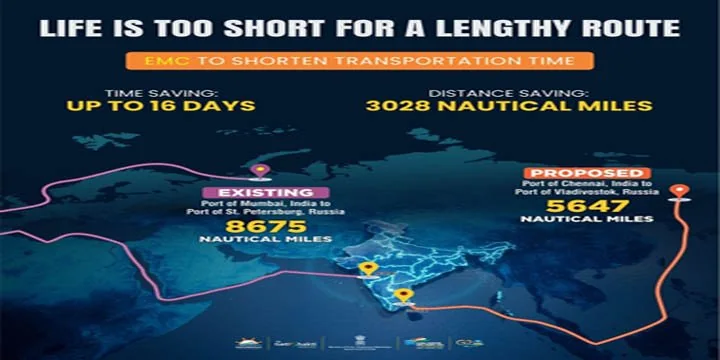
Overview: The Chennai-Vladivostok Eastern Maritime Corridor became fully operational by the end of 2023. This maritime route facilitates the transportation of goods, such as oil, food, and machinery, between India and Far East Russia. The announcement was made by Sarbananda Sonowal, the Minister of Ports, Shipping, and Waterways, on November 18, 2024.
Overview:
- The Chennai-Vladivostok Eastern Maritime Corridor became fully operational by the end of 2023.
- This maritime route facilitates the transportation of goods, such as oil, food, and machinery, between India and Far East Russia.
- The announcement was made by Sarbananda Sonowal, the Minister of Ports, Shipping, and Waterways, on November 18, 2024.
KEY DEVELOPMENTS
- Time and Distance Reduction:
- The Chennai-Vladivostok Maritime Corridor has reduced the shipping time by 16 days, from 40 days to 24 days.
- The travel distance has also been reduced by up to 40%, enhancing efficiency in trade between India and Far East Russia.
- Ports Involved:
- The corridor connects key Indian ports such as Chennai, Paradip, and Vizag along with important ports in the Bay of Bengal.
- These ports serve as the starting points for goods being shipped to Vladivostok in Russia.
- Cargo Flow:
- The types of cargo being transported include crude oil, food products, and machinery.
- This indicates a significant trade between the two regions and is expected to grow in volume.
INDIA’S MARITIME VISION
- Ambitious Maritime Goals:
- India aims to become a top maritime nation by 2047, excelling in key areas such as port operations, cargo handling, ship ownership, shipbuilding, and maritime technology.
- Port Capacity:
- India plans to increase its port capacity to handle 10,000 million metric tonnes of cargo annually by 2047.
- This will position India as a major player in global maritime trade.
- Strategic Trade Routes:
- India will utilize key international trade routes, including the IMEEC and the INSTC (International North-South Transport Corridor), to strengthen its presence in global maritime trade.
- The INSTC is a network of 7,200 kilometers linking India, Iran, Azerbaijan, Russia, and Central Asia to Europe.
- Focus on Clean Shipbuilding:
- India will focus on green shipbuilding, emphasizing the construction of ships powered by clean fuels such as ammonia, hydrogen, and electricity.
- This aligns with India’s commitment to sustainability and reducing its carbon footprint in the maritime sector.
POLICY & INFRA REFORMS
1. Important Legislative Reforms:
- India has already passed key laws to improve the maritime sector:
- Major Port Authority Act: This Act decentralizes port governance and aims to enhance port efficiency.
- National Waterways Act: This Act promotes inland water transport to reduce road congestion and improve cargo movement.
- Inland Vessel Act: Aims to improve the use of inland waterways for transportation.
- Recycling of Ships Act: Provides a legal framework to safely recycle old ships and improve environmental standards.
- Additionally, two more bills are in the pipeline:
- Coastal Shipping Bill: This will boost coastal shipping by improving the efficiency of domestic maritime transport.
- Merchant Shipping Bill: This will strengthen shipbuilding, ship recycling, and maritime safety.
- Investment in Port Infrastructure:
- ₹80 lakh crore investment has been committed to modernizing India’s port infrastructure and expanding its inland waterways. The key infrastructure projects include:
- Vizhinjam International Seaport (Kerala): A deep-water port designed to handle large ships.
- Vadhavan Mega Port (Maharashtra): This project will significantly increase India’s capacity to handle large volumes of cargo.
- Galathea Bay (Nicobar Islands): A strategic port development in the Bay of Bengal that will boost connectivity and enhance India’s maritime infrastructure.
INDIA’S STRATEGIC MARITIME VISION
- Shipbuilding Ambition:
- India aims to become one of the Top 10 shipbuilding nations by 2030 and reach the Top 5 by 2047.
- This ambition supports India’s goal of becoming self-reliant in shipbuilding, as part of the Atma Nirbhar Bharat
- National Maritime Heritage Complex:
- A National Maritime Heritage Complex is being built in Lothal to promote India’s rich maritime history and modern shipbuilding skills.
- The complex will also serve as a center for maritime technology.
- Focus on Sustainability:
- India is working toward green shipbuilding, focusing on ships powered by clean fuels like hydrogen, ammonia, and electricity.
- These efforts align with India’s climate goals and sustainability targets.
IMPROVEMENT IN PORT EFFICIENCY
- Turnaround Time:
- India has made significant progress in reducing turnaround times at its ports.
- According to the World Bank’s Logistics Performance Index, turnaround time has improved from over 40 hours a decade ago to just 22 hours today, surpassing major maritime nations like Singapore and the United States.
- Reforms to Boost Growth:
- The Coastal Shipping Bill and Merchant Shipping Bill will further enhance the efficiency of coastal shipping and integrate inland waterways into India’s maritime transport system.
- The revamped Major Port Authority Act aims to improve port governance, efficiency, and capacity, ensuring that India’s ports can handle more cargo.
- Prelims: Key facts, institutions, locations and terminology in the article.
- Mains: Connect the topic with Environment, Economy, International Relations.
- Revision: Use the article headings to prepare concise notes and answer-writing points.
Test your understanding
Questions from this article
Prelims practiceWith reference to Chennai Vladivostok Maritime Corridor, consider the following statements:
- The Chennai-Vladivostok Eastern Maritime Corridor became fully operational by the end of 2023.
- This maritime route facilitates the transportation of goods, such as oil, food, and machinery, between India and Far East Russia.
- The announcement was made by Sarbananda Sonowal, the Minister of Ports, Shipping, and Waterways, on November 18, 2024.
Which of the statements given above are correct?
- 1 and 2 only
- 2 and 3 only
- 1 and 3 only
- 1, 2 and 3
View answer
Answer: (d) 1, 2 and 3. All three statements are drawn from the article.
Mains practiceDiscuss the background, key issues and significance of Chennai Vladivostok Maritime Corridor for India.
Answer in 250 words.
View answer approach
- Overview:
- KEY DEVELOPMENTS
- INDIA’S MARITIME VISION
- POLICY & INFRA REFORMS
- INDIA’S STRATEGIC MARITIME VISION
Frequently asked questionsFrequently asked questions
Why is Chennai Vladivostok Maritime Corridor in the news?
Overview: The Chennai-Vladivostok Eastern Maritime Corridor became fully operational by the end of 2023. This maritime route facilitates the transportation of goods, such as oil, food, and machinery, between India and Far East Russia.
What are the key facts about Chennai Vladivostok Maritime Corridor?
The announcement was made by Sarbananda Sonowal, the Minister of Ports, Shipping, and Waterways, on November 18, 2024. KEY DEVELOPMENTS Time and Distance Reduction: The Chennai-Vladivostok Maritime Corridor has reduced the shipping time by 16 days, from 40 days to 24 days. The travel distance has also been reduced by up to 40%, enhancing efficiency in trade between India and Far East Russia.
Why is Chennai Vladivostok Maritime Corridor important for UPSC preparation?
The topic connects current developments with Environment, Economy, International Relations and is relevant for both objective revision and analytical answer writing.