UPSC Current Affairs
ARTEMIS 2 MISSION
10-day NASA mission launched on April 2, 2026, marking the first crewed lunar flyby in over 50 years. Four astronauts (Reid Wiseman, Victor Glover, Christina Koch, Jeremy Hansen) are traveling around the Moon in the Orion spacecraft to test systems ahead of future lunar landings, orbiting without landing. Artemis II builds on the success of the uncrewed Artemis I in 2022, and will demonstrate a broad range of capabilities needed on deep space missions.
VRAuthor Desk
3 min read
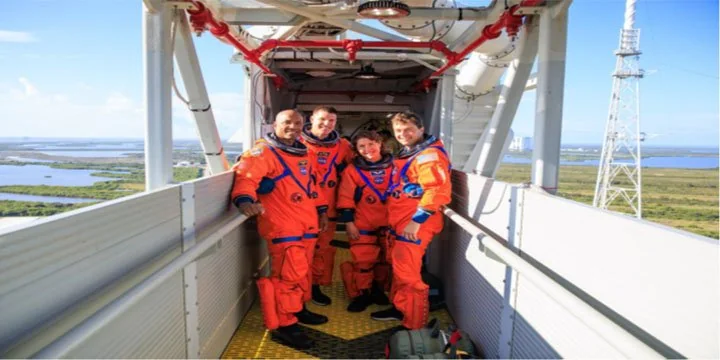
10-day NASA mission launched on April 2, 2026, marking the first crewed lunar flyby in over 50 years. Four astronauts (Reid Wiseman, Victor Glover, Christina Koch, Jeremy Hansen) are traveling around the Moon in the Orion spacecraft to test systems ahead of future lunar landings, orbiting without landing. Artemis II builds on the success of the uncrewed Artemis I in 2022, and will demonstrate a broad range of capabilities needed on deep space missions.
10-day NASA mission launched on April 2, 2026, marking the first crewed lunar flyby in over 50 years.
Four astronauts (Reid Wiseman, Victor Glover, Christina Koch, Jeremy Hansen) are
traveling around the Moon in the Orion spacecraft to test systems ahead of future lunar landings, orbiting without landing.
- Artemis II builds on the success of the uncrewed Artemis I in 2022, and will demonstrate a broad range of capabilities needed on deep space missions.
- The Artemis II test flight will be NASA’s first mission with crew aboard the SLS (Space Launch System) rocket and Orion spacecraft.
 MISSION OVERVIEW
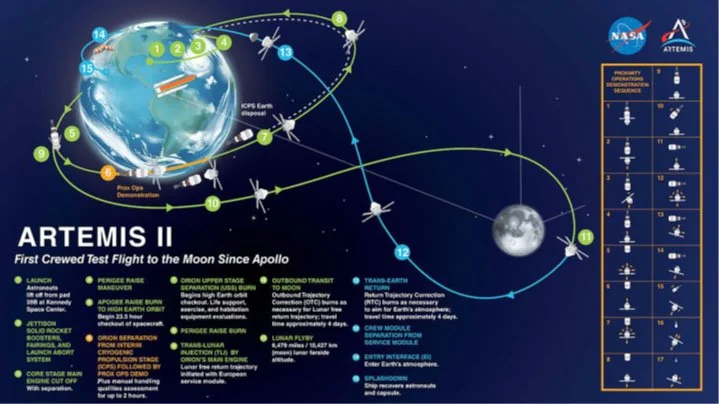
Artemis II is a 10-day flight test designed to validate the Orion spacecraft's life-support systems and the Space Launch System (SLS) rocket's performance with a crew on board.
- The Path: The mission follows a "free-return trajectory." After orbiting Earth twice, Orion performs a Translunar Injection (TLI) burn to head toward the Moon.
- The Flyby: The crew will fly around the far side of the Moon, reaching a distance of approximately 4,600 to 4,700 miles beyond the lunar surface before Earth's gravity naturally pulls the spacecraft back home.
- The Goal: It serves as a precursor to Artemis III, which currently aims to land humans on the lunar surface in late 2027 or 2028.
THE ULTIMATE OBJECTIVE
The first crewed Artemis flight marks a key step toward
long-
term return to the Moon and
future missions to Mars.
PURPOSE OF THE MISSION
- Crewed Test Flight: Testing the Orion spacecraft and Space Launch System (SLS) rocket with humans on board for the first time.
- Lunar Flyby and Return: Testing the free-return trajectory to ensure safe human transportation to and from lunar orbit
- Scientific Research: Conducting experiments such as the AVATAR (A Virtual Astronaut Tissue Analog Response) investigation to study the effects of deep space radiation on human tissue.
- Operational Validation: Training in deep space, testing manual navigation of the Orion capsule, and validating systems for sustainable, long-term human presence on the Moon.
SYNONYMS USED FOR ARTEMIS 2
- NASA's first crewed lunar flyby in 50 years.
- Artemis II Lunar Flyby.
- The first crewed mission of the Artemis program.
- The "around-the-moon" mission.
- Formerly designated as "Exploration Mission-2" (EM-2)
ABOUT ARTEMIS MISSIONS
NASA’s Artemis mission is aimed at exploring Moon with specific objective of getting
human beings back on lunar surface and possibly beyond, to Mars and elsewhere.
ABOUT THE VARIANTS IN ARTEMIS MISSION:
Artemis I mission was an
uncrewed tested flight.
(2022)
Artemis 2 will have a
crew.
Lunar landing is only expected in
Artemis III.
ABOUT ARTEMIS
Artemis 1 was going to be the first flight of new
Space Launch System (SLS) rocket (one of the most powerful) that will
propel Orion spacecraft, designed to meet demands of human missions to deep space.
There has been
renewed interest on Moon with several countries planning lunar missions in coming years.
WHY?
- Economic: Helium-3 (an isotope of the element helium) is abundant on Moon, but rare on Earth. It is a potential fuel for nuclear fusion.
- Base for future space exploration: To test how life reacts to harsh conditions of space.
- To study Earth: as Moon and Earth share a common past.
- Prelims: Key facts, institutions, locations and terminology in the article.
- Mains: Connect the topic with Economy, Polity & Governance.
- Revision: Use the article headings to prepare concise notes and answer-writing points.
Test your understanding
Questions from this article
Prelims practiceWith reference to ARTEMIS 2 MISSION, consider the following statements:
- Artemis II builds on the success of the uncrewed Artemis I in 2022, and will demonstrate a broad range of capabilities needed on deep space missions.
- The Artemis II test flight will be NASA’s first mission with crew aboard the SLS (Space Launch System) rocket and Orion spacecraft.
- The Path: The mission follows a "free-return trajectory." After orbiting Earth twice, Orion performs a Translunar Injection (TLI) burn to head toward the Moon.
Which of the statements given above are correct?
- 1 and 2 only
- 2 and 3 only
- 1 and 3 only
- 1, 2 and 3
View answer
Answer: (d) 1, 2 and 3. All three statements are drawn from the article.
Mains practiceDiscuss the background, key issues and significance of ARTEMIS 2 MISSION for India.
Answer in 250 words.
View answer approach
- PURPOSE OF THE MISSION
- SYNONYMS USED FOR ARTEMIS 2
- ABOUT ARTEMIS MISSIONS
- ABOUT THE VARIANTS IN ARTEMIS MISSION:
- (2022)
Frequently asked questionsFrequently asked questions
Why is Artemis 2 Mission in the news?
10-day NASA mission launched on April 2, 2026, marking the first crewed lunar flyby in over 50 years. Four astronauts (Reid Wiseman, Victor Glover, Christina Koch, Jeremy Hansen) are traveling around the Moon in the Orion spacecraft to test systems ahead of future lunar landings, orbiting without landing.
What are the key facts about Artemis 2 Mission?
Artemis II builds on the success of the uncrewed Artemis I in 2022, and will demonstrate a broad range of capabilities needed on deep space missions. The Artemis II test flight will be NASA’s first mission with crew aboard the SLS (Space Launch System) rocket and Orion spacecraft. MISSION OVERVIEW Artemis II is a 10-day flight test designed to validate the Orion spacecraft's life-support systems and the Space Launch System (SLS) rocket's performance with a crew on board.
Why is Artemis 2 Mission important for UPSC preparation?
The topic connects current developments with Economy, Polity & Governance and is relevant for both objective revision and analytical answer writing.