UPSC Current Affairs
AFRICA HEADING FOR A CONTINENTAL BREAKUP
Researchers have stated that Africa is slowly breaking apart due to ongoing tectonic activity beneath the continent. Scientific studies suggest that Africa may split into two separate landmasses within the next 5 to 10 million years. This process could eventually lead to the formation of a new ocean basin.
VRAuthor Desk
3 min read
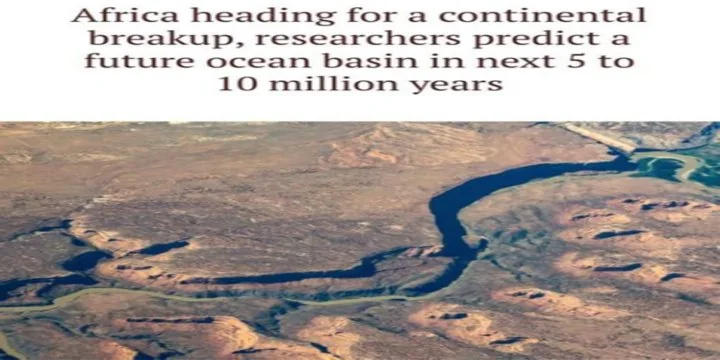
Researchers have stated that Africa is slowly breaking apart due to ongoing tectonic activity beneath the continent. Scientific studies suggest that Africa may split into two separate landmasses within the next 5 to 10 million years. This process could eventually lead to the formation of a new ocean basin.
Why is this issue in the news?
- Researchers have stated that Africa is slowly breaking apart due to ongoing tectonic activity beneath the continent.
- Scientific studies suggest that Africa may split into two separate landmasses within the next 5 to 10 million years.
- This process could eventually lead to the formation of a new ocean basin.
- The findings are based on new analysis of magnetic data and long-term geological observations.
WHAT EXACTLY IS HAPPENING TO THE AFRICAN CONTINENT?
- Africa is undergoing a gradual but continuous geological separation.
- The crust beneath Africa is stretching, thinning, and tearing apart.
- Scientists compare this movement to “the zip on a jacket”, opening slowly from northeast to south.
- The process is accompanied by volcanic activity, earthquakes, and seismic movements.
When is the complete breakup expected?
- According to geological timelines, the continental split is expected to be completed in the next 5 to 10 million years.
- Scientists emphasise that this is an extremely slow process, not perceptible in human lifetimes.
What will Africa look like after the split?
- After the breakup, Africa will likely exist as two distinct landmasses.
Western African landmass
This larger portion is expected to include:
- Egypt
- Algeria
- Nigeria
- Ghana
- Namibia
Eastern African landmass
This smaller block will likely include:
- Somalia
- Kenya
- Tanzania
- Mozambique
- Large parts of Ethiopia
SCIENTIFIC BASIS: THE THEORY OF PLATE TECTONICS
- The explanation for this phenomenon lies in the Theory of Plate Tectonics.
- This theory states that:
- Earth’s continents sit on tectonic plates.
- These plates are constantly moving, though very slowly.
- Over millions of years, continents break apart and move, leading to:
- Formation of new oceans, and
- Creation of new crust through seafloor spreading.
Continents have
never been fixed in Earth’s history.
EAST AFRICAN RIFT
- The most important region for this breakup is the East African Rift System.
- It is a massive tectonic fissure about 4,000 miles long.
- It stretches from Jordan, passing through East Africa, and reaches Mozambique.
- The rift is approximately 30–40 miles wide on average.
WHAT CHANGES ARE OCCURING IN EAST AFRICAN RIFT?
- The Earth’s crust in this region is weakening and pulling apart.
- Over geological time, the rift is expected to:
- Grow deeper, and
- Eventually be filled by ocean water.
- The rift is also expected to pass through major lakes such as:
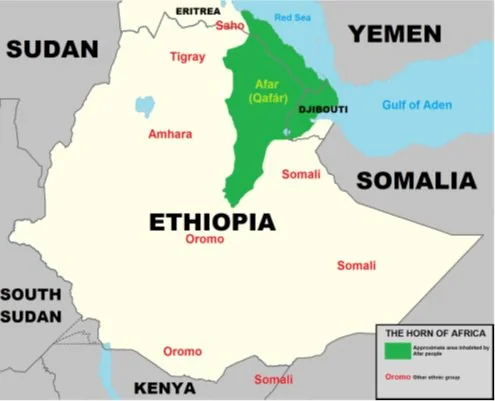
THE AFAR REGION
- Scientists have focused on the Afar region, which lies at the junction of:
- The Red Sea, and
- The Gulf of Aden.
Why Afar is special
- It hosts a triple junction, where three rift systems meet:
- Main Ethiopian Rift
- Red Sea Rift
- Gulf of Aden Rift
- A triple junction is considered a classic indicator of continental breakup.
- Scientists believe Afar shows the earliest visible stage of a new ocean formation.
ROLE OF MAGNETIC DATA
- Researchers re-analysed magnetic data collected in 1968 and 1969 using modern techniques.
- The data was gathered using airborne magnetic surveys.
Why magnetic data matters
- When magma cools, it records the Earth’s magnetic field direction.
- These magnetic patterns behave like:
- Barcodes, or
- Tree rings, preserving geological history.
WHAT DID THE MAGNETIC DATA REVEAL?
- The data showed evidence of ancient magnetic reversals, proving that:
- Seafloor spreading had already occurred between Africa and Arabia millions of years ago.
- This confirms that the region has been undergoing slow but steady rifting for tens of millions of years.
Evidence of steady rifting
- The Earth’s crust in the rift zone is stretching like soft material.
- Over time, this stretching leads to:
- Thinning of crust
- Eventual rupture
- Formation of a new ocean basin
SPEED OF THE CONTINENTAL BREAKUP
- According to Dr Emma Watts, a geochemist at Swansea University:
- The plates are currently separating at a rate of about 5 to 16 millimetres per year in the northern section.
- This confirms that while the process is active, it remains extremely slow.
- Prelims: Key facts, institutions, locations and terminology in the article.
- Mains: Connect the topic with Environment, Economy, Polity & Governance.
- Revision: Use the article headings to prepare concise notes and answer-writing points.
Test your understanding
Questions from this article
Prelims practiceWith reference to AFRICA HEADING FOR A CONTINENTAL BREAKUP, consider the following statements:
- Researchers have stated that Africa is slowly breaking apart due to ongoing tectonic activity beneath the continent.
- Scientific studies suggest that Africa may split into two separate landmasses within the next 5 to 10 million years.
- This process could eventually lead to the formation of a new ocean basin.
Which of the statements given above are correct?
- 1 and 2 only
- 2 and 3 only
- 1 and 3 only
- 1, 2 and 3
View answer
Answer: (d) 1, 2 and 3. All three statements are drawn from the article.
Mains practiceDiscuss the background, key issues and significance of AFRICA HEADING FOR A CONTINENTAL BREAKUP for India.
Answer in 250 words.
View answer approach
- Why is this issue in the news?
- WHAT EXACTLY IS HAPPENING TO THE AFRICAN CONTINENT?
- When is the complete breakup expected?
- What will Africa look like after the split?
- SCIENTIFIC BASIS: THE THEORY OF PLATE TECTONICS
Frequently asked questionsFrequently asked questions
Why is Africa Heading For A Continental Breakup in the news?
Researchers have stated that Africa is slowly breaking apart due to ongoing tectonic activity beneath the continent. Scientific studies suggest that Africa may split into two separate landmasses within the next 5 to 10 million years.
What are the key facts about Africa Heading For A Continental Breakup?
This process could eventually lead to the formation of a new ocean basin. The findings are based on new analysis of magnetic data and long-term geological observations. WHAT EXACTLY IS HAPPENING TO THE AFRICAN CONTINENT?
Why is Africa Heading For A Continental Breakup important for UPSC preparation?
The topic connects current developments with Environment, Economy, Polity & Governance and is relevant for both objective revision and analytical answer writing.