UPSC Current Affairs
16TH FINANCE COMMISSION
February 2026, the Union Government accepted the core recommendations of the 16th Finance Commission (16th FC), chaired by Arvind Panagariya, for the award period 2026–31. While the Commission maintained the status quo on the vertical share of tax devolution, it introduced a "performance-heavy" horizontal formula and proposed a landmark 'grand bargain' to address the long-standing issue of cesses and surcharges. VERTICAL DEVOLUTION & THE GRAND BARGAIN Status Quo on Share: The Commission retained the States' share of the divisible pool at 41%, the same level as the 15th FC.
VRAuthor Desk
3 min read
February 2026, the Union Government accepted the core recommendations of the 16th Finance Commission (16th FC), chaired by Arvind Panagariya, for the award period 2026–31. While the Commission maintained the status quo on the vertical share of tax devolution, it introduced a "performance-heavy" horizontal formula and proposed a landmark 'grand bargain' to address the long-standing issue of cesses and surcharges. VERTICAL DEVOLUTION & THE GRAND BARGAIN Status Quo on Share: The Commission retained the States' share of the divisible pool at 41%, the same level as the 15th FC.
February 2026, the Union Government accepted the core recommendations of the
16th Finance Commission (16th FC), chaired by
Arvind Panagariya, for the award period
2026–31.
While the Commission maintained the
status quo on the vertical share of tax devolution, it introduced a
"performance-heavy" horizontal formula and proposed a landmark
'grand bargain' to address the long-standing issue of cesses and surcharges.
VERTICAL DEVOLUTION & THE GRAND BARGAIN
- Status Quo on Share: The Commission retained the States' share of the divisible pool at 41%, the same level as the 15th FC. This provides a sense of "semi-permanence" to the current fiscal arrangement.
- The 'Grand Bargain' Proposal: To address the shrinking shareable tax base caused by cesses and surcharges (which aren't shared with states), the 16th FC proposed that the Centre merge these levies into the divisible pool. In return, states would accept a smaller percentage share of a significantly larger pool, ensuring no revenue loss while restoring constitutional fiscal balance.
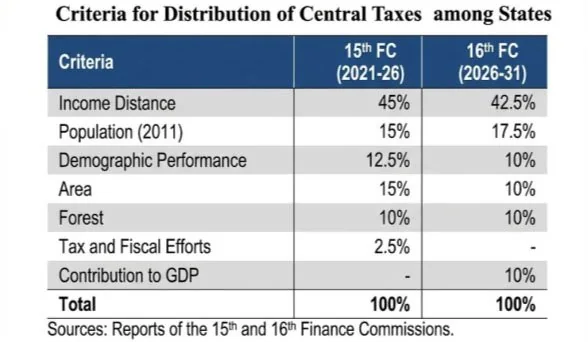
REVISED HORIZONTAL DISTRIBUTION FORMULA
The formula for distributing the
41% among states has seen major shifts, moving away from "need-based" to "performance-based" criteria:
GRANTS IN AID & LOCAL BODIES
- Total Grants: Recommended 9.47 lakh crore over five years.
- Local Bodies (8 Lakh Cr): Split between Rural (4.4 Lakh Cr) and Urban (3.6 Lakh Cr). Grants are now divided into 80% Basic and 20% Performance
- New Initiatives: * Urbanisation Premium Grant (10,000 Cr): One-time incentive for merging peri-urban villages into Urban Local Bodies (ULBs).
- Special Infrastructure Grant (56,100 Cr): Targeted at wastewater management in mid-sized cities.
- Major Discontinuation: The 16th FC has discontinued Revenue Deficit Grants (RDGs), as well as state-specific and sector-specific grants, urging states to achieve fiscal self-reliance.
FISCAL DISCIPLINE & REFORMS
- Deficit Targets: Recommended the Centre reduce its fiscal deficit to 5% of GDP by 2030–31, while States must strictly adhere to a 3% GSDP cap.
- Off-Budget Borrowings: Recommended a complete end to off-budget borrowings, requiring all such liabilities to be reflected in the main budget.
- Power Sector: States are encouraged to privatise DISCOMs to qualify for certain performance-linked assistance.
- Transparency: For the first time, the Commission recommended annual disclosure of CAG-certified "net tax proceeds" under Article 279 to clarify the exact size of the divisible pool.
KEY CONCERNS & REGIONAL IMPACT
- The Equity-Efficiency Gap: The new "Contribution to GDP" weightage favors industrialized southern and western states (Karnataka, Kerala, Gujarat). Conversely, populous states like Uttar Pradesh and Bihar have seen their overall shares decline.
- Structural Deficits: The removal of Revenue Deficit Grants poses a severe challenge to Himalayan and Northeastern states, which face high cost disabilities and limited revenue-raising avenues.
- Fiscal Autonomy: Stringent conditions on subsidies (especially unconditional cash transfers) and DISCOM privatization are viewed by some states as an encroachment on their policy-making autonomy.
CONCLUSION
The 16th Finance Commission's report marks a transition toward
"Compliance-Driven Federalism." While the 41% retention ensures stability, the shift toward rewarding GSDP contribution signals that the future of federal transfers will be increasingly linked to economic efficiency. The success of this award period will largely depend on whether the proposed "Grand Bargain" on cesses is implemented to restore the integrity of the shareable tax pool.
- Prelims: Key facts, institutions, locations and terminology in the article.
- Mains: Connect the topic with Economy, Polity & Governance.
- Revision: Use the article headings to prepare concise notes and answer-writing points.
Test your understanding
Questions from this article
Prelims practiceWith reference to 16TH FINANCE COMMISSION, consider the following statements:
- Status Quo on Share: The Commission retained the States' share of the divisible pool at 41%, the same level as the 15th FC. This provides a sense of "semi-permanence" to the current fiscal arrangement.
- The 'Grand Bargain' Proposal: To address the shrinking shareable tax base caused by cesses and surcharges (which aren't shared with states), the 16th FC proposed that the Centre merge these levies into the divisible…
- Total Grants: Recommended 9.47 lakh crore over five years.
Which of the statements given above are correct?
- 1 and 2 only
- 2 and 3 only
- 1 and 3 only
- 1, 2 and 3
View answer
Answer: (d) 1, 2 and 3. All three statements are drawn from the article.
Mains practiceDiscuss the background, key issues and significance of 16TH FINANCE COMMISSION for India.
Answer in 250 words.
View answer approach
- VERTICAL DEVOLUTION & THE GRAND BARGAIN
- GRANTS IN AID & LOCAL BODIES
- FISCAL DISCIPLINE & REFORMS
- KEY CONCERNS & REGIONAL IMPACT
Frequently asked questionsFrequently asked questions
Why is 16Th Finance Commission in the news?
February 2026, the Union Government accepted the core recommendations of the 16th Finance Commission (16th FC), chaired by Arvind Panagariya, for the award period 2026–31. While the Commission maintained the status quo on the vertical share of tax devolution, it introduced a "performance-heavy" horizontal formula and proposed a landmark 'grand bargain' to address the long-standing issue of cesses and surcharges.
What are the key facts about 16Th Finance Commission?
VERTICAL DEVOLUTION & THE GRAND BARGAIN Status Quo on Share: The Commission retained the States' share of the divisible pool at 41%, the same level as the 15th FC. This provides a sense of "semi-permanence" to the current fiscal arrangement. The 'Grand Bargain' Proposal: To address the shrinking shareable tax base caused by cesses and surcharges (which aren't shared with states), the 16th FC proposed that the Centre merge these levies into the divisible pool.
Why is 16Th Finance Commission important for UPSC preparation?
The topic connects current developments with Economy, Polity & Governance and is relevant for both objective revision and analytical answer writing.