Nanotechnology
Nanotechnology is the branch of science and technology that deals with materials and structures with the nano scale, typically between 1-100 nanometers(nm). "There's Plenty of Room at the Bottom" is a historic 1959 speech by physicist Richard Feynman that laid the conceptual foundation for modern nanotechnology
- 1 nanometre = one-billionth of a metre ( m).
Why are nanoscale materials different?
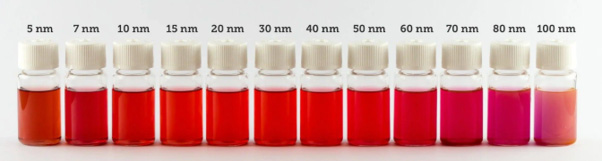
Materials at the nanoscale can exhibit properties different from those of the same material in bulk. Example: Gold nanoparticles can appear red or purple instead of the familiar golden colour because their interaction with light changes at the nanoscale.
- High Surface Area-to-Volume Ratio: As a material shrinks, a much larger percentage of its atoms sit on the surface rather than inside. This makes them more chemically reactive and vastly improves their efficiency as catalysts.
- Quantum Effects: At this tiny scale, quantum mechanics take over from classical physics. Quantum confinement forces electrons into discrete energy levels instead of continuous bands. This changes how they absorb or reflect light, causing gold nanoparticles to look red or purple instead of shiny gold.
- Dominance of Electromagnetic Forces: Gravity becomes nearly irrelevant at the nanoscale, while electromagnetic forces between atoms and charges take total control.
- The electromagnetic force is one of the four fundamental forces of nature and describes the physical interactions between electrically charged particles.
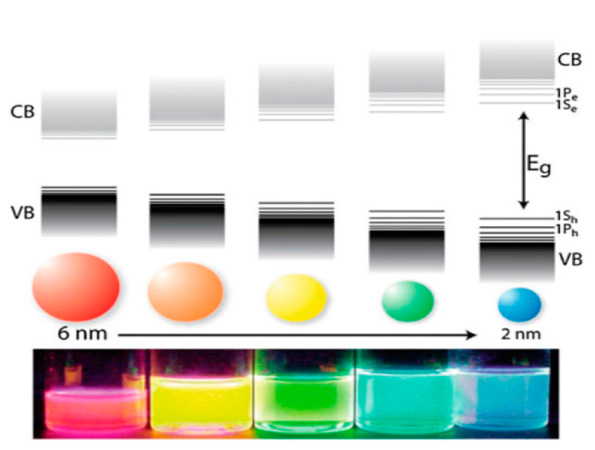
- Quantum confinement is a physical phenomenon where the motion of electrons is restricted to a very small space.As the physical size of the structure decreases, the energy gap between the valence and conduction bands increases.
- Valence Band: Contains electrons are tightly bound to the atomic structure.
- Conduction Band: Consists of free or loosely bound electrons that can drift when an electric field is applied.
- Band Gap: The energy space separating the valence band and conduction band where electrons cannot normally exist.
|
Types of nanomaterials
Carbon nanotubes (CNTs)
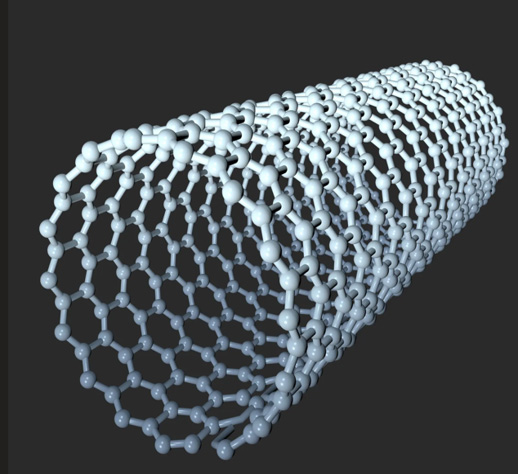
Carbon nanotubes (CNTs) are cylindrical nanostructures made of rolled-up sheets of single-layer carbon atoms (graphene).
Key Properties
- Strength-to-Weight Ratio: Up to 100 times stronger than steel while weighing only about one-sixth as much.
- Electrical Conductivity: High current-carrying capacity, far exceeding copper.
- Thermal Conductivity: Exceptionally high thermal resistance/conduction outperforming diamond.
Graphene
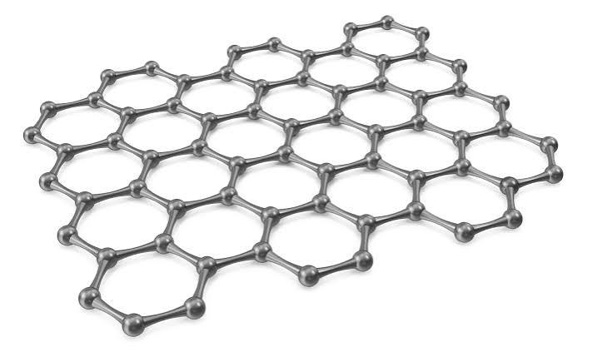
A single layer of carbon atoms arranged in a hexagonal honeycomb lattice. It is a 2-dimensional allotrope of carbon.
Key properties
- Strength: Up to 100 to 300 times stronger than steel and harder than diamond.
- Conductivity: Graphene has both high electricity and thermal conductivity.
- Transparency: Nearly transparent, absorbing only about 2% of visible light
- Permeability: Completely impermeable to gases
3. Silver nanoparticles
Silver nanoparticles are microscopic particles of silver measuring between 1 and 100 nanometers in size.: They offer high electrical and thermal conductivity, strong catalytic activity, and broad-spectrum antimicrobial properties.
4. Gold nanoparticles
Gold nanoparticles are small gold particles whose diameter is between 1 and 100 nm that exhibit unique optical, electronic, and chemical properties.
5.Quantum Dots (QDs)
Quantum Dots are nanoscale semiconductor particles (2–10 nm) that exhibit unique optical and electronic properties due to the Quantum Confinement effect. Because they are so small, they behave like "artificial atoms".
Their optical and electronic properties change directly with their physical size. Smaller dots (~2 nm) emit higher-energy blue light, while larger dots (~6 nm) emit lower-energy red light.
Major applications of nanotechnology
A. Healthcare and medicine
- Targeted drug delivery: Nanocarriers can transport medicines towards particular tissues or cells, potentially reducing exposure to healthy tissues. Example: Lipid nanoparticles are used to deliver mRNA in certain vaccines.
- Cancer treatment: Nanoparticles are being developed to improve drug delivery, imaging and some forms of heat-based therapy.
- Diagnostics: Nanosensors can help detect biological markers associated with diseases. example : Gold nanoparticles for biosensing
- Medical imaging: Certain nanoparticles can improve contrast or enable specialised imaging techniques. Example: PillCam is a minimally invasive, swallowable capsule endoscopy system that captures images of the digestive tract, primarily the small bowel and colon.
- Antimicrobial materials: Selected nanomaterials are used in wound dressings and coatings. Example: silver nanoparticles used in wound dressing.
B. Agriculture
- Nano-fertilisers: Designed to improve nutrient delivery or nutrient-use efficiency in specific formulations. Example: nanourea by IFFCO provides 30-40% more yield.
- Nano-pesticides: May enable controlled release and more targeted application of active ingredients. Example: Encapsulated pesticides release active ingredient only when needed.
- Nanosensors: Can help monitor soil moisture, nutrient availability and plant health.
- Food packaging: Certain nanomaterials can improve barrier properties or help detect spoilage. For instance nano coatings on fruits to delay fruit ripening.
C. Environment
- Water purification: Nanomaterial-based membranes and adsorbents can help remove selected contaminants. Example: CNT filters used for arsenic removal in Ganga-Brahmaputra plains
- Pollution control: Nanomaterials may assist in degrading or capturing pollutants.
- Heavy-metal removal: Engineered nanomaterials can help remove certain contaminants, depending on their composition and design.
- Environmental monitoring: Nanosensors may detect pollutants at low concentrations.
D. Energy
- Solar cells: Nanostructured materials can improve light absorption or charge transport in some solar technologies. Example : Quantum Dots for multi-junction solar cells
- Batteries: Nanostructured electrodes can improve reaction rates and charging performance, depending on the material and design.
- Hydrogen production: Nanocatalysts are being researched to improve water splitting and related processes.
- Fuel cells: Nanomaterials can increase catalytic activity.
- Energy efficiency: Nanocoatings and insulation materials may reduce heat loss. Example : Superconducting carbon nanotube cables for energy distribution,
- Piezoelectric nanogenerators that can produce electricity through body movements such as walking, speaking and swallowing.
Defence and space technology
- Lightweight materials: Nanocomposites can reduce the weight of aircraft and certain defence equipment. Example: Bhabha Kavach a bullet proof jacket for Indian Armed Forces which are cheaper and much lighter.
- Protective coatings: Nanocoatings may improve resistance to corrosion, wear and heat.
- Sensors: Nanoscale sensors can support chemical detection and monitoring. This can help us to prepare adaptive camouflage uniforms.
- Stealth technology: Nanostructured materials are researched for controlling electromagnetic-wave absorption and reflection. Radar-absorbing coatings on the aircraft helps to increase stealth capability.
- Space applications: Advanced nanomaterials may help develop lightweight structures, specialised coatings and sensitive instruments.
Challenges and concerns related to Nanotechnology
Health risks
Some nanoparticles may enter the body through inhalation, ingestion or skin contact. Long-term effects remain uncertain for several materials. For instance, Carbon Nanotubes may cause lung inflammation.
Environmental risks
Nanomaterials released during manufacturing or use may accumulate in the environment, and can cause bioaccumulation in the food chain.
Regulatory challenges
Conventional safety tests may not fully capture the behaviour of nanomaterial. Risk assessment methods need to be reformed to account for nanoparticles and their properties.
Economic inequality
Since nanotechnology is capital intensive and costly, thus it can lead to “nano divide” between developed and developing nations and also between rich and poor people.
Ethical and social issues
Nanotechnology can be potentially misused for surveillance using nanosensors, and privacy invasion of the people.
Grey Goo scenario
is a hypothetical doomsday event where out-of-control, self-replicating nanobots consume all biomass on Earth to create more copies of themselves
Nanotechnology in India: Government initiatives
The Government of India supports nanotechnology through dedicated national programs, specialized research institutes, and multi-agency funding grants managed by the Department of Science and Technology (DST).
Nano Mission
Launched in 2007 by the DST, an umbrella program boosted basic research, infrastructure development, human resource training, and international cooperation. It later transitioned into the National Programme on Nano Science and Technology.
Institute of Nano Science and Technology (INST)
Established in 2013 in Mohali, Punjab, under the Nano Mission, INST focuses on cutting-edge research in medicine, agriculture, energy, and the environment.
Indian Nanoelectronics Users Programme (INUP-i2i)
Run by the Ministry of Electronics and Information Technology (MeitY) to support nanoelectronics research, semiconductor fabrication, prototyping, and skill development at premier institutes like IISc and IITs.
Conclusion
Nanotechnology is an emerging field with the potential to transform healthcare, agriculture, energy, environmental protection and industrial development. For India, it offers opportunities to strengthen scientific innovation, promote self-reliance and achieve sustainable development. However, its benefits must be balanced with concerns related to human health, environmental safety, affordability and ethical use.